Random

Monday, 18 October 2010

'I have made my way to you through life'


Portrait of the Mother as a Young Woman
by Friedrich Christian Delius

The third book in the initial offering from Peirene Press is saddled with a slightly cumbersome title that can't be said to have lost anything in translation coming from the literal German equivalent Bildnis der Mutter als junge Frau. The format of the book is a single, 117-page sentence with paragraphs that break up the page mid-thought and punctuation limited mainly to commas; all of which sounds like a bit of a gimmick. This is Peirene Press however, whose two previous titles have been rewarding reading experiences and whose Director, Meike Zervogel, has a passionate attachment to the literature she is bringing into English translation that is borne out by adding her name to a small statement at the front of each book. With this book it was that structure that enthralled her but also the light it shed on a generation we can't help but want to examine by looking at the lives of 'ordinary' Germans during the Nazi era.

On a recent trip on the Eurostar from London to Paris I had the opportunity to really try out the reading experience that Peirene's titles are designed for. A single journey of just over two hours gave me a chance to read the book in a single sitting and it was a timely reminder of how much the reading of a book can be improved by the time and space to devour it uninterrupted. In fact if I were a bookshop in St Pancras I'd see a huge opportunity in a stand of novellas that can be read on the trip across to Europe (and how appropriate for them to be books that have already made the reverse journey, through translation, from Europe to England). Anyway, back to that format. Is the book really a single sentence? Not really. There are several moments when it cried out for a full stop and the supposed benefit or effect of all those commas - to create the flow of thought that mirrors the wandering journey of the book's narrator - could probably have been achieved just as effectively with something closer to standard punctuation. But it really isn't worth worrying about in the grand scheme of things, whatever techniques used Delius' writing has a fluidity that perfectly serves the book's purpose.

A young, pregnant German woman living in Rome during the Second World War walks through the city to attend a Bach concert at the Lutheran church. That is the plot in its entirety. As we follow her along her route we also follow the train of her thoughts and through this we learn personal details such as how she came to follow her husband to Italy and how they first met, and also gain an insight into the life of an ordinary German girl from Mecklenburg virtually alone in a country that may share fascist ideology as the machinery of the state but whose Catholic culture is in vast contrast to her Lutheran upbringing. In one section for example she passes a promenade of statuary, busts seem to adorn plinths everywhere she looks and
'she could not help thinking
          that so many die each day on the battlefronts, each head a life, each life a gift, each life at the centre of other lives, although she knew that every day it was thousands more than these men here, but with these heads, all so different from each other, it was easier to imagine what each individual life meant, just how many hopes, efforts, joys and pains, and yet she felt how narrow her power of imagination was, because in truth she was only thinking of one life, the one which influenced and affected her most,'
That man, Gert, her recent husband, had no sooner brought her to Rome than he was redeployed to North Africa. Through her monologue we realise that our narrator is naive in almost all aspects of her life and riven by the conflict of her upbringing, her love, her conscience and her loneliness. Gert has expressed in the past his standpoint on faith and power, something he is uniquely placed to comment on having been both preacher and soldier.

'our God, our Bible, our faith are greater than all reason, and also greater than all the figures of authority we include in our intercessionary prayers in church, so that they may act responsibly, but if the Fuhrer places himself above God and God's will, then we must not obey him blindly'

But all that eloquence can be punctured by the reality and confusion of the militarised citizen during Nazi rule

'even Gert wore God and the eagle and the swastika across his stomach, but he did not like to talk about it, it was all too difficult,'


That difficulty is a crucial thing that keeps returning, she doesn't want to compare her religious faith with her loyalty as a German for example, she doesn't want to think about those things that are too unpleasant. Quite often it means a return to the personal; she may be praying for victory but it is really only because victory would mean an end to the war and the return of her husband. That flow I mentioned earlier allows Delius to move seamlessly from thought to thought and in that way he is able to cover a huge amount of ground in a relatively small amount of pages. Perhaps appropriately for a publisher specialising in literature in translation this novel has a lot to say about the differences between cultures even at a time when you might expect war to break down those constructions by bringing everything down to its basest level. Cultures separated by history, religion and language prove to have an entirely different response to even the concept of war itself as is explained to our narrator by an elder fellow German.
'the war is going on too long for them, people only like war if it is young, and for the Italians the war is feminine, la guerra, whereas for us Germans it is masculine, people only idolize young women, do you understand what I'm saying,'

In my review of Stone In A Landslide I mentioned my surprise that a book covering such a turbulent period and containing such hardship could have such a gentle feel through it's own narrator. This book achieves almost the opposite with a very gentle set up and approach that contains some hard hitting moments and an elegiac denouement. That, coupled with its format, means that it may be the kind of book that would offer a very different read when approached again in a different setting for the reader. Peirene should be commended for these first three titles, all of which share distinctive and memorable female narrators. Their forthcoming releases are building on a solid foundation and with a new translation from Anthea Bell amongst them it is hard not to be excited about the future of another independent press with a genuine love for distinctive literature.

Read more...

Thursday, 14 October 2010

'To you, my beloved, I shall confide my dream'


The Life Of An Unknown Man
by Andrei Makine

When reviewing his last novel, Human Love, I described Makine as unashamedly romantic. He has an ability to wear his heart on his sleeve whilst not being terribly sentimental which could be summed up by a sentence in his latest novel where one character highlights 'The extreme difficulty of having faith in human goodness and at the same time the awareness that only this faith could still save.' By placing his characters in jeopardy and demonstrating the power of love in the face of it he has been able to write at a pitch that almost demands orchestral underscore. Human Love played out against the backdrop of Angolan revolution in the 1960's and 70's and took the reader on a harrowing journey. This time the theatre of war is back in his native Russia and covers the Siege of Leningrad, the march forwards to Berlin and beyond into the era of Stalin's purges. It is another harrowing tale, enough to make every hair on the head of its unknown man turn white, and yet it is a tale of nostalgia and admiration for 'not a territory but an era', the 'monstrous Soviet era.'

Makine begins his novel in the present day however with, naturally, a Russian emigre. Shutov, a former dissident who has lived in Paris for twenty years, is not only a disenchanted writer but

He is the absolute prototype of a man ditched  by a woman young enough to be his daughter. The plot for a lightweight novel in the French manner, a hundred pages of Parisian bed-hopping and gloom. All a love affair such as his would be worth.

Makine has a lot of fun in this first section with his own literary influences. Comparisons with Nabokov, Proust and Chekhov have been made and it is the latter who provides part one with its repeating image of a couple 'hurtling down a snow-covered hill in a toboggan' (from A Joke) and Shutov's frustration that in a modern world it would be dismissed as sentimental, over the top, old-fashioned ('And yet it works!'). The fact that Shutov has misremembered the story undercuts wonderfully his treatment of his own love life and adds the perfect punchline to this slightly sad figure's own joke of a life.

Literary Paris fascinated her and Shutov seemed like a very well-established writer. The illusion lasted less than a year. The time it took for a young woman from the provinces to get her bearings and realize that this man was, in fact, no more than a marginal figure. And even his past as a dissident, which in the old days had given Shutov a certain aura, was becoming a flaw, or at least a sign of how prehistoric he was: just think, a dissident form the eighties of the previous century, an opposition figure exiled from a country that had since been erased from all the maps!

If the first section plays with the romantic nature of Chekhov the second satirises modern Russia through Shutov's confusion at its altered state when he makes a return journey in order to pursue an old flame. TV adverts, new social structures and the new order of power are all eye-opening moments for Shutov as he stumbles about in his ill-conceived plan. The targets in Putin's Russia are all pretty obvious and the fact is that these two sections take up two-fifths of a novel that only really gets going when Shutov meets and finally speaks to the man with the real story to tell. Awaiting his transfer to an old people's home which has been delayed by the tercentenary celebrations in St. Petersburg, the seemingly mute old man that occupies one of the apartments in the building in which Shutov is staying turns out in fact to have a lot to say.

Over the next hundred pages we hear from Volsky, the unknown man of the title, as he finally gives voice to a story that is both tragic and yet, as the title suggests, commonplace: 'A circle completed and, within it, the span of a whole life.' A singing student at the Conservatoire in Leningrad, he meets the woman who will form the other part of that circle just a day before the speakers that line the streets will bring the news of war. No sooner has he met Mila than they are separated by the realities of civilian life during military siege. Makine has undoubted skill in describing human hardship, the scenes in Leningrad are enough to set your teeth chattering or heighten any hunger pangs as Volsky struggles to survive on the meagre ration of 125 grams of bread.

He began exploring the very last zone that precedes extinction. He had always pictured hunger as a relentless, gut-wrenching torment. And so it was, for as long as one had the strength to feel it. Then the torture came to an end for want of a victim, the latter having become a shadow for whom a mouthful of water already represented a painful effort of digestion. The cold, too, caused suffering to those who were utterly exhausted and waiting for the tend. Yet this increasing weakness seemed to be external to the body. It was the world that was changing, making objects too heavy (the can in which the water was heating now weighed a ton), lengthening distances (three days before he had managed to reach the bakery: a veritable polar expedition).

Volsky comes as close as is possible to death, saved by an act of charity and the generosity of another. What really saves him however is the moment when he is reunited with Mila, already altered beyond recognition by the privations of war. The two of them grab hold of one another like the survivors of a shipwreck and their love alters their perception of the world around them, now seeing 'the world from a very remote perspective. A perspective that could have seemed godlike in its detachment yet was grievously human, for each of them greatly dreaded the other's death.' Their connection through music and singing (for Mila was another choral student) is another transcendent aspect and amidst a decaying city they add their voices to the others at the Musical Comedy Theatre. It is a salvation of sorts but as food continues to decline and the cold remains their company is depleted by occasional deaths, the parts allocated not so much by the director 'but by a silent being, present at every performance. The Grim Reaper himself.'

The inevitable call up for all men not already at the front eventually comes but before he leaves they both take part in concerts close to the front line. Makine creates a memorable set piece with the singers performing virtually under fire and it is when mortar shells begin to actually fall among them that Volsky and Mila are separated. We then follow Volsky as he joins the defence of Leningrad and I will stop describing any more of the plot there for fear of spoiling it. If the circle of a life is about bringing two points together to enclose it, then the trajectories of Volsky and Mila having already been separated and brought together twice will not be immune from repeating that pattern again. As in previous novels Makine specialises in the transcendence of love and pushes his characters to the very limits of human endurance in order to heighten that further. For that reason it's hard not to be slightly disappointed by the opening sections of the book but what they do allow is for Shutov to undergo a form of personal epiphany and, in the books final section, to find not only his writing but also his emotional life reinvigorated. If there are those that praise Makine with comparisons to Chekhov then it could be that those modern Russian criticisms of the master mentioned earlier are aimed by Makine squarely at himself. If so, then this book is eventually a fine rebuttal, a writer proving that it may be all the things you accuse it of being, 'And yet it works!'

Read more...

Monday, 11 October 2010

'And so I waited...'


The Art Of Pho
by Julian Hanshaw

Sometimes the debate is about terminology (graphic novel or comic), sometimes it's about whether it should be regarded alongside traditional written literature; increasingly the debate for me is about what the most effective use of the graphic form is or indeed how to classify some of its more genre-defying incarnations recently. Winner of the Observer/Cape Graphic Short Story Prize 2008 for Sand Dunes and Sonic Booms, Julian Hanshaw's first full length piece is hard to classify. Perhaps the best way to approach it would be to avoid the temptation to attach a label but the only reason that I raise all this is because something didn't quite click with this book and I think it has something to do with that identity confusion.


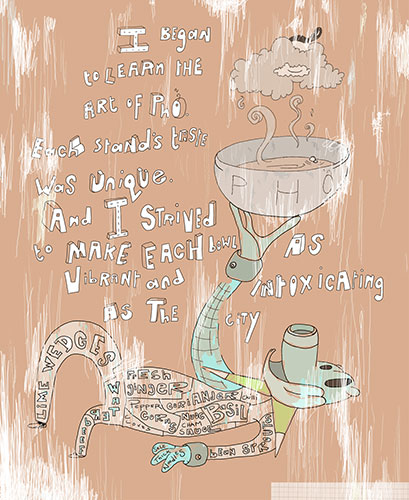
A character called 'Little Blue' is dropped off in the middle of nowhere by a man in a red car. He's a funny looking chap, a bit like a cross between a dog and a robot (but walking on two legs - not like Doctor who's K-9. Oh, it's hard to describe, just look below). He's walked to a post and told to count to five hundred. When he opens his eyes he has no one but a large cow for company, so he waits. And waits, and waits and as he does so we see a city build up around him. After causing an accident in Ho Chi Minh City that wrecks a food stand he offers to man one himself in order to pay the owner back. This is how Little Blue is introduced to Vietnam's national dish - Pho.


Pho is a noodle soup and, as Little Blue discovers, each pho stand in the city is slightly different with its own unique taste. Blue throws himself into an appreciation of the art of making pho and it isn't long before he has some loyal customers and a flourishing stand. As well as a narrative the book offers recipes for the various kinds of pho and the different ingredients used. Hanshaw clearly has a great love for the food and whilst he has admitted that he 'nicked the recipes idea from the Kurt Vonnegut novel Deadeye Dick', they certainly add something to a book that doesn't quite satisfy in the narrative stakes. The city is a confusing place and the novel has a confusing structure built very much on the chance encounters of the alien abroad (which Hanshaw once was and whom Little Blue visually represents). Sometimes this means forming an attachment to someone who doesn't reciprocate in the same way and sometimes it means misinterpreting another's friendliness. If most of your friends are other travellers then where do you find any kind of permanence, security or stability? Whilst these themes have some interest they don't make for the most rewarding reading experience.


The artwork however is fantastic. Constantly interesting and innovative, the book's restless narrative is beautifully realised in pages that vary wildly and a format that never gets fixed. The eye is encouraged to wander (and wonder) over the page throwing up all sorts of lovely detail and varied technique. There's also a lot of charm about this book, Little Blue is incredibly endearing, and there is a sadness that grows as the fleeting attachments that he makes gradually fade away. This book may not be exactly sure whether it wants to be travelogue, memoir, cookbook, or fiction but it does know that the innocence of its central character is enough to keep up your interest. And if you're anything like me it'll have you desiring a nice bowl of pho before you turn the final page.

Read more...

Thursday, 7 October 2010

'homo obscurissimus'


The Royal Game
by Stefan Zweig

The arrival of a new Zweig from his champions at Pushkin Press couldn't have been better timed after I struggled and finally gave up (for the moment) on a recent read. Not only does Zweig always manage to satisfy, and not only are the little french-flapped, tactile editions from Pushkin a joy to have in one's mitts but I have long wanted to read this novella, having always suspected that the game of chess would provide the perfect architecture on which to hang a tale. I used to play a tiny bit of chess when I was a kid and received a Kasparov chess computer as a birthday or Christmas present. An electronic board with pressure sensitive pads and LED's along the edges, it felt cutting edge at the time but a little clunky in memory. You signalled each move by pressing down the piece you wanted to move and then down again on the square you wanted to move it to. Kasparov, playing to the difficulty level you had set him on, would then move via the medium of those LED's. Even on an easy setting I found it hard to compete and didn't have the discipline to play on my own repeatedly to get much better so it became another gift with a short shelf-life and my future as a chess champion disappeared for good. After reading this novella I'm glad I didn't dedicate hours to studying in solitude, the game of chess itself comes across as a fearsome adversary and the humans in thrall to it left battered and bruised by their association.

On a liner journeying from New York to Buenos Aires our narrator discovers through a friend that the world famous (but unknown to him) chess champion Mirko Czentovic is on board. His friend relates this man's history, from his lowly beginnings as an orphaned boy in a remote Yugoslavian village, his care under the village pastor, his ignorance in 'every field of culture' and the sudden emergence of his innate understanding of chess. With his talent unearthed it isn't long before he has mastered 'every secret of chess technique,' his only weakness an inability to imagine the board in his mind, needing both board and pieces to hand in order to sort through problems. Such a meteoric rise 'transformed his early unsureness into a cold and awkwardly flaunted pride', something that shall be tested within the confines of this journey.

Fascinated by monomaniacs our narrator determines to find out as much as he can about Czentovic but is frustrated by his aloofness. He decides to use a chess board to draw him out, fully aware of what makes the royal game so enticing.

...a union of all contradictory concepts: primeval yet ever new; mechanical in operation yet effective only through the imagination; bounded in geometric space though boundless in its combinations; ever-developing yet sterile; thought that leads to nothing; mathematics that produce no result; art without works; architecture without substance, and nevertheless, as proved by evidence, more lasting in its being and presence than all books and achievements; the only game that belongs to all peoples and all ages; of which none knows the divinity that bestowed it on the world, to slay boredom, to sharpen the senses, to exhilarate the spirit. One searches for its beginning and its end. Children can learn its simple rules, duffers succumb to its temptation, yet within this immutable, tight square it creates a particular species of master not to be compared with any other...

Eventually through the garrulous behaviour of a fellow passenger a game is finally created between Czentovic and a collective of the liner's chess players and it is through this encounter that the real central character of the novella will emerge. Amongst the passengers is a man who might even be able to challenge the supremacy of the champion; armed with the one skill that Czentovic lacks but crippled by his own weaknesses, it will be a fascinating contest. This man's back story allows Zweig to vent his feelings about the Nazi regime and to develop one of the novella's central themes: that of confinement and freedom. Not only is the location of the novella confined: a limited space, a finite journey, a set cast list; but as the quote above makes clear, the game of chess itself is an expression of the dichotomy between confinement and limitless freedom. This Austrian gentleman has had his own experience of confinement at the hands of the Gestapo who didn't use physical torture to extract secrets but almost its opposite.

They did nothing to us; they merely deposited us in the midst of nothing, knowing well that of all things the most constant pressure on the soul of man is nothingness. By placing us singly, each in an utter vacuum, in a chamber that was hermetically closed to the world without, it was calculated that the pressure created from inside, rather than cold and the scourge, would eventually cause our lips to spring apart.

His story is horribly compelling and matched by the thrilling chess match that slowly unfolds. As I suspected, the confines of the form, the subject and the approach make The Royal Game a perfect novella, providing exactly what a reader could ask for. It's far too terrifying to tempt me into dusting off those 32 black and white pieces but has instilled in me a new-found respect for a pursuit for which our narrator believes the word game is 'an offensively narrow construction.'

Read more...

Monday, 4 October 2010

'the tyranny of contingency'


Nemesis
by Philip Roth

Before the title page of Roth's books the list of his previous novels isn't given chronologically but grouped into narrative approach. There are the Zuckerman books beginning with The Ghost Writer and ending with the recent Exit Ghost, the concupiscent Kepesh books, even 'Roth' books like Operation Shylock and The Plot Against America. Roth's prolific output of short novels recently are gathered together as Nemeses: Everyman, Indignation and The Humbling now joined by the novel that gives the collection its thematic title. As an exploration of mortality and chance, each of these short novels on their own has felt a little underwhelming to a committed Roth fan like myself but then gained far more when seen as part of a larger whole. With this final novel in the series I wondered whether they might be a larger pay-off or perhaps a tying together of themes and ideas. On a first reading it doesn't really feel that way, this is another standalone tale that continues Roth's study of death and the only surprise (although by now it shouldn't be) is that such a fundamental topic, and the approach taken with this book, should yield a story that for all its strengths still manages to underwhelm ever so slightly. I'll come to the reasons why that might be later but let us first look at the set-up.

Roth's alternative history, The Plot Against America, was set in his own native Weequahic section of Newark during the 1940's, a time and place he returns to here with a no-less imagined polio outbreak during the stifling summer of 1944 ('...that decade when it seemed that the greatest menaces on earth were war, the atomic bomb and polio'). This isn't a 'Roth' book however, it is narrated by Arnie Mesnikoff, a child at the time of the outbreak, looking back from the relative safety of 1971. The period before the development of a vaccine and before even a clear understanding of how the virus was transmitted was one of fear, rumour and suspicion. In this climate we meet Bucky Cantor, playground director for Chancellor Avenue School (for those, like me, not sure what that job is, it seems that during the holidays from school, children would play ball, jump rope and generally run themselves around in the school's playground under the watchful eye of the playground director).
He stood slightly under five feet five inches tall, and though he was a superior athlete and strong competitor, his height, combined with his poor vision, had prevented him from playing college-level football, baseball, or basketball and restricted his intercollegiate sports activity to throwing the javelin and lifting weights... His was the cast-iron, wear-resistant, strikingly bold face of a sturdy young man you could rely on.
That poor eyesight has kept him at home whilst friends and others his age are away fighting in Europe and the Pacific, something for which he feels huge guilt, which is the novel's major theme (developed more specifically as survivor's guilt). On the home front however he is a hero to the children he looks after and finds himself on the frontline when polio first strikes and then quickly develops into an epidemic. Through the playground scenes we here the chants of girls jumping rope, an alphabetised chorus going through various names and a little like the plague-associated Ring a Ring o' Roses sounding like a deathly roll call as one after another of the children falls prey to the virus. Bucky's own playground favourite, Alan Michaels, is dead within 72 hours and in a touching scene with his father, the two men struggle to find meaning in the death of such a wonderful child.
"Everything he did, he did it right the first time. And always happy. Always with a joke. So why did he die? Where is the fairness in that?"
"There is none," Mr. Cantor said.
"You do only the right thing, the right thing and the right thing and the right thing, going back all the way. You try to be a thoughtful person, a reasonable person, an accommodating person, and then this happens. Where is the sense in life?"
"It doesn't seem to have any," Mr. Cantor answered.
At the same rate with which the virus spreads, and more and more children fall victim to its most extreme conclusion, grows fear. Fear, which had driven many of the Jewish neighbourhood's residents from Europe in the first place, fear which threatens to close the playgrounds and send children into hiding or exile, fear which Bucky is advised to 'foster less' of by his girlfriend's father, the calming Dr Steinberg, for "Fear unmans us. Fear degrades us." But the relentlessness of the virus' march and the way in which this forces Bucky to confront the blocked emotions surrounding his own mother's death in childbirth lead to perhaps the only natural reaction: to blame God. When his girlfriend pleads with him to leave Newark and join her at summer camp in the Pocono Mountains he eventually relents, deserting the quietened playgrounds of Newark, adding further to his guilt.

'Ensconced in this noisy funhouse of a summer camp', which at night becomes an Eden-like idyll where he and Marcia can make love without fear of discovery Bucky is still tormented by 'the force of circumstance', the random events or smallest choices that can cause paths to diverge so wildly. For who decides each lot, who fights abroad or stays at home, who catches or carries a virus? The only surety: '...what he no longer had was a conscience he could live with.' For a man whose whole life perhaps has been clouded by guilt Bucky comes to the only conclusion he is capable of when the first case of polio occurs at the summer camp.
All at once he heard a loud shriek. It was the shriek of the woman downstairs from the Michaels family, terrified that her child would catch polio and die. Only he didn't just hear the shriek - he was the shriek.
In the novel's final section we fully engage with the adult narrator as he meets the now elderly Mr. Cantor and converses with him about what happened next. Bucky's reaction to God is not so much one of rejection but vilification, casting him not as the omnipotent holy trinity but an evil double act 'a sick fuck, and an evil genius.' Arnie is slightly more charitable.
Sometime you're lucky and sometimes you're not. Any biography is chance, and, beginning at conception, chance - the tyranny of contingency - is everything. Chance is what I believed Mr. Cantor meant when he was decrying what he called God.
So chance, guilt, cowardice, and honour are some of the major themes that crop up and we learn how much Bucky's life has been defined by this one summer, his life's potential altered by that combination of chance and decision, and crucially the role in which he casts himself. For the nemesis of the title could be the virus itself or the man at the novel's centre and one begins to wonder whether what these short novels have made clear is that man is his own worst enemy.

So having written all of that, and you now reading it, why the reservations? Why am I not immediately satisfied by these recent reads? The odd thing is that the process of writing this review has made me realise that the book is better than I thought it was initially, but that doesn't take away from the fact that the experience of reading it and the feelings it raised at the time were a little low-key. I started this book after becoming mired in another and thinking that the always well-crafted prose of Roth's would be my literary solvent to loosen things up a little. You do feel immediately comfortable in the opening pages; the ease with which he sets the scene, the economy of language, the control of period, place and persons shouldn't be underestimated. But there is a kind of professional detachment; that control over the material that in other books of his is broken down by the rage, or the sex, or the authorial play. Only occasionally did the fear feel palpable. Only occasionally did I feel Bucky really wrestling with himself. Part of this might be Roth's choice of narrator who despite his own, late-revealed back story remains a bit of a non-character, but I think the main reason might be the character of Bucky himself. The 'sturdy' man mentioned earlier as a kind of almost-hero is later described thus.

He was largely a humorless person, articulate enough but with barely a trace of wit, who never in his life had spoken satirically or with irony, who rarely cracked a joke or spoke in jest.

There is never really enough there to ignite Bucky in the reader's imagination. Like a lot of Roth's characters he is a man who seems to be decent, who tries to make the right decision and ends up a victim of circumstance. The thrill of novels like American Pastoral, Sabbath's Theatre or I Married A Communist was to see how their male protagonists took a stand and raged against their obstacles (as well of course as having moments of doubt, introspection and anguish). Bucky Cantor has flashes but remains a far more passive aggressor and it might be this that prevented me, despite the tragedy, from really engaging with him fully.

Read more...

  © Blogger templates The Professional Template by Ourblogtemplates.com 2008

Back to TOP