Random

Showing posts with label films. Show all posts

Tuesday, 15 February 2011

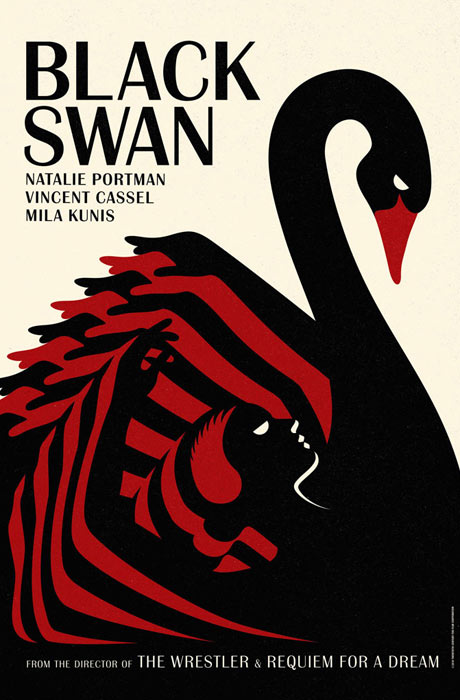
Black Swan


I had the craziest dream last night. About a girl who was turned into a swan. She needs love to break the spell, but her prince falls for the wrong girl and she kills herself.

I had been looking forward to watching this film ever since first hearing about the premise. The professional dance training in my past and connection to the world of ballet combined with my admiration for the films of Aronofsky and his last one, The Wrestler, in particular meant that my usual impatience was magnified as the release date approached. As it happened I ended up watching it around Valentine's Day, continuing my rather twisted take on romance (The first gift I gave my now wife was a copy of Angels by Denis Johnson in which a man and woman meet on a Greyhound bus and both end up in various forms of incarceration) and was pleased that the film managed to survive my high expectations and some of the criticism that has been levelled at it recently. It is by no means a perfect film, and certainly not to all tastes. A bit like going to watch classical ballet itself, if you don't get it then it's going to be a very weird evening, if you can understand the language and go with it then it can be a transcendent pleasure. The film is modelled on Swan Lake itself which is why I've included the quote above. A young dancer perfectly suited to the role of the virginal White Swan has to find within her the sensuality and darkness required to play her evil twin, the Black Swan. Precision and restraint get in the way of passion and her obsessive focus begins to alter her perception of those around her.

Let us be clear first: this is NOT a film about ballet. The recent newspaper articles that packed professional dancers off to the cinema in order to provide their opinion on the veracity of the world depicted and the ballet technique of Natalie Portman were so misguided it isn't even funny. This is a film about madness and obsession, a companion piece to The Wrestler which featured a character similarly incapable of moving away from the world to which he had dedicated himself (and in particular, his body); it is a horror film rather than a realistic depiction of the backbiting and ambition of the American ballet scene. That said, Aronofsky shows in some telling detail the physicality of dance. The shots of pointe-shoes being broken down and customised, the bone-crunching and clicking as dancers adopt these unnatural positions, the sweat, the heavy breathing, the broken toenails, the hard skin; all brilliantly observed and true.

 Natalie Portman has been hailed by some for the training she underwent to portray a ballet dancer (beginning a year before filming) and vilified by others for not being convincingly up to scratch. If that's how you're watching the film then I'm afraid you're missing so much but let me say as someone who trained professionally but hasn't danced in a long while (a bit like Portman) that I couldn't hope to come within a country mile of what she achieves in this film. Her body is starved down to that level that allows you to see the individual muscles moving in her back as she moves her arms up and down and her nervous and frail demeanor is visible in minute detail on her face where tiny muscle twitches and tics express so much. She dances convincingly but more importantly gives a performance of such dedication and commitment that it blows the theory that the role should have been given to a dancer who could act out of the water. Most of the actresses in Hollywood couldn't hope to match Portman here let alone the dancer/actresses.

There is excellent support from Vincent Cassel as the exploitative choreographer and Barbara Hershey as the domineering and bitter mother. Mila Kunis is sultry in her role as the competition and the only bum piece of casting comes in the form of Winona Ryder who has always been beautiful, never been able to act and couldn't convince anyone that she is, was or ever could be a ballet soloist. Aronofsky's handheld camera floats continuously, miraculously avoiding its reflection in the many mirrors and keeping close scrutiny on the actors helping to build the tension as it closes in or Portman particularly. The film is underscored brilliantly by music developed from Tschiakovsky and a sound design that heightens breathing and the sounds of the swan to chilling effect. You might criticise the film for being too insular, perhaps a little repetitive, I wondered whether it might have been a little shorter or even had the bulk of the dialogue stripped away, making it even closer to the ballet from which it is inspired. The overall tone is so heightened that there are even moments that make you want to laugh. We're not used to this tone in film making and certainly weren't prepared for it by The Wrestler but both films however different their styles are driven by the same theme of obsession, something of a unifying theme in Aronofsky's work. Where will it take him, and us, next?

Read more...

Thursday, 16 December 2010

2010 - A review of my year

Well I started this year with the aim to read more translated fiction and more titles from independent publishers and I'm pretty pleased with how that turned out, exposing myself to books I would never normally have come across and still making room for some of the big titles too. In a year when new books from Franzen, Amis and Roth have gathered headlines and Howard Jacobson finally landed the Booker Prize my fondest memories have been books that haven't had anything like that kind of blanket coverage and may have struggled to get mentioned in the mainstream media at all. You don't need me to confirm the worth of Booker nods to David Mitchell's The Thousand Autumns of Jacob de Zoet, Tom McCarthy's C or Damon Galgut's In A Strange Room. They're all worth a read. It's just not possible for me to pick a single book of the year, or even a top three so here is a selection of the best.


Books

Easy Reads

Tony and Susan - Austin Wright

You may notice that this title is missing from the picture above and that's because I lent it to someone at work who then passed it on to someone else and it still hasn't come back yet. I think we can call that a word-of-mouth success and that's exactly what this book needed. Originally published in 1993 when the author was 70 years-old the book garnered positive reviews but never really took off. Wright died ten years later leaving behind a body of work but Atlantic Books reissued this literary thriller earlier in the year to more positive reviews and hopefully many more readers. A novel within a novel that plays on the very act of reading it combines the guilty pleasure of a pulpy thriller with something far more high-minded.
(original review here)


Nourishment - Gerard Woodward

Another book which has proved popular at work, Woodward's follow up to his impressive trilogy about the Jones family is easily the oddest book of the year and one of the funniest too. During the Second World War, a time of rationing and 'make do and mend', we follow Tory Pace as she deals with living with her mother again, her husband's internment as a POW and his request for dirty letters. The theme of nourishment is expressed in many ways and I'll eat my hat if you can find a more enjoyable novel that combines cannibalism, starvation, self-immolation and public conveniences.
(original review here)

Non-fiction

The World Of Yesterday - Stefan Zweig

It may not have been to all tastes but I loved reading this memoir from an author who crops up time and again on this blog. A must read for any fans of Zweig and indeed anyone who wants an insight into the passing of a golden age in Europe. Zweig's intelligence, political acuity and deep connection to the cultural life around him make him a fascinating guide through inter-war Europe and the poignancy of the ending, given that we know he was to take his own life shortly afterwards, unavoidable.
(original review here)


Footnotes In Gaza - Joe Sacco

If anyone wanted to make the case for comics being taken seriously they should move away from the serious sounding 'graphic novels' and take a look at the reportage of artists like Joe Sacco. His previous books on Palestine and the war in Bosnia helped me to understand those complicated conflicts in a way that no serious article or news item ever had. Using personal testimony to tap into the human stories behind the fighting he helps us to understand that large scale conflicts are often about very personal feelings and a sense of grievance passed down through generations. Nowhere was this more obvious than in his latest work which brought to life two historical massacres that have everything to do with the tensions that still exist in Gaza and showed that Sacco essential reading.
(original review here)


The Lost Gem

The New Perspective - K Arnold Price

Discovering a book that hardly anyone knows about and yet which deserves praise and a wider readership is one of the many ways I get a major kick from reading and blogging. I have Colm Toibin to thank for this slim debut novel which was written when the author was 84 years-old. It is a perfectly distilled portrait of marriage that had it been written by a new writer today would surely be being hailed as a masterpiece and nominated for awards all over the place. Subtle, intelligent, sensitive and painfully honest it is a novel that took a lifetime's experience to write and yet takes just a small portion of your day to read. It's finding a copy that's the tricky bit.
(original review here)

The Wildcard

A Naked Singularity by Sergio De La Pava

Only just reviewed and making it onto the list purely because it's too bonkers to leave it off is the 700 page, self-published leviathan that channels the spirit of Pynchon, Melville, Gaddis and Price; combines boxing, both sides of the law and even the laws of physics into a vast, sprawling, digressive monster that probably scared off any editors who looked at it but deserves to be read by far more than the handful who can have made it through to the final page. If you fancy a challenge then I dare you. I double dare you...
(original review here)

Looking Back, Looking Forward, Looking You Right in the Eye

Stoner - John Williams

NYRB Classics have done a quite incredible job of resurrecting classic books that might have remained in obscurity if it weren't for their endeavour. This book has received ecstatic praise from bloggers, reviewers and even A-list celebrities and if you don't believe any of them then please believe me when I tell you that it is a masterpiece. The kind of novel that if you were forced to pitch it today would probably be considered un-marketable, it is quite simply the life of a man called Stoner. Everything you need to know about a man's life within the pages of book. That is a gift. I feel under no compulsion to say any more. You really should read this book at some point in your life, it's fine if it isn't right now, it will be ready for you when you are.
(original review here)

The Canal - Lee Rourke

One of the few novels I've read recently that feels as though it's talking about the world I live in right now, Lee Rourke's debut has won the Rising Stars award on Amazon and was also joint-winner of the Guardian's Not The Booker Prize, taking some pretty hefty flak along the way. It won't be to all tastes but who cares about that? A novel about a man who embraces his boredom that is never boring is something to cherish and the fact that it has lots to say about how we live, connect, and deal with everyday terrors makes it a vital read, filled with an energy that a novel about ennui aught not really to possess.
(original review here)

Beside The Sea - Veronique Olmi

I've read some amazing books this year, books that haven't even made it onto this list for a mention, but if I was to pick one that knocked me about more than any other it would have to be this one. Pound for pound this is easily the hardest hitting piece of fiction I have encountered in the last twelve months. There are so many reasons why we should be championing it. Peirene Press is a new indy publisher bringing literature in translation to an English-reading audience in handy novella-sized portions, and have already made themselves essential reading with just their first three titles. The first of these is still the best for me, containing the kind of ambiguity that makes fiction as a medium such an exciting place to be. In only 120 pages Olmi manages to make the reader complicit in the judgement of what they read and whilst dealing with similar themes to the much vaunted and Booker-nominated Room, she manages to knock that novel into a cocked-hat without resort to sensation, gimmicks or whimsy. If you can think of a decent excuse as to why you shouldn't go out (or online) and buy a copy right now I'd like to hear it...
(original review here)

Not Book Of The Year

Room - Emma Donoghue

You know why.

Music

BiRd-BrAiNs - tUnE-yArDs

Two close runners for album of the year were The National for High Violet and Deerhunter for Halcyon Digest. What do these artists and albums have in common apart from being excellent? They all come from the same label: 4AD. This is no fix and it's not really a matter of taste; these albums aren't particularly similar. Their only common attribute is excellence. Oh, and excitement. So before I get into the specifics let me first heap huge amounts of praise on a label that produces consistently amazing work of a wide and varying nature and that got behind an album that might have remained an obscurity without them. tUnE-yArDs is Merrill Garbus who has a past as a puppeteer but used a digital voice-recorder and shareware mixing software to entirely self-produce this album. Defiantly lo-fi this is an album for those who are bored by polished performance, style over substance and the general sheen that comes with a lot of modern music. By concentrating on lyrics, original instrumentation and a genuine need to express through music you get an album whose very flaws are its strengths. A word I find myself using again and again to describe works of art that I admire is 'genuine'. It is worrying that it is a word that you can't use more often to describe the artistic output that we consume but I guess the 'c' word is the important one there. In an age of easily consumed and forgotten art it is refreshing to hear an album that doesn't sound like another, doesn't want to seem like another and stands or falls by its own standards. All of which is far to poncey a way of describing one of the most enjoyable albums you're likely to hear.
(original review here)


Not Album Of The Year

20Ten - Prince 

It was given away free in the Daily Mirror.
QED.
(original review here)

Film

Ok, so this year the LoveFilm subscription was cancelled as there just wasn't the time to meet even the minimum requirements. Therefore I haven't had the chance to watch many films at all this year but what I have seen has been great. Three films played in different ways with the notion of cinematic truth. Duncan Jones made a striking debut with Moon, a film that put British sci-fi back on the map, Christopher Nolan cashed in on the success of his Batman reboot by making a good-looking, intelligent cinema experience in the form of Inception and from the left-field came the intriguing Certified Copy which still has me confused today about what the real truth might have been.

One film still haunts me though and that is why I will raise it above the others.

Antichrist

Lars Von Trier is not an easy man to like and I had some great debate with friends about his previous work after watching his latest. I have no doubt after Antichrist that the man is an artist and a serious one at that. Dark, difficult, disturbing and very adult (in the mature sense of the word rather than the sensational reaction to the pumping penis on display here) it is a film difficult to watch in many places but which challenges you to watch it again. Beautifully filmed and acted, if you think you're up to the challenge then I really recommend it (and would welcome the opportunity to discuss afterwards).
(original review here)

Not Film Of The Year

The Da Vinci Code


I'm not even sure of the weakened mental state that placed me in front of the TV watching this one but it was nothing compared to the vegetative state the film itself reduced me to. I haven't read the book but the film was so stupid in its need to explain everything and leave the audience nothing to do that I could feel myself getting stupider by the minute. Every actor in it was appalling and looked uncomfortable, the script was laughable and I can't think of a less thrilling thriller. Give me the X-Factor over this any day.


So, there's a quick look back at some of my 2010. How was yours?

Read more...

Wednesday, 1 September 2010

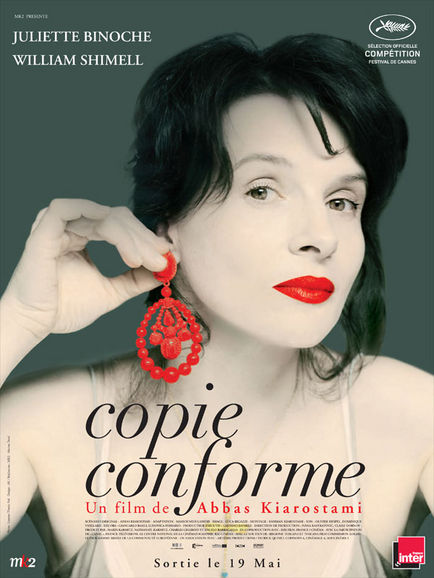
Certified Copy (Copie Conforme)


Juliette Binoche won the Best Actress Award at this years Cannes Film Festival for her performance in this intriguing film. She does indeed give an amazing performance, able to change from comic face-pulling to quiet glances and watery eyes in an instant and displaying an openness throughout that is endearing and heartbreaking. It's interesting to read that the genesis of the film came when director Abbas Kiarostami told Binoche the synopsis for the film as an anecdote which she believed as true. He then confessed to having made it up but that willingness to believe is integral to the film he went on to make after several years of struggles to get production under way. One of the problems was to find the right man to star opposite her with several actors beginning to film or slated to do it, including Robert De Niro at one point, until Kiarostami came to direct an opera and worked with baritone William Schimell, later commenting, "When I saw him, I immediately perceived in him the strength, finesse and humour of the character." Perhaps only in the world of opera was he likely to find someone capable of switching from English to French to Italian with the ease employed by Shimell, but for a début film performance he acquits himself more than adequately, particularly opposite someone of Binoche's experience in what turned out to be a prize-winning performance.

Why is the film so intriguing? Well, because it isn't easy to be sure of even the basic synopsis. In Tuscany a gallery owner (Binoche) meets an academic James Miller (Shimell) who is an expert on copies in art. He signs his latest book for her and then agrees to accompany her on a drive. Later they are mistaken for a couple and the pair pretend to have been married for many years and their dialogue plays with this very notion. If Miller's work concerns the ambiguities of original and copy, authentic and fake, then the conversation between the two of them covers similar ground with regard to relationships; what is real, what is pretend? In a village where a wedding is taking place the two of them converse, laugh, bicker and fight. Just like a real married couple. And this is where it gets tricky, because perhaps they are and those early scenes where they appeared to be meeting are in fact the false conversation, an elaborate piece of role-play for a couple whose marriage is fading. There is no definitive answer and my wife and I are still not close to agreeing with each other about what's closest to the truth (oh, the irony), which all goes to show how successfully Kiarostami has realised his original idea.

This is not a film for everyone. It is simply shot with almost all the dialogue coming from the two stars and the language changing frequently. It is slow too, but you might be thankful for that as you attempt to piece together what's real and what's performance. I've been intrigued by notions of authenticity in fiction in the past and it was interesting to see them toyed with so effectively in film, the medium perhaps best suited to explore them.

Read more...

Monday, 5 April 2010

The Hurt Locker


I found myself rooting for this film when it came to Oscar time without having seen it, sensing that it must be better than even the 'greatest ever film with blue pretend cat people'. Kathryn Bigelow created two of the greatest chase sequences, on foot rather than in vehicle, for Point Break and Strange Days, and some commentators (Mark Kermode for one) thought that a victory for her would be marvellous as it would see a woman beating the men at their own game. That seems like a pretty hollow victory to me, and perhaps even a defeat for female directors when Kermode said he'd much rather see a film like The Hurt Locker provide the first female Best Director Oscar than the films of someone like Jane Campion (he found a rather derogatory way of summarising them which I can't remember now, sneering at the arty-ness). However one feels about the sexual politics, and the tabloid feel to the oft-repeated fact that Bigelow and Cameron were once married (briefly), all I really care about is whether the damn film is any good, the time to watch anything these days being so precious.

After some early and rather worthy treatments of the second Iraq misadventure (Lions For Lambs etc) Bigelow has chosen to look at the bomb disposal experts, or Explosive Ordinance Disposal unit, of the US Army. By focusing on their work she is able to examine the place of the military in a prolonged occupation, the modern threat of counter-insurgency, and the way in which war, for a certain kind of person, can be as attractive as any of the other dangerous and potentially life-threatening stimulants out there. We are thrown straight into the action and I shall throw you straight into a spoiler alert which you can avoid by skipping to the next paragraph. In Baghdad we watch Guy Pearce's sergeant deal with an improvised explosive device or IED. Donning the distinctive protective body suit he works away at the device until it is remotely detonated via mobile phone and Bigelow dispatches the first of her celebrity cameos (It worked with Drew Barrymore in Scream for Wes Craven - kill a star in the opening moments and you know it's serious). What this sets up nicely is the danger that anyone holding a mobile phone, any of the many Baghdad residents watching the spectacle of bomb disposal in their streets could be a potential insurgent.

Bravo Company's Sanborn and 'Specialist' are joined by new team leader, William James, with only 39 days left on their rotation. James however is what all military films require - a maverick. He doesn't need to use the robot to check out any suspect rubble piles or parked cars, he doesn't particularly want to wear the protective gear, and he is, crucially, very good at what he does. His recklessness and personal mission will make it an especially eventful final month for his two colleagues and a tense, thrilling ride for us. Anyone could be a potential suspect, almost anything or any place a potential bomb. This is naturally a completely one-sided representation of the conflict but this is done from a neutral standpoint. We see things only through the eyes of the American soldiers becuase it is only that way that we can really understand the jeopardy of not being able to trust even the most innocent bystander, the man they are supposed to be there to protect of course. In one of the final set pieces the protestations of a man who claims to be good and upstanding are rendered almost meaningless by the explosives and timer strapped to his chest.

Bigelow builds tension well, not only in the bomb disposal set-pieces but also amongst her core cast. James has a complicated family situation at home, Sanborn is struggling to keep a hold of the rules and protocol that have kept him safe thus far and 'Specialist' is traumatised by the knowledge that the slightest hesitation on his part could lead to the death of himself, his team or an innocent onlooker. Much like the blockbuster that featured another military 'Maverick' you even get some homo-erotic horseplay, but the close bonding that their job forces upon them is well realised and helps add to the building atmosphere. All three can see the end in sight and that causes a different kind of strain for each of them. For James a return to normality, to family, to stability, isn't the boon he might have thought: how do you replace the thrill of such an extreme 'profession'?

The Hurt Locker will go down in history as the first film to earn a Best Director Oscar for a woman but it is also the lowest grossing film to win the award for Best Film. I'm sure that'll change in wake of its victory but part of me, whilst admiring this as a good film, isn't quite convinced that it's a great film. It is well directed, well acted and brilliantly edited (both image and sound), but it only reminded me how much I had enjoyed Generation Kill which has the advantage of time as a TV mini-series, but also boasted an extraordinary script and cast. Both are worth watching however for a truly embedded look at the experience of the modern soldier.

Read more...

Wednesday, 24 March 2010

Away We Go


Now may not be the best time to use Sam Mendes and last chance saloon in the same sentence but that was kind of how I was feeling about him as a film maker before watching this Dave Eggers and Vendela Vida scripted rom-com (Eggers is another one who was on a verbal warning until Zeitoun - review coming up next week). Mendes it seems is never going to make what you might call a pacey movie but this film does at least have some charm to it and a pair of likable leads in John Krasinski and Maya Rudolph. As Burt and Verona they play a young couple, pregnant with their first child, worried that they aren't quite grown-up enough for the responsibility, something born out by their ramshackle house and slightly unfocused lives. When Burt's parents drop the bombshell that they will be leaving the country for Europe a month before the baby is due Burt and Verona turn the loss of the only thing holding them in Denver into an opportunity to travel the country, visiting friends, to find the perfect spot for them to move and raise their child.

Beginning with the scene with Burt's parents the film is like a collection of vignettes or sketches, each destination and, in particular, each friend they visit is given full blooded performances by actors like Catherine O'Hara, Maggie Gyllenhaal and Allison Janney. Our young couple are not only auditioning various cities for the role of family home but also various methods of upbringing. The more absurd these episodes become (Maggie Gyllenhaal's 'continuum method' mum is a particular kind of mental) the more we realise that the couple we might have taken for flaky quirks at the beginning are by far the sanest of the bunch, and do at least have genuine love for one another.

Nothing to get too excited about, but a very pleasant way to spend an evening (far more pleasant than (500) Days Of Summer for example).

Read more...

Monday, 22 March 2010

The Kreutzer Sonata


Danny Huston seemed to appear out of nowhere when he starred in Ivansxtc, Bernard Rose's adaptation of Tolstoy's The Death Of Ivan Ilyich. That extraordinary smile which has been described as shark-like and the rich voice which seems to sound more and more like his father's were suited perfectly to the despicable character of Hollywood agent Ivan Beckman. Much was made of the resistance by some in Hollywood to see a film that depicted the darker side of the industry to be made first of all, and secondly to be distributed once it had been shot. There's no such thing as bad publicity of course and it helped to draw attention to the film which made a virtue of its low budget digital video camera work and used a classical score to excellent effect. Rose intends to make a trilogy of Tolstoy adaptations, of which this is the second part; again starring Danny Huston, again using that handheld digital video look and naturally making excellent use of classical music.

I had wanted to read the novella on which it is based after reading Sofia Tolstoy's account of the book's ban and her attempts to see it lifted, even though the book, with its destruction of the institution of marriage, caused her great embarrassment and pain. I finished reading it just an hour or so before watching the film so it was with some ease that I could recognise some of the lines that Rose had lifted from the book, what parts he had decided to discard and what to keep. In Tolstoy's novella the story is related by its hero, Pozdnyshev, to our narrator as they share a train journey. In adapting it into a film Rose has to rely heavily on voice over to relate the views and opinions of his own hero Edgar. Voice over is one of those things that critics get very sniffy about, and it's certainly a pain when it's lazy or unnecessary, but I'm not sure how else Rose could have got across Edgar's many views and theories about modern life without using it. Perhaps it might have been improved slightly if it had been set up early on that the voice over we were listening to was in fact a conversation between Edgar and someone else. Edgar is a man from a similar social strata to Beckman but with a far more beneficent outlook, helping to run a foundation set up by his family which provides funding for work in the sciences. We see him meet his future wife at a party when she is currently dating someone else and so their own relationship is born of infidelity and possessiveness. The arrival of children is unplanned and the impact of that is for Elisabeth Rohm's wife to give up her career as a classical pianist. So the film clearly follows the book's themes of marriage as enslavement, sex as dangerous, and children as a curse and burden. Over the films length we see the relationship from its very beginning to its bloody end with the slow decay in between.

"We were like two mortal enemies put together in the stocks, bound by a single chain, poisoning each other's lives and refusing to admit it. I was not yet aware that ninety-nine percent of all husbands and wives live in the same way, and that this is inevitable."

This would make a terrible date-movie.

The book is divided roughly into two sections. The first where Pozdnyshev holds forth with his wisdom from experience about marriage, human relations and the truth of the world as he sees it, and the second where he tells the story of his own descent into jealousy, torment and finally murderous rage. The book is weighted just slightly in favour of the former, the film naturally is all about the latter with the voice over providing snippets of Edgar's wisdom. The central event to both is the duet of wife and violinist on Beethoven's Violin sonata no.9. It is Edgar who organises the charity benefit during which the piece will be played, Edgar who chooses Aiden, the violinist, and Edgar who chooses to introduce him to his wife, determined to prove himself the perfect husband by allowing his wife to regain some of that freedom and individuality lost by becoming a wife and mother. Aiden recounts the history of the piece of music, originally dedicated to George Bridgetower, the dedication changed when Bridgetower apparently 'besmirched' the morals of women Beethoven cherished (Aiden's own theory being that Bridgetower had slept with one of Beethoven's ex's) and finally bearing the name of Rodolphe Kreutzer, who considered the piece unplayable and in fact never played it himself. So the music itself is possibly tainted with the stain of immorality but for Edgar it is a very personal experience. A man who doesn't see the point of classical music at all becomes obsessed with this one piece, the music going round and round in his head, as the constant presence of Aiden in their house practising begins to build up the pressure, feeding that green shoot of jealousy until it is all Edgar can think about.

How every detail of that evening is impressed on my mind! I remember his picking up his violin, unlocking the case, removing the cover some woman had embroidered for him, taking out the instrument, and tuning it up. I remember the air of indifference my wife assumed to hide her bashfulness (a bashfulness caused primarily by her playing) and her sitting down with this false expression on her face. Then began the sounding of middle G, the plucking of strings, the setting up if sheets of music. I remember their exchanging looks, their glancing at the assembled guests, their saying something to each other, then beginning. He played the first chord. I remember the grave, strained, fine expression that came to his face, as, listening for his tone, he pressed the strings with cautious fingers. And the piano responded. They had begun.


Rose's editing and use of the music itself is brilliant, helping to create the fever of jealousy, the irrationality of Edgar's thoughts, his animalistic urges, the subtle shift from sexual passion to violent possession to murderous rage.

"Whatever her relations were with that musician, they meant nothing to me, or to her either. The only thing that meant anything was what I have already told you - my bestiality. Everything happened because there was that dreadful gulf between us; so great was the strain of our mutual hatred that the slightest provocation was enough to bring things to a head. Our quarrels had become terrible, and they were the more terrible in that they alternated with periods of intense animal passion."


There is something however that makes the film slightly less impressive than Ivansxtc, something hard to pin down. Some of the improvised dialogue falls very flat (and in one truly bizarre moment Edgar's daughter walks in on her mother practising at the piano and says 'You're not doing it for real' - presumably because the actress isn't doing it for real (the piano parts played by a professional musician) but its inclusion in the final edit suddenly draws attention somewhere it shouldn't be), the film feels a bit long even though it is only 99 mins (perhaps due to some of the improvised meandering), the digital camera work has fewer moments where it can assert itself stylistically and there were even times when I wanted Huston to ramp it up just a notch. Rohm is fantastic as his wife, particularly in an exposed role which demands she spend much of it naked and engaged in vigorous sex with her husband. She exudes a natural beauty and openness on which Edgar can project his lurid fantasies and paranoias. However, given that you can read the book in roughly the same time it takes to watch the film, you don't need me to tell you which would be the better use of your time.

Read more...

Wednesday, 24 February 2010

Up


I watched Finding Nemo with my 2 year old the other day and almost immediately remembered that within the first couple of minutes of the film they kill off Nemo's mother and all his potential siblings. He hasn't quite worked out the significance of that opening scene yet, but I'm not relishing his dawning realisation. It made me realise that if you think about it, a lot of Disney films for children don't tend to pull their punches. I believe those film classification types call it 'mild peril' or something like that. Kids that are too young to get it, don't, and so their films work on those different levels for the wide audience range and when kids make those connections as they grow up perhaps the medium of the film helps to soften the blow.


With the opening section of Disney and Pixar's latest however it's the adults who may need to have a hanky at hand. In another of those magical sequences with no word spoken we are presented with almost the entire life of Carl Frederickson with all of the love and loss that entails. If you can make it through that without a lip tremble then you're made of tougher stuff than me. After a trash compacting robot in Wall.E Carl is another unlikely hero for an animated family film. A 78 year old balloon salesman with hearing aid and walker, Carl is cantankerously voiced by Ed Asner. As housing developments and blocks of flats spring up around the home he has occupied for most of his adult life Carl makes an extraordinary escape, house and all, in order to purse one of his life's ambitions. Piloting a detached house (no pun intended) is presumably hard enough but when Carl finds a stowaway in the form of Wilderness Explorer Russell you know things can only get tougher. The double generation gap and Carl's general impatience create a nice tension, of which Russell is entirely ignorant, for their adventure in South America. The fauna they encounter, especially the non-indigineous variety, add further to Carl's obstacles in achieving that long-held ambition.

So, yet another engaging, charming, quirky, and original film from the Pixar lot. What this film manages like no other before it is to be heart-breakingly romantic without a touch of sentimentality. You can see the love of the filmmakers in every scene. Their successes from Toy Story onwards were allegedly all sketched out in a single meeting, what a meeting of creativity that must have been. One wonders what they might come up with next (after Toy Story 3 that is).

Read more...

Wednesday, 17 February 2010

Antichrist


If it hadn't been for the vociferous praise from a friend, wild horses couldn't have dragged me to watch Lars Von Trier's latest controversy. Not only did it seem to be thoroughly unpleasant but having recently been joined by our second son the timing couldn't have been any worse for a film which follows the tortured path of a couple grieving after the death of their toddler. It doesn't matter who you are though, or what your familial setup might be, Antichrist is always going to be an uncomfortable and uncompromising watch. Deeply troubling, controversial in the truest sense of the word and as admirable as it is repulsive, I'm still not entirely sure how I feel but after a week or two I am at least ready to get something out there.


It is an uncompromising start, Von Trier seems keen to set out his stall early. The first few minutes of the film, shot in beautiful slow motion black-and-white, show Willem Defoe as 'He' and Charlotte Gainsbourg as 'She' making love, including a close-up shot of a thrusting, erect penis so that you can accuse him of pornography and the simultaneous, slow, almost balletic sequence events that leads to the couple's son falling from their apartment window onto the snowy street below. We are then into Grief, the name of this first section, which has hospitalised and medicated her and left him, who is a therapist, with the cold detachment of a professional, searching for the best way to help her through her grief. At first we feel huge sympathy for Gainsbourg, crippled by her grief, lashing out for some kind of purchase on her emotions, whilst at the same time being repelled by Defoe's clinical and arrogant treatment of his partner. You sense that there can only be danger once the barrier between lover and therapist has been broken down and this feeling only intensifies when the couple leave the oppression of their apartment for the rural retreat they call Eden.

After Grief come sections entitled Pain (Chaos Reigns) and Despair (Gynocide) where rural retreat becomes a place of frightening isolation, Eden becomes Hell, and the couple embark on a course of tortured treatment, recrimination and confrontation. Von Trier's landscape is dark hued and frightening, populated by totemic animals like a doe with a stillborn fawn hanging behind it, and a rank fox which even speaks to Him ("Chaos reigns!") a horrible visual representation of Her assertion that Nature is Satan's Church. The increasingly nightmarish feel to the film continues as the violence escalates and all is enhanced by Anthony Dod Mantle's amazing cinematography; Eden is fecund and rotting, a harsh light cuts through the night and the black and white sections are deep and textured.

The torturous violence meted out wouldn't look out of place in the rash of horror flicks from the Saw stable but it isn't that or the explicit sex that worry me. It is of course the sexual politics and the inevitable accusations of misogyny. I've already mentioned our differing sympathies for He and She and these shift through the film with Von Trier providing revelations that alter our perception particularly of her. She had been working on a thesis of historical violence against women (Gynocide) but her endeavour stalled in the face of her unacceptable conclusion. Human nature is evil and therefore women are evil, a conclusion dangerously close to 'she asked for it' and one rejected emphatically by He. But those revelations about her would seem to support her thesis and the last of these is such a paradigm shift that it risks alienating part of the audience entirely. This is what I'm still struggling with. Von Trier can't really be suggesting that women are evil, their sexual desires perverse and murderous, and their relationship to their offspring ambivalently abusive; so what is he trying to say exactly? The final scene in which a crowd of faceless women surge over the hill on which He now stands alone, baffled, is perhaps an indicator of Von Trier's own bafflement and certainly a neat symbol of mine. What I can say for sure is that the film is a work of art rather than pornography of sex or violence. It is uncomfortable and difficult, challenging and unique. There is no right time to watch it but it would be a mistake to dismiss it out of hand.

Read more...

Monday, 18 January 2010

Moon


A quick review here of a film that manages to pilfer from just about every sci-fi classic but gets away with it by employing a charm that makes it feel like homage rather than blatant rip-off. Duncan Jones' (formally Zowie Bowie - there's one in the eye for celebrity baby naming) directorial debut is assured, well-paced and has a brilliant central performance from Sam Rockwell who's one of those actor's actors - brilliant in everything he does and yet hardly well known to the general movie-going public.


The moon has become the site of a mining operation that returns clean energy back to earth, solving the energy crisis. Rockwell plays Sam Bell, the lone crew member nearing the end of his 3 year-contract, longing to return to Earth and his wife and young daughter. Live communications are down and so he subsists on intermittent recorded transmissions but 3 years is a long time and with only GERTY, a support robot voiced by Kevin Spacey, for company he is in desperate need of that trip back to earth. I won't say any more about the plot as that would spoil it. Along the way you may be reminded of Alien, Silent Running, Outland or 2001 but Moon deserves its place amongst them thanks to the fine work from Jones, Rockwell and Spacey (is there another actor who can sound both menacing and empathetic at the same time?). Rockwell deserves particular praise for a performance in isolation of great range. It isn't easy when you haven't got someone else to act off, and he manages to not only hold your attention but arouse your sympathy too.

Read more...

Wednesday, 23 December 2009

2009 - A quick review of my year

I wasn't sure whether to bother with this having published my books of the decade last week but this blog has always included more than the written word so I hope you'll indulge me a little further. I was pleased to be able to continue reviewing generally, what with the arrival of baby No.2 into our lives, and only hope the quality of what I have to say hasn't dipped too dramatically. I'll try to keep the reviews coming as quick as I can next year but if there's a bit of a pause in between posts you'll know why.

Books

You already know that I picked Lark and Termite as my novel of the year (other notables include Simon Mawer's The Glass Room, Stefan Zweig's Beware Of Pity and Fred Wander's The Seventh Well) so I'll draw your attention to some short and non-fiction if I may.

Plenty of other bloggers as well as the mainstream press have been queueing up to praise David Vann's collection of stories, Legend Of A Suicide. It is a book which almost defies categorisation and indeed has been presented differently here from the US (where each section is numbered as you might chapters in a novel rather than headed with story titles as it is in the UK). A fictional exploration of his father's own suicide, the stories are like broken fragments that reflect something unique about the experience. The facts change in each story but remain linked by their common themes and inspiration. The book is dominated by its central tale which makes the book worth buying on its own; a thrilling and horrific short that has a twist in the middle that will take your breath away.

Another collection of shorts is worthy of a mention firstly because of its beautiful production. Twenty-six separately bound booklets brought together in a box, An A-Z Of Possible Worlds by A C Tillyer is the kind of book you wish someone would give you for Christmas. Inspired by her own repetitive commuter journeys Tillyer has created a series of journeys into the mind, each to a separate world where you might find anything from archaeologists to strippers as expressions of power, repression or rebellion. I was surprised by how powerful the collection became as I worked my way through from A-Z and that is a testament to the writing. It is also worth noting that the book is published by new independent Roast Books

I really should read more non-fiction but one of the consolations of my low reading rate is that my hit-rate is pretty much 100%. Philip Hoare is one of those writers like Geoff Dyer who you should keep an eye on; always be ready to read whatever they write, no matter how far away from your normal remit or pattern that might be. Hoare's latest, Leviathan or the Whale is a genre defying biography of Earth's largest creature and Hoare's lifelong obsession. Informative, enlightening and personal, you'll have huge respect and admiration for the animal at the end if you haven't already. It is also a valuable companion to Melville's Moby-Dick which is its own reference material I know but Hoare's background on the man himself as well as the time he was writing in add more flesh onto that considerable beast.

I've also begun to get a handle on finding those neglected classics to accompany the glut of new titles published each month. The trick of course is to discover the right publishers and let them do the hard work for you. Pushkin Press, Oneworld Classics and New York Review Books Classics have been great guides so far and I look forward to latching onto some more in the year ahead (please feel free to tell me of more in the comments section below).

Music

I wish I'd been able to listen to more music this year. I don't know why, but finding the time to enjoy music has become harder and harder, actually I do know why - pesky kids. It may be just as well however because trying to pick a favourite album has had me somewhat stumped. If you were to force me to name just one then I'd have to mention the album that I have come back to more than any other, the stunningly titled 'Album' by Girls. The story behind singer Christopher Owens is almost to extraordinary to ignore (read my original review for details) but the music on the album is joyous, infectious and unpolished.

What I'd rather do though is pick a few tracks from some of my favourite albums as a kind of Just William's 2009 EP (upload problems are the reason for the videos). Enjoy.


Two Weeks by Grizzly Bear from Veckatimest

White Blank Page by Mumford & Sons from Sigh No More

Laura by Girls from Album

Keep The Streets Empty by Fever Ray from Fever Ray


Film


It was released right at the start of the year and remains the film that made the biggest impact on me at the very end. Darren Aranovsky's film was a comeback for him as much as its star in my eyes and the unflinching honesty of this portrayal of a former wrestler's comeback makes it uncomfortable but essential viewing. We are so used to watching polished film stars being beautifully lit and shot from angles that compliment, dare I say it - enhance their features that the harsh daylight and shadow of this film, the way that every imperfection on that pummelled face and body is highlighted make it all the more extraordinary. It isn't only Mickey Rourke who allows himself to become the object of our scrutiny, Marisa Tomei is just as brave in her own performance and both are to be commended for the way they open themselves up for our perusal.

I won't bother about Theatre and Art as I've done virtually none of either. Suffice to say that theatre wise you should all come and see me in War Horse. As for Art, all I can suggest is that you give the latest installation in Tate Modern's turbine hall by Miroslaw Balka a miss. You make your way up and into the vast shipping-like container via a ramp, the light gradually disappearing inside, the sound deadened by felt-lined walls. In theory you would be tentatively feeling your way forward, afraid of colliding with others, scared of bumping into the dead end of the space, unsure of where that is. Balka hasn't taken into consideration the mobile phone however. There are two types of people: those that would turn off their mobile phone when going into a gallery/theatre etc in order to enjoy the experience and those that wouldn't even consider doing that and certainly have no worries about using them. Despite a sign saying that phones and cameras are not to be used I'd be surprised if you could find a time of day when that black space isn't being illuminated by someone taken a picture/video, texting, or simply finding there way about via their mobile phone screen. It's a shame but I'm not convinced that I'd have got an awful lot more from the installation if rules had been observed or I'd been on my own.

So, 2010, that futuristic date is suddenly upon us, and what do I hope to achieve? Well, to keep it up for one thing, but to try to find and review books from smaller publishers and more works in translation too. If you publish books like that then please get in touch, if you're a reader of this blog and would like to recommend books/publishers then you get in touch too. Happy Christmas everyone and all the best for the New Year...

Read more...

Wednesday, 9 December 2009

Telstar


Nick Moran's film started life as a play, which he co-wrote with James Hicks. It was Con O'Neill who took the lead role of record producer Joe Meek in the West End and who revives it in the film version. The film is well made, well acted on the whole and certainly has a courageous central performance from O'Neill and only falters in one major way: Joe Meek was a complete c**t. This is why O'Neill's performance is courageous, he's not afraid of making him unsympathetic, his moments of clarity and affection few and far between, not to mention fully committing to his Gloucester accent (O'Neill used to work as an accent coach), a first surely for the silver screen. Meek was the man behind hits like 'Johnny, Remember Me', 'Just Like Eddie' and 'Telstar', recorded in a ramshackle studio housed above a handbag shop on Holloway Road, which is faithfully recreated for the film and where most of the action takes place (spot the script adapted from a stage play). This combination of manic genius producer and upstairs/downstairs comedy makes it a bit like watching an episode of Are You Being Served starring Phil Spector. Well, not really, but it's as bonkers an image as what you get, with opera singers recording in the loo and marbles being tossed down the toilet to record sound effects there's a manic energy to the proceedings.

O'Neill is excellent as I said and there's no doubt that his life lends an interesting narrative (one of many who passed on The Beatles it seems) to the film but there's no escaping the fact that despite the spiralling depression and mental instability you don't ever really care about him, so unpleasant has he been to those around him. His song writing partner Geoff Goddard is portrayed brilliantly by Tom Burke in a well judged and subtle performance. His protege Heinz is served equally well by JJ Feild and there is good support from brit flick regulars James Corden and Ralph Little. What to make of Kevin Spacey as Meek's backer Major Banks though. It isn't that the performance is particularly good or bad, it's just that it's Kevin Spacey in the middle of this very British film, looking about as conspicuous as he would if he walked into, well, a handbag shop on Holloway Road. Maybe he was part of the financing deal but there's no excuse for some very weird cameo performances from Marcus Brigstocke, Jimmy Carr, Justin Hawkins (from The Darkness - as Lord Sutch - I kid you not) and even author Jake Arnott. Carl Barat (of The Libertines and Dirty Pretty Things) takes the honours though in a cringeworthy turn as Gene Vincent, his American accent does not bode well for his upcoming stage debut alongside Sadie Frost in Sam Shepherd's Fool For Love. All of these celebrity turns don't do anything to help the film, especially when the real gold is coming from O'Neill and Feild, two actors who many won't have heard of, quietly getting on with things whilst the circus whirls around them.

Meek's sexuality allows the film to take a look at attitudes to homosexuality in the period leading up to the sexual revolution but this isn't a film trying to make a point much beyond the four walls of Meek's studio. It's a shame in that case that there isn't more of the music, or more of an insight into what he did as a producer to so hone that sound (especially given that he was tone deaf). I should be recommending this film, it's certainly streets ahead of most of the drivel that we seem to produce here with alarming frequency, but it's just not that enjoyable.

Read more...

Wednesday, 25 November 2009

Star Trek


I am no Trekkie but the tone of surprise with which people told me that this re-invigoration of the franchise from man of the moment JJ Abrams was really rather good had me intrigued enough to take a look. My plan to watch it at the IMAX in Birmingham when I was working up there for a couple of days was scotched when my employers had the temerity to take me out for dinner that evening. Babies and work have meant that I've had to wait for the DVD release, no substitute I know for the big-screen experience but it's still an enjoyable ride in your own living room. The previous film incarnations had done enough to bury any integrity in the series years ago but somehow they've managed to begin at the beginning, include enough references for the fans and enough character and bangs for the neutral to give the USS Enterprise a chance of a few more years of bold going.

The casting is excellent for a start (although they could be accused of simply applying the simple 'younger, prettier' rule), Chris Pine as Kirk starting out off the rails and building steadily into the captain he will become , settling into that famous chair (with an uncannily familar posture) only at the very end of the film. It is Zachary Quinto's Spock who seems to be the natural leader and the duelling that goes on between these two very different men is the backbone of the film. Each has their own conflict with themselves and their ancestry and it is that which they battle against as much as Eric Bana's snarling Nero. Oh and the new look Uhura has both of them and probably most of the male audience turning their heads too. I particularly enjoyed Karl Urban's grouchy 'Bones' and was steeling myself against what could have been a cringe-worthy turn as Scotty from Simon Pegg only to find myself chuckling away.

As the first film there was always bound to be a fair bit of exposition and the time-travelling plot wasn't nearly as ingenious or puzzling as I believe the storylines can be but it was nice to see a film that made space feel like a genuinely dangerous place, the vacuum that it is, rather than just threatening the tilting camera on the wobbling sets of old. The battle scenes and space travel are genuinely thrilling, which is just as well in a film which felt a tad long to me. The big bangs and SFX won't be enough on their own though to keep this re-animated corpse going. If the franchise can maintain the human-(and alien)-interest storylines and keep the brain-teaser factor high then they might just get away with it. Don't worry about that for the moment though, just watch it and have some fun, everyone in the cast seems to be.

Read more...

Friday, 20 November 2009

Coraline


Why do I find myself having to watch 'children's' films in order to see innovative design, witty scripts and feel moved in some way? We can discuss that together below (although the yawning silence that greeted my request for feedback on Synecdoche, New York was not encouraging - unless you were all playing some kind of sick joke on me and providing me with the only appropriate response to a film like that), let's get on with Coraline. Any fans of Henry Selick's previous stop-frame animation features, James And The Giant Peach and The Nightmare Before Christmas will definitely want to see this as it continues that vein of work, looking slicker and more adventurous than ever without losing any of the charm that comes from using genuine puppets rather than CGI.

Based on Neil Gaiman's book of the same name, the film begins as Coraline moves with her parents to an apartment in a slightly dilapidated house in the country. Basically ignored by her parents she goes exploring finding first a deep well, then a neighbouring boy, Wybie, and then within the house a small door that she later discovers leads to a parallel world, similar to her own but better in every way. Here she meets her 'other' mother and father, again similar but improved and chillingly sporting buttons in place of their eyes. As they try to convince her to stay there rather than return and Wybie tells Coraline more and more about the disappearance of his grandmother's sister she realises the danger she is in and will have to fight hard, with a little help from a feral cat, to get back the family she wants.

Make no mistake, this film is dark. The first half an hour or so is harmless enough but once the plot darkens there are some pretty 'scary images', as the official parental guidance puts it. Which is great of course, I'm all for scaring the pants off kids, but I'd keep the younger ones on some safer fare for the moment. The performances work well , the visuals are striking, the design really beautiful in places, it's easy to see why the critics were so enthusiastic about it. Just get past the slow opening and you'll be rewarded by some stunning work, and a quick glance at the making-of documentary will give you an idea of the deliberation and attention to detail that helps make it that way.

Read more...

Friday, 13 November 2009

District 9


A little like the alien spacecraft that adorns the poster this film seems to have arrived out of nowhere. Who would have thought that South Africa would be the breeding ground for a top-notch alien-politico-docu-buddy-flick (catchy, eh)? As one of the narrating voices says at the beginning, people would have expected first contact to happen in a city like New York rather than Johannesburg but it is here that an alien ship came to a halt almost 30 years ago bringing not laser beams and alien invasion but close to a million alien refugees in need of help. Referred to perjoratively as 'prawns' they now live in the titular shanty-town, looked upon by many of Johannesburg's human residents as a burden they would rather see jet off back home or shipped off elsewhere.

The private company in charge of policing them are MNU (Multi National United) who are looking to exploit the potential of the alien weaponry which so far is useless, the alien's DNA being integral to its functioning. The film begins as MNU are preparing to serve the aliens with eviction notices before moving them forcibly to District 10, a purpose-built camp 240 miles away from the city. We follow Wikus Van De Merwe, played by Sharlto Copley in what is his first major acting role (it won't be his last - not just because I think he's marvellous but because I see he will be playing Capt. 'Howling Mad' Murdoch in the feature film of The A Team), as he heads the operation but intercut with that documentary and news footage we hear from various people involved, talking about it all as a past event, and we know from what they say that something goes very wrong.

When he is sprayed by some kind of fluid during a search Wikus begins a transformation. Anyone familiar with The Fly will understand what I mean and also have a good idea of the kind of special effects, not to mention the feeling of unease. What works so well here is that Wikus goes from a tank-top-wearing company man who regards prawns as a bureaucratic nuisance, to someone reliant on them for their help and protection. Given what his assimilation of alien DNA could mean to MNU he becomes a fugitive and the pace is frenetic, perhaps running away with itself towards the end where it becomes just like any other action thriller. It's most interesting moments come with the clever intercutting of different film stocks and perspectives, the distinctly weird way that man and alien have to work together, and the obvious significance of themes like segregation, dehumanisation and violence in a post-apartheid South Africa. All of this ignores the humour and the few tender moments that also dot the film; this is a man after all who wants nothing more than to be back with his wife again and that is the motivation behind all of the film's action.

In the age of identikit thrillers and action movies the set-up of this one is sufficiently interesting, and its execution in the first hour-and-a-bit original enough to warrant attention. It certainly heralds a promising future for its lead actor and director Neill Blomkamp


Read more...

Wednesday, 4 November 2009

Synecdoche, New York


Whereof we cannot speak, thereof we must be silent.


(By which I mean it's been a couple of weeks since I saw this and I'm still not sure what I can usefully say without discussing it with a few others first, so I'd like to open up the comments box to you and see if we can sort this out. At the moment all I have are a few words to get us started: performance, reality, wordplay, Beckett, meaning, self-indulgence, simulacrum, depression...)

Read more...

Friday, 25 September 2009

In The Loop


As a big fan of The Thick Of It I was equal parts intrigued and worried by the feature length spin-off. Not just for myself you understand but as with many British comedies you do wonder whether the humour will translate well across the pond and elsewhere. The strength of the series was always the up to the minute political satire and the profane logorrhea of Peter Capaldi's Malcolm Tucker. By it's very nature a feature film would not be able to be current by the time of its release unless Armando Iannucci had some kind of political crystal ball (which it sometimes seems as though he does) and I suspected that the pressures of pleasing a stateside audience might lead to a toning down of the language and perhaps even the accent it was delivered in. Iannucci avoids the first problem by focusing on the lead up to the second Iraq war, complete with the dodgiest of dossiers, and makes a joke of the second by playing on the American squeamishness for 'cuss-words' and keeping Tucker as explicit as ever and his protégé Jamie MacDonald (the brilliant Paul Higgins) even more so.

The major problem with the film is that it doesn't ever transcend its roots, it just feels like an extended episode of the series, which may not be a problem for those who are already on board but may not make the best viewing for those coming to it new. The involvement of the Americans allows those of us starved of a James Gandolfini fix the chance to see him again, providing the film with one of its more absurd moments as his vast hulk hunches over a little girl's toy calculator so that he can calculate troop numbers and possible casualties for any upcoming invasion. The British cast reprise their roles well and the slot of vacant buffoon is filled by Tom Hollander who just about gets away with it, flooring me with one line: 'difficult, difficult, lemon difficult', which won't make any sense unless you see the film which I recommend you do.

Read more...

Friday, 11 September 2009

United 93


When Paul Greengrass's dramatisation of the fate of the one plane not to reach its target on 11th September 2001 was released five years after the event some questioned whether enough time had elapsed for a film like it to be made. That same year saw the release of Oliver Stone's World Trade Centre, which I haven't seen, but I suspect that the documentary integrity of United 93 makes it a film that was actually timely rather than mis-timed. There has been a steady stream of 'post 9/11' artistic interpretations since then, in fact that phrase has become so clichéd that is risks taking away from the impact of the event itself. Watching this film now eight years later it brought back all the confusion and incredulity of the day, brilliantly capturing I think the utter unpreparedness of America in the face of such a paradigm shift in terrorism.

Because we know exactly where the story ends there is almost a double dramatic irony in watching events unfold. The slow progress made by each passenger to the plane, the workaday normality for the air traffic controllers, the sense of unease as the last passenger sprints to make it in time to the door, these are all fairly obvious; but the confidence is what is about to be shattered. When the first hint of a hijacking is revealed the air-traffic controllers almost joke about how long it's been since they've had to deal with a hostage situation, they're almost fishing out the manual on how to deal with this kind of thing completely unaware that the hijackers have no intention of landing, bargaining or explaining anything. Because so many things seemed to happen on that one day the chronology of events is something I still haven't quite managed to pin down. Greengrass exploits this and the stuttering relay of information to show the total inability to comprehend and react to the unfolding tragedy. After the film finishes a piece of text informs us that the military only became aware that the flight had been hijacked four minutes after it had crashed in Pennsylvania. The military confusion and communication breakdown is total: planes leave without weapons, fly in the wrong direction, clarification of the rules of engagement is always being asked for. It is stressed that the final say lies with the President and I couldn't help but remember that blank expression on his face when he was told of the second plane, sat on that small chair, as children read a story.

For those on the plane, after the initial shock and violence of the hijacking, it is amazing how quickly they galvanize and start thinking about their situation. Information is everything. The change in direction, the spotting of the pilots down on the ground, the sense that the bomb that is strapped to the waist of one of the hijackers may not be real; these set them investigating. Once they have news of the attack on the twin towers of course everything has changed. The film is impressively put together, well acted by pleasingly unknown faces and the only question I had was what can be learned from watching it? The unprecedented nature of the attacks softens any kind of blow that might be struck at the reactions of those on the ground. The passengers on the plane seem not so much heroic as utterly human in their response. The big question mark lies over the hijackers of whom we learn little about, beyond the mechanics of the operation. It is a question mark which still remains in place, in large part, today.

Read more...

Friday, 4 September 2009

Revolutionary Road


The mantra goes something like: 'Always read the book before watching the film', and that was the plan but then the reviews of the film were a little lukewarm and so the book slipped down the pile. Then 'er indoors wanted to see it and I figured that because the book was bound to be better than the film then perhaps this was exactly the right way round to do it: enjoy decent-ish film, then read masterpiece. A sound theory. And like many theories in practice it turned out to be wishful thinking. I'm sure the book is a masterpiece and I shall probably read it some day but the film was not so much decent-ish as just -ish.

Sam Mendes makes slow films. Really slow films. Thanks to Roger Deakins they have some nice cinematography in them but far too often I find myself thinking 'that's a rather clunky camera move, why is he moving the camera out here, or panning there?' Mendes was honest about his lack of experience with film-making after the success of American Beauty but with the recent release of his fifth feature he had better start showing some more mastery or those brownie points are going to lose their currency. This film has three stars written all over it but because it feels a bit long and frankly (no pun intended) a bit boring in places it left me feeling more like I wanted to give it two out of spite. Even without reading the book I can tell that Leonardo DiCaprio is miscast. He may be the right age but it's one of those films where there's an awful lot of 'not-acting' going on. What I mean by this is that DiCaprio has a few modes: the films where he's so well cast that you don't really see the acting (Basketball Diaries, Romeo and Juliet, Catch Me If You Can), the films where he's doing a character so that all you can see is the acting (Gangs Of New York) and the films where he's trying so hard to give a worthy performance that his 'not-acting' is totally conspicuous. I may not be the biggest fan of Mad Men but there are several actors in that that I completely believe in that sort of period and setting and who convey the sexual mores of the time. I just didn't get Frank Wheeler from this film.

Kate Winslet as April Wheeler is another enigma. Family life clearly wasn't working out for her (her children are almost entirely absent from the film) but I didn't ever really understand why she got so little joy or contentment from being a mother. It's a pretty good performance but I understand she's much better in Little Children. Kathy Bates looks like she's treading water as Mrs Givings and Michael Shannon as her son John gives a performance that screams Oscar nomination. God, I'm sounding a bit moany, I can't imagine where I've picked that tone up from. Oh, I know, The Wheelers.

Right, a comedy next I think.

Read more...

Saturday, 22 August 2009

Let The Right One In


So, time for my pick in the Rycroft-vampire-film-cultural-exchange (I think we need a better title than that) and it's almost the mundanity of the setting that sets this film apart from others in the genre. Tomas Alfredson's film (released as Låt den rätte komma in in Sweden) is set in Blackeburg, a concrete suburb of Stockholm, in 1982. Thick snow blankets the urban landscape, deadening the sound, the first few minutes of the film close to silent. Twelve year old Oskar lives with his mother in an anonymous block of flats. He is lonely, bullied and seems to suffer with a constantly streaming nose. He dreams of revenge, playing with a knife and reciting, in true Travis Bickle style, what he would say to his attackers if he only had the courage. But we sense that he never will. He then meets Eli.

Eli is a curious creature, appearing almost spectrally as the camera pans across the estate play area. In the tradition of vampire films it will be a while before she is unveiled as one but the signs are all there. She can only come out at night, she doesn't eat, cat's seem to have a problem with her. . . oh, and she has a companion who knocks out strangers, hangs them upside down and then taps their blood for her. The film's title plays on one aspect of vampire lore: that vampire's cannot enter a dwelling unless invited in; and the film is dotted with other examples which look all the more extraordinary given the very ordinary setting of the film.

What the film is really about though is the relationship between Oskar and Eli, why they both need each other, what they can give each other, the boundaries beyond which love can be pushed. The darkness in the atmosphere comes from the banality of the strains and stresses in the human world. Oskar comes from a broken family, is a victim of bullying, other characters seem to be leading fairly drab lives fuelled by alcohol. Even when bodies are found there is very little alarm until one of the block's residents spots something from his balcony. I had to sell this film as a fairly non-gory thriller in order to get my wife to watch it at all and I think I was just about right. The film manages to build tension and release it without the standard horror tropes and it is very far from a gore-fest. The subtlety of the set-up combined with the sudden moments of attack make it a very adult thrill, whilst saying something genuinely interesting about children entering their teens. Film of the year so far for me. My wife? She still prefers The Lost Boys.

Read more...

  © Blogger templates The Professional Template by Ourblogtemplates.com 2008

Back to TOP