Random

Thursday, 10 November 2011

'what kind of story is it?'


Sandcastle
by Pierre Oscar Levy 
and Frederick Peeters

I just love the cover to this book. It's disconcerting before you even open the cover and that should be fair warning to anyone who's intrigued to find what's inside. This is certainly the oddest graphic novel I've read in a while and quite possibly the oddest piece of fiction, graphic or otherwise, for quite some time too. With artwork from Peeters and storyline from film-maker Levy this is a graphic novel that seems to be in one kind of genre, switches to another and may possibly be in another category of storytelling altogether. That's quite a feat in a hundred pages.


The location is a beach, a haven amongst some rocky cliffs, and we watch as several characters make there way to it. One is already there, an Arabic looking man, who watches as a young girl undresses completely and goes for a swim in the sea. A couple of families make their way to the sand and whilst they bicker and banter a grandmother and her grandson make the gruesome discovery of the floating corpse of the girl we watched undress earlier. So we might be reading a crime novel and the patriarch of one of the families thinks he has it solved when he sees the Arabic man from earlier (he is in fact Kabyle but the casual racism of his accuser doesn't care about distinctions like that). But there is something far stranger going on and it is some time before the assembled company begin to notice the signs. One woman's children appear to have outgrown their swimming costumes despite only just having purchased them and on closer inspection she notices that her 'baby boy' of three looks for more like a child of five or six and has quite clearly grown in line with that. His older sister appears to have grown up too and when she walks off with the young boy from another family the two of them appear to go through a fast track adolescence and sexual awakening. When grandmother takes ill and then stops breathing the group begin to start asking what on earth is going on.


A writer is amongst them and when he reveals that it is science fiction he specialises in they want to know what possible explanation there could be for their apparent accelrated ageing and inability to leave the beach itself. His theories don't result in any kind of satisfactory solution and whilst the adults find themselves confronting their own mortality (with each half hour representing a year it is clear that some of them won't make it through the night let alone the next day) the children are experiencing the opposite, an explosion of sexual awareness and procreation energy that will see that young girl from earlier get pregnant, come full term and even give birth on the same beach on which she lost her virginity.


So it isn't crime and once we get past the slightly Twilight Zone feel of the device you can't help but wonder if this graphic novel isn't offering something rather more profound. This isn't quite a life compressed into a day but it isn't far off, and it's certainly the sudden end of life for many of the characters; and the different ways in which they deal with that, or the way in which it comes about, provide some truly moving sequences and images. To find a husband and wife slowly reconciled into a spooned hug, or to watch a once powerful man reduced to second infancy as he makes a sandcastle on the beach are just a couple of those highlights. And whilst the fast approaching death of these older characters might make this feel like a slightly hopeless book there is always the hope provided by new life and the promise for its future. Like I said, quite a feat to get you thinking about all that in just 100 pages and some lovely artwork in places too.

Read more...

Tuesday, 8 November 2011

'When I was eleven...'


The Dubious Salvation Of Jack V.
by Jaques Strauss

Being absolutely honest, I wouldn't have read this book (which came en spec from the publisher) if it hadn't been for a very favourable review at the ever-reliable Asylum. Even with that it languished on the TBR shelf until such time as a genuine pause appeared in my reading schedule (yeah, it's that bad) and I found myself finally taking a punt. I'm glad I did, books that are easily entertaining, witty, political and populated with sharp characters are a joy when they plop in your lap at the right time and it is the seeming ease of this book which makes it such a pleasurable read. The fact that it has received so little newspaper review space even with a big-name publisher is a little saddening, especially when I think about some of the books that have received lots of undeserved column inches (some from the same big-name publisher), but that's what us book bloggers are here for I guess.

The novel is a confessional from Jack Viljee; half English, half Afrikaans resident of 'a very nice street' in Johannesburg, looking back on the definitive moment from his childhood. As an eleven year old during the final years of the Apartheid regime in South Africa Jack is able to give an interesting perspective on the shifting politics of a country about to undergo momentous change. It is his dual ancestry however that provides the real interest for it allows him to point out the differences between the two cultures, their attitudes towards the black population and the way in which Jack's own mixed-race status, if we dare call it that, leaves him in an uncomfortable no-man's land between the two. A prologue sets the tone, several paragraphs each beginning 'When I was eleven...' and informing us of the preoccupations of any boy heading towards his teenage years. This is the period when he 'was stupid enough to try to have sex with a shampoo bottle' or 'old enough to know that peeing in the bath was disgusting but young enough not to care and do it anyway' but it is also the time '...I betrayed Susie, our housekeeper, my friend, my second mother, and perhaps in other significant ways, my first.'

The closeness of the relationship he enjoys with Susie is highlighted and indeed jeopardised by the arrival of her own son into the household but I don't need to go into any plot details as such, that isn't where the real enjoyment of this novel lies. Jack is an engaging, funny and perceptive narrator (particularly from his retrospective viewpoint - of which more later) and the sheer scope of his observations mean that this novel, which feels so light and easy to read, is actually packed full interest. By making Jack's 'distinguishing characteristic' the fact that he is half English and half Afrikaans, 'that I could slip unnoticed between the two peoples like a spy,' Strauss has lots of fun pointing up the differences between the two sides of his family, the Afrikaaner's obsessions with suffering and food for example, and creates a fabulous character in grand-matriarch Ouma who 'had the required quota of grief to make most quirks permissible; mild anti-Semitism, mild racism - nothing rampant or unseemly, nothing undignified.' It is Ouma's admiration for the 'debonair' Pik Botha that allows Jack to make one of his telling observations about the time when Pik Botha, whilst overseas, said that he would be happy to serve under a black president, only to change his tune when back in front of his president PW Botha.

It was a little bit like saying 'fuck' in front of your friends - for a while it seemed like a very brave, very manly thing to do, but unless you were prepared to say it in front of your mother it didn't mean much at all.

This kind of comment can only be made by an adult looking back on their childhood and is so much more perceptive and interesting than anything the child themselves might say at the time. This is why it remains a mystery to me why authors are so seduced by child narration. In the same way Jack can tell us about the very real pains of growing up: the embarrassment of growing awareness; that your parents don't necessarily like all their friends, that the relationship as it stands between whites and blacks makes you feel awkward and embarrassed in a way that it doesn't to your parents and some of your friends, that your desires can be surprising. Jack's burgeoning sexuality is rather brilliantly handled, allowing moments of comedy and painful revelation. Young boy's willy obsession achieves due prominence and a unique detail from Jack's dual-luanguage skills.

I guess around eleven we all thought that to coax our dicks out of hibernation we should stop calling them 'willies' and start referring to them as 'cocks', but my mother detested this word almost as much as the Afrikaans equivalent, vöel, which means 'bird'. Calling your cock a vöel was a very Afrikaans and manly thing to do. It was enough to make my willy look bigger and my voice sound deeper.

The selfishness of children is something of a recurring theme given even greater significance by Jack's privileged status. He has something of an obsession with deformity and disability (perhaps this comes from having a neighbourhood prosthetics shop) even finds 'something alluring about these broken children with missing arms and missing legs.'

And I wished that, for the afternoon, I might be without a limb too, so that I could be part of this orgy of tragedy, of heartbroken but proud parents, of the paraphernalia, the prosthetic limbs, the wheelchairs, the crutches, like Tiny Tim, the epicentre of sympathy and tragedy and poetry. 

Jack has a tendency towards the grand gesture, particularly when it might atone for the guilt he feels for certain actions or simply for being white. These again come about from his privileged position so that the purchase of an ice-cream from the weathered (black) ice-cream salesman on the beach, or the donation of his pocket money to a homeless woman would allow him to 'act like a God.' And this all ties in with one of the great lessons he learnt from his childhood on the school visit to the Natural History Museum. The exhibit of a caveman family being attacked by a sabre-toothed tiger contains the rather graphic image of skull-piercing teeth to drive home the point that our survival 'was dependent on the suffering of some other innocent creature.'

...that life is an economy of suffering so that when we die, like my grandmother, we are an accumulation of those compromises, bones and loose skin, mildly anti-Semitic, mildly racist, nothing rampant or unseemly, having suffered and caused suffering, dying, I suppose, with a small credit but completely ravaged by all the exchanges.

Jack's story is a reckoning, but a hugely entertaining one. My only worry when reading it was that the ease in its telling was due to Strauss mining his own childhood for all the sparkling details, would that mean that his next novel would suffer from the depleting stocks of autobiographical riches? I have no idea whether this novel is in any way autobiographical and the only way to find out whether Strauss has real legs as a novelist is to read what comes next. I, for one, look forward to finding out what that is (and won't take so long to get around to it next time) and can only hope that these thoughts on a hugely enjoyable debut might tempt you to do the same.

Read more...

Thursday, 3 November 2011

'I will return'


A Sky Full Of Kindness
by Rob Ryan

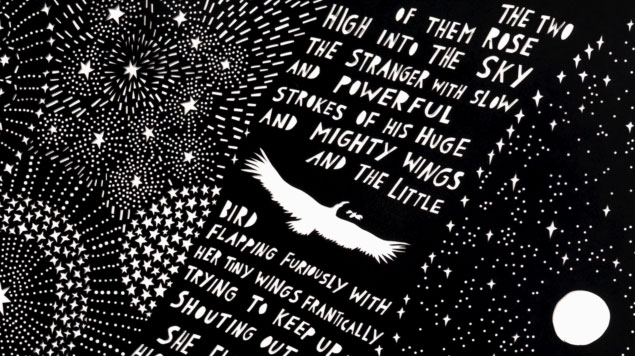
There's a good chance you may have seen Rob Ryan's work already. Greetings cards, posters, mugs, cushions, book covers, umbrellas, bags, and even vases and crockery have all been emblazoned with his distinctive paper-cut designs in gift ranges at stores like Liberty and Heals. He even has his own shop on London's Columbia Road where his work can be seen in many forms. There's no substitute for seeing one of his extraordinarily intricate paper-cuts in the flesh, even the mass-produced card I bought for my recent anniversary is a tactile beauty and the detail of some of his larger works is truly staggering.


He has also written, or created, one previous book, This Is For You, which concerned one man's search for a soulmate. His latest is described by Helena Bonham Carter on the back cover as 'a bedtime story for every age' and follows the fortunes of two birds who have a baby. The mother has an important seeming dream and soon finds herself undertaking an epic journey to discover its meaning. That's all you really need to know plot-wise; this fable or fairytale-like story uses the mother's journey to explore themes of friendship, discovery, freedom, release, reliance and the ways in which we need the help of others.


Ryan's artwork really is astonishing, it's hard not to turn each successive page and ask 'How does he do that?' Some pages have a decent bit of background colour to them and so you can feel the relative solidity of the page from which they were cut but others are almost impossibly fragile, it's hard to see  how the lines of text, or twigs that make up a nest, the flocks of birds or clouds in the sky manage to remain connected to the rest of the picture so that the paper remains unbroken. The wonder of that really does sustain for the book's 64 pages. What I might question is the quality of the writing itself. It's hard not to think of the wisdom of greeting's cards when reading certain passages in this book, the vaguely comforting feeling that comes from vague and comforting phrases, and it makes the intricacy of the labour all the more extraordinary when you find that all the effort to cut out those words has been in the service of words that could possibly be improved on. This is similar to the effect of Brian Selznick's recent book Wonder Struck, whose beautiful pencil drawings were let down by some truly pedestrian prose. Ryan's book is way better than that, I'm having a relatively minor quibble, but it does just highlight that it isn't enough for a book to look beautiful and have its heart in the right place, I still want the quality of the writing itself to be as high as the craftsmanship that created it. That said, I can easily imagine plenty of parents getting as much pleasure from reading this book as their children will get from both hearing and seeing it.

Read more...

Tuesday, 1 November 2011

'wounds that will never heal'


Brodeck's Report
by Phillipe Claudel
translated by John Cullen

Another one from the Shelf of Guaranteed Literary Fulfilment (this is an actual shelf in my home, although it hasn't been actually labelled as such. Yet.) this book found its place there after my review of Claudel's more recent novella, Monsieur Linh and his Child, drew lots of comments from admirers of this winner of the Independent Foreign Fiction Prize. Both books deal with the legacy of war and violence but whereas the title character in Monsieur Linh was most obviously an example of trauma brought about through conflict, Claudel uses the title character in this novel to look at themes of persecution, isolation and otherness.

A little as in the recently reviewed Death Of The Adversary, Claudel keeps many of the details hidden in this novel. A time period isn't specified but we can guess, the location too isn't named but seems to be somewhere in Alsace-Lorraine where a German dialect is spoken by the French population. This dialect is important for a couple of reasons: firstly because it highlights the way in which a country's borders are shown to be the arbitrary things they are when two countries find themselves at war and two regions on either side of that imaginary line, their age-old histories linked, have in common 'legends, songs, poets, choruses, a way of preparing meat and making soups, an identical melancholy and a similar propensity to lapse into drunkenness.' Claudel retains many of this dialect's words, explaining their sometimes ambiguous meaning, or rather his narrator Brodeck explains. Brodeck has been assigned the task of writing an account of the events that lead up to the murder of 'the Anderer' (or 'other'), a visitor to the village. He has been assigned this task despite thinking himself unequal to it - 'To be able to tell stories is a skill, but it is not mine. I write only brief reports on the state of the flora and fauna...I am not sure my reports are still reaching their destination, or, if they are, whether anyone reads them.' We needn't worry about that lack of confidence for Brodeck is a fine writer and there are even some extraordinary moments where his usual subject matter is perverted by the fact that this is a village that has recently been through a war and that he is a man who has been made to suffer more than any other resident of that village. The River Staubi for example that runs nearby, usually a place of animal life and movement became something else entirely at moments during the war when 'creatures other than fish were to be found floating in it, blue creatures, some of them still looking a little astonished, others with their eyes firmly closed, as if they had been put to sleep by surprise and tucked up in pretty liquid sheets.'

In putting together his account of the 'Ereigniës' - the thing that happened - Brodeck introduces us to the increasingly sinister inhabitants of his village. The very fact that so many of them were together on the evening of the murder and Brodeck absent highlights his isolation within the community, something only heightened by the job he has been assigned by them; a task that can only increase the sense of fear and guilt with which they already regard him. And what of the Anderer, what kind of threat did he pose when he wandered into their village '...dressed like a character from another century, with his unusual beasts [a horse and donkey] and his imposing baggage, entering our village which no stranger had entered for years, and moreover arriving here just like that, without any ado, with the greatest of ease. Who would not have been a little afraid?'

In a telling episode, when it becomes clear that the Anderer will be staying for a while rather than passing through it is decided that a proper welcome should be organised with a banner, music and some speeches. It is the banner with it's ambiguous message that gives us a taste of the tension that exists.

"Wi sund vroh wen neu kamme" can mean "We are happy when a new person arrives." But it can also mean "We are happy when something new comes along" which is not the same thing at all. Strangest of all, the word vroh has two meanings, depending on the context: it can be equivalent to "glad" or "happy", but it can also mean "wary" or "watchful", and if you favour this second sense, then you find yourself faced with a bizarre, disquieting statement which nobody perceived at the time, but which has been resounding in my head ever since; a kind of warning pregnant with small threats; a greeting like a knife brandished in a fist, the blade twisting a little and glinting in the sun.

The Anderer doesn't do anything other than observe and make notes and enquiries into this village's life and its inhabitants are antagonised by this being held to account. He may not have ridden in on the donkey itself but there is something Christ-like about his arrival, impact and sacrifice. The village priest, a man driven to drink by the impact of war and all the filth that has been confessed to him over the years, doesn't make such an explicit connection but provides a useful image for Brodeck to consider.

That man was like a mirror, you see. He did not have to say a single word. Each of them saw their reflection in him. Or maybe he was God's last messenger before He closes up shop and throws away the keys. I am the sewer, but that fellow was the mirror. And mirrors, Brodeck - mirrors can only be smashed.

Brodeck's project may be about the Anderer but it is also really about himself and his own tragic history in this community. Having come from 'a country which had never appeared on a map, a country no tale had ever evoked, a country which had sprung from the earth and flourished for a few months, but whose memory was destined to weigh heavily for centuries to come' he has always been something of an outsider himself. When war came to the village with its desire to cleanse the area of undesirable elements Brodeck stood no chance. Sent of to a camp, from which he wasn't supposed to return, Brodeck managed to survive physically only by abasing himself, becoming 'Brodeck the Dog', kept as a kind of pet by one of the guards, led around on a collar, and crucially fed scraps of food that kept him healthier than his fellow internees. Spiritually he was sustained by the memories of his surrogate mother Fedorine and lover Emilia to whom he has promised to return. When he does he is haunted by the void of those two years away, something which has its own unique word in this dialect.

The Kazerskwir - that was because of the war: I spent nearly two long years far from the village. I was taken away like thousands of other people, because we had names, faces or beliefs different from those of others...Those were two years of total darkness. I look upon that time as a void in my life - very black and very deep - and therefore I call it the Kaserskwir, the crater. Often, at night, I still venture out on its rim.

This is a novel that bursts at the seams with themes but one last thing to mention is the way in which the legacy of conflict extends beyond Brodeck's personal experience. For those that survived the camps, those that escaped the attempt by neighbours and friends to wipe them from memory there is not only the burden of survival-guilt but the fear of uncertainty in the future.
We can never meet the eyes of other people without wondering whether they harbour a desire to hunt us down, to torture us, to kill us. We have become perpetual prey...I think we have become and will remain until the day we die, a reminder of humanity destroyed. We are wounds that will never heal.

Read more...

Thursday, 27 October 2011

'where's Robbie?'


The Wrong Place
by Brecht Evens

As you can see from the cover above Brecht Evens graphic novel is a colourful affair. Painted in watercolour throughout the Belgian artist uses his palette brilliantly to delineate character, to create vast scenescapes, to capture movement and in a few pages near the centre to create possibly the only convincing sex-scene I've found so far in graphic fiction (you can see just how graphic below). In a book which is light on plot there is still loads to enjoy in its depiction of social interaction, akward personal relationships and the frenzy of an impulsive night out. The energy that is created by people desparate to have a good time is what drives this book along and that energy is just as likely to end up exploding in a moment of tragedy as of triumph, and how lovely and dangerous that is.

Two entirely mismatched friends are at the heart of this book. First of all we meet Gary, a drab persona rendered in grey who is hosting a party in his flat which many people (mainly female) seen to be attending because they expect his friend Robbie to make an appearance. Gary is the kind of guy who'd prefer it if you smoked in the kitchen and turned on the oven extractor fan. The kind of person who joins a conversation and effectively kills it, as we see him do several times in the opening pages. Through the awkward chats at his party we begin to form an idea of his friend Robbie, a man so infamous that he has several imitators, one of whom is even rumoured to have had plastic surgery to look more like him. Whilst Gary is the grey man, Robbie is an electric-blue satyr, a party animal par excellence who has managed to turn around the fading fortunes of a nightclub called Disco Harem through his attendance. But whilst he has managed to make that place the coolest in town by coming again and again, his no-show at Gary's party sends the assembled guests off into the night and Gary is once again alone in his drab apartment.


We then meet Naomi, recently dumped by her boyfriend but encouraged by a friend to go out on the town, even adorning a pair of kitten ears and even a new persona under the name of Lulu. Identified easily by her bright red colour, Evens creates some brilliant panels where a supposedly static wide shot of the nightclub actually contains several highlighted Naomis which track her progress through the room.


Naomi's night at Disco Harem lifts off when a case of mistaken identity brings Robbie himself hurtling into view. Naomi is literally swept off her feet and treated to exactly the kind of evening that her friend thought she needed, providing us with page after page of excitement as Naomi is swept from one location to the next, Robbie is pawed at by one person after another and the two of them finally fall into a room and upon each other to satisfy their carnal desires.


Then it's time for Gary to have his night out and at Disco Harem once again he hooks up with his incongruous friend Robbie. How these two ever became friends is a mystery but I'm sure you can think of a couple of people in your own life who really had nothing in common with each other and yet somehow hit it off and became inseparable. Such is the case with Gary and Robbie who have a catch up, pop up to another room to have a sword-fight (as you do) and then create the evening's climax in a moment of extreme crowd-surfing that will define the two men


On a first reading to be absolutely honest this book didn't make a massive impression. Perhaps it was the lack of any real 'plot' but I was able to flick through it quickly and be left with not much of an aftertaste when I got to the final page. Subsequent viewings however have shown up not only that brilliant use of colour I mentioned but also the way in which Evens is able to hide lots of complexity in seemingly simple brush strokes. On many pages and in many panels a character is really only depicted using a few dashes of colour and a couple of details and yet even with those restricting tools we can see sensuality, vulnerability, fear and ecstasy. It even takes a few viewings after that to realise that you are looking at work that is influenced by painters like George Grosz and deserves to be taken incredibly seriously for its artistic merit alone. As I've said before I cannot draw to save my life so I would never denigrate the talents of any artist but this isn't mere doodling, this includes some really fantastic watercolour work, particularly in the crowd and wider-angle shots and Evens deserves plenty of praise for those panels alone.

If the perfect night out is all about being in the right place at the right time then perhaps this book is more about the slightly jarring sensation that comes when things don't align quite so fortuitously, those nights when you might need a little help to piece together the exact sequence of events and find yourself shaking your head ever so slightly at the ways in which it seemed to be enjoyed by someone who wasn't quite you.

Read more...

  © Blogger templates The Professional Template by Ourblogtemplates.com 2008

Back to TOP