Random

Thursday, 24 February 2011

'You're always together.'

The Twin
by Gerbrand Bakker
translated by David Colmer


I don't want to sound like I'm sucking up to any publishers when I draw attention to their output, it is usually more to point out the distinguishing features of the books they publish, those things that give a sense of the ethos behind the colophon. I say this because I was sent a couple of books by Harvill Secker and they are both bloody brilliant, so good that I feel the need to point it out and even swear a little bit. The first, I Am A Chechen, was reviewed here - an important and wildly creative work born out of the conflict in the Chechen Republic, a book that I have been saddened to see received virtually no press attention. This novel is very different, having received plenty of attention after winning the Impac Award last year but no less deserving of praise from me because of that. Books that are reserved and controlled can often bring forth a passionate response in their readers, as if some kind of compensation comes in to play, and The Twin is such a book. As I attempt to give an impression of the power of this quiet book be in no doubt that in my humble opinion The Twin is a magnificent novel.

The idea for the novel came from Bakker wanting to write about a son who treats his father appallingly. That man is Helmer van Wonderen who opens the novel by moving his elderly father from his downstairs room to a bedroom upstairs, the opposite move you might expect for a man in poor health and an immediate hint of the way in which he intends to hasten his father's decline. Spartan surroundings, a permanently open window, infrequent meals, Helmer mounts a campaign of domestic terrorism which leaves the reader uncomfortable and wondering what reason he could have for treating him so badly - 'Staring up at the ceiling I realise that everything would be very different if I had someone, if I was married with children. When you have a family you can get rid of your father without feeling guilty.' At the same time he is stripping back the house, removing old furniture, repainting walls and floors with primer, almost as though he is trying to remove the traces of the family home that used to be. Whilst he carries out these labours a large hooded crow takes up residence outside the house, clearly visible form the window and standing like some kind of ill-omen, something fulfilled by the arrival of a letter that suddenly brings the past hurtling into the present. The letter comes from Riet who was the girlfriend of his twin brother Henk and who was also at the wheel of the car they shared when it spun off the road back in 1967 to land in a lake where Henk drowned.

This event unsurprisingly had far-reaching consequences. Riet was sent away by Henk and Helmer's father and with the loss of the son who had been primed to take over the farm he recalled Helmer from Amsterdam where he had been studying in order to learn his trade. So this is partly a novel of frustration and we begin to get an insight into Helmer's actions in the present day but it is far more than that. Looking back on his childhood we learn something of the unique bond between the two brothers. Themes of comparison and differentiation crop up in many different ways and as the boys go through adolescence, a time when the body goes through some of its biggest changes there is a touching intimacy in the way the two of them share a bed on occasion and Helmer finds in his brother someone whom he 'fits' perfectly. That bond is jeapordised by the arrival of Riet of course and the manner in which one brother becomes an excluded observer is brilliantly realised with the reader becoming as much a voyeur as the sidelined Helmer.


Bakker himself worked as a subtitler on nature films before training as a gardener but has been writing for many years beginning with children's fiction. He is not the product of a creative writing course or degree in literature and I can't help but wonder if that and his clear connection to nature is fundamental to this novel's success and in some way. The prose is pared back to the bone, its simplicity a stylistic statement in itself, and this helps to make the daily descriptions of the rural life of its protagonist and the Dutch countryside that surrounds him attain a poetic beauty whilst not having any kind of obvious poetic flourishes.

I've milked the cows, day after day. In a way I curse them, the cows, but they're also warm and serene when you lean your forehead on their flanks to attach the teat cups. There is nothing as calming, as protected, as a shed full of sedately breathing cows on a winter's evening. Day in, day out, summer, autumn, winter, spring.

The Netherlands is a country reclaimed from the sea and its cultivation has always been about maintaining defences against the water that always threatens to overwhelm it once again. It is the perfect landscape for this story of a man and the past that always threatens to return with its full force and overwhelm his own stoutly constructed defences. That simple prose acts in the same way, reflecting the controlled behaviour of the characters but always threatening to explode as past events and feelings long buried rise to the surface. This isn't always in a traumatic sense, Helmer's plain speaking even leads to moments of surprising humour ('Mother was an outrageously ugly woman') but there is no avoiding the generally bleak tone as Helmer confronts his family life. We learn about his now deceased mother and the 'alliance of glances' that they shared to support one another against the tyranny of his father and having lost his brother, the further devastating loss of his mother.

After her death I didn't have anyone left to look at, to look with - that was the worst of it. The alliance had been unilaterally dissolved. I found it - and find it - very difficult to look Father straight in the eye. In Mother's eyes I always saw Henk's shadow and I assumed that she saw the same in mine. (of course, she also saw Henk in my body as a whole, in my eyes she saw him double.)
All of this remembrance comes at the same time as the events put in motion by that letter from Riet. Her reason for writing was that she wants her possibly delinquent 18-year-old son to come and stay with Helmer and learn some discipline by helping out on the farm. There is plenty more 'plot' within this storyline but the dialogue between them is particularly well-written, in fact the dialogue as a whole is brilliant, written with a playwright's ear and instinct for what to leave out. Helmer's nosey neighbour and the comic interactions between Helmer and her young sons are other highlights that lend some much-needed levity to proceedings.

The original title of this novel in Dutch translates as 'It Is Quiet' something that reflects the prose and surroundings of this book. That style means that some readers might not immediately connect to it in the way that I did and lose patience but the hidden power in that quiet is always felt and the book's themes of loss, separation and frustration are all the more effectively portrayed because of it.

Read more...

Tuesday, 22 February 2011

'that indecent something Other'


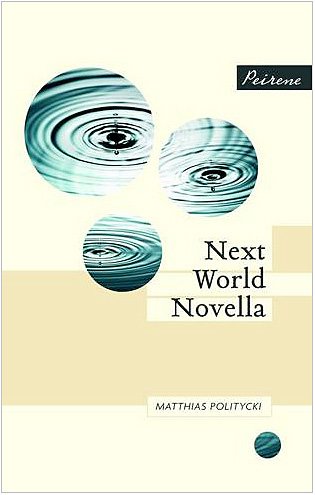
Next World Novella 
by Matthias Politycki

My favourite of Peirene's first three releases, Beside The Sea, had an ending that was quite simply devastating. In its own way their first release for this year has a beginning that packs a comparable punch, although presented in a much softer fashion. Hinrich wakes in the morning and comes into his sun-filled room, 'a world of stucco moulding and decorative wallpaper, book-lined walls, chairs with silk covers.' He can spot his wife, Doro's hair above the back of his desk chair and there is something incredibly tender about the way he moves closer to her.

Before he planted a kiss on her neck, stealing up quietly like a man newly in love, a few of the little wooden segments of the parquet creaking slightly, a fly buzzing somewhere (but even that sounded familiar and homely), before he bent over Doro, to the little mole at the base of her throat he knew so well - any minute now she would wake with a start and look askance at him, half indignant, half affectionate...
But before any of those things can happen he catches once again the smell that had hit him on walking in, 'as if Doro had forgotten to change the water for the flowers, as if their stems had begun to rot overnight, filling the air with the sweet-sour aroma of decay.' Only when he is right by her does he realise with a shock that Doro has passed away in the night from an apparent stroke. This is the first of many shocks for him and us and in this novella Politycki uses this rather ingenious set-up to explore weighty topics like marriage and death with a surprising lightness. What dialogue you might wonder is possible between a man and his wife's fresh corpse, but the surprise is not only that there is one but that it contains wit, humour and genuine bite.

Their marriage was founded on a very simple promise. Having met whilst both were studying ancient Chinese texts, Doro an expert on the I Ching and Hinrich a Sinologist, Doro's fascination with what comes after death and her fear of the 'cold, dark lake' that she would have to cross into the next world made Hinrich's daily devotion to her, bringing her tea whilst she worked, and his promise to accompany her on that journey into the afterlife enough to tie herself to him for this life and even to step back from her own promising future in order to support his work. Despite having worked as his editor for many years Hinrich is surprised to see a stack of papers on the desk that morning having not written much since an operation to correct his eyesight. What he finds is the long-abandoned manuscript of his only foray into fiction and this is where things get rather clever for along with the standard editorial corrections Doro seems to have gone beyond her brief.

...soon the marginal notes became more extensive, forthright, cutting. Doro had always been a model of discretion, but now the sharp tone of her comments was unmitigated by lenience, she sparkled with icy elegance.

What begins as a series of corrections becomes 'a second text superimposed on his own', Hinrich's fiction is exposed as little more than thinly veiled autobiography with only the names changed (only to be changed back by Doro) and her editorial comments become the means by which she is able to accuse, cajole and mock her husband as she lies lifeless in the room with him. That's some black humour on display as a man moves from grief to recrimination, sensitively noticing the subtle changes in her appearance one minute and then shouting out accusations at her the next.

Behind his back she had maliciously compiled a reckoning, had left him all her resentment in black and white, and he couldn't even contradict it. Oh no? He'd see if he couldn't!

We read the text of his story along with him, with Doro's corrections mentioned too. This is similar to the reading experience of Tony and Susan by Austin Wright although Polyticki uses the shifts between Hinrich's real-life fascination with a waitress and its fictional counterpart to blur further the distinction between fact and fiction. We'd do well to remind ourselves of the hard-to-rationalise I Ching once more, for in the same way that that text and its symbols are open to interpretation rather than clearly representing single concepts, so too can partners in a marriage fail to fully understand the actions and motivations of those closest to them. Hinrich's eye-operation quite literally alters his view of the world and gives him all the encouragement he needs to forestall his progress towards old-age and death by having another go at acting like a young man with a woman he is ill-suited to. He will be surprised even further as he reads through his palimpsest-like manuscript and discovers just how much his new-found sight blinded him to what was happening around him.

If Doro's text is a note of farewell then Hinrich's reading of it is a chance to move on from recrimination to remorse.

Being dead, he thought, means first and foremost that you can't apologise, can't forgive and be reconciled, there's nothing left to be forgiven, only to be forgotten. Or rather there's nothing to be forgotten, only forgiven.
This tone is perhaps the reason for the novella's coda, something that I'm still a little unsure about and can't really discuss until you've read it so please don't hesitate: Peirene have brought another compelling narrative into English that demands to be read and talked about. I've got the ball rolling, it's time for you to add your own notes...

Read more...

Thursday, 17 February 2011

'the dictates of my heart'


The Last Brother 
by Nathacha Appanah
Translated by Geoffrey Strachan

On 26 December 1940 a ship landed at Port Louis, Mauritius with 1,500 Jews on board. Having fled from the scourge of Nazism this collection of Austrians, Poles and Czechs were denied the sanctuary they sought in Palestine due to incomplete paperwork and deported to Mauritius to be interred in the prison at Beau-Bassin. During four years of exile there 127 of them died.

From this shameful and little-known piece of history Appanah has spun a tale of one boy's childhood forever altered and of another boy's childhood ended. One boy called Raj, the other David, both from different cultures with different languages, thrown together by history and events that force them out of childhood into 'the terrible world of men.' Sixty years after that boat landed the elder Raj is disturbed by a dream in which he is visited once again by David. He wakes with a determination to make the journey he has avoided all his life, to the cemetery in Saint-Martin.

During the early years, when the memory of David never left me for a moment, I was too young to come here and face this. Later on, I would set myself dates for coming here - my birthday, the anniversary of his death, the New Year, Christmas, but I never came. It looks as if I lacked the courage to do so and, if the truth be told, I thought I should never manage it.
It proves to be as hard a visit as he had always feared, bringing him face to face not only with the few days he spent with David but the hardships of his childhood as a whole. Living in a basic camp at first this is the world where 'father's work from dawn till dusk, came home drunk and bullied their families.' Raj is the middle brother between Anil and Vinod, always the most protected of the three. His mother is a woman who always quietly worked away, skilled with her knowledge of plants and seeds, always making concoctions. His father is the scourge of the family but Raj's memories of the drunken violence meted out are stained by the guilt he feels at his own failure to fight back or protect his mother. Guilt continues throughout the book as a major theme, and it is a survivor's guilt for Raj is the only brother to survive a tropical storm in which flash floods sweep Anil and Vinod away. Memory is also skewed by the act itself and this next extract describes not only that haze that obscures the view but also the competing narrative voices employed in this book.

Am I now inventing the smile on my father's face. Am I inventing his eyes, suddenly so alive, so cruel? And if I say that he took pleasure in acting thus, is it my old man's voice or my little boy's memory dictating this to me?
The voice does switch and for me, with my innate antipathy towards child narrators, it's a little too heavily inclined towards the child. What Appanah does bring to her prose is a light poetic feel, words and phrases are repeated so that there is a lyrical quality to the writing. About halfway through the book it occured to me that the effect of this was to make it feel like the written down version of aural storytelling so imagine my joy (and smugness) when at the end of recounting the past to himself Raj determines that he is now ready to tell the story to his son.

It is after the devastating loss of that storm that Raj's father moves the family and begins work as a guard in the prison at Beau-Bassin. Here Raj has his first experience of anyone from outside the island community and his first sighting of the boy David.
I cannot remember the precise moment when I noticed David. Perhaps it was when he walked towards the barbed wire. What I saw first was his hair, that magnificent mop of it, which floated around his head but which was certainly his and his alone, in a way that nothing has ever belonged to me, those curls hiding his brow, and his way of advancing stiffly, not limping, for all the world as if he were made of wood and iron and his machinery had not been oiled for quite some while.
Safely hidden in the shade of a bush Raj observes these prisoners and David in particular, his golden hair almost miraculous, the two boys share a confidence outside language and when another storm loosens some of the fencing around the prison Raj liberates his new friend, a surrogate brother.
I was full of hope, I wanted a brother, two brothers, a family as before, games as before, I wanted to be protected as before, I wanted to catch sight of those shadows out of the corner of my eye that let you know you are not alone. I was struggling desperately to resist everything that took me further away from childhood, I rejected death, rejected grief, rejected separation, and David was the answer to everything.
We have always known of course that David isn't going to survive and that theme of guilt continues again as Raj comes to terms with the fact that he 'did not want to get David out of the prison because he was unhappy, no, I wanted to get him out because I was unhappy.' Which makes for a curious kind of book. I haven't read The Boy With Striped Pajamas, with which this book bears obvious comparison, but I presume that the appeal of these stories lies in friendship across a divide, something that transcends the brutal and inevitable end brought about by the persecution of at least one of the characters. The slightly odd thing here is that Raj is in effect the cause of David's real suffering and death. It is an extraordinarily brave book that depicts so ruthlessly the selfishness of children when they aren't aware of the possible consequences of their actions. What kind of a reading experience that becomes will depend on you.

Read more...

Tuesday, 15 February 2011

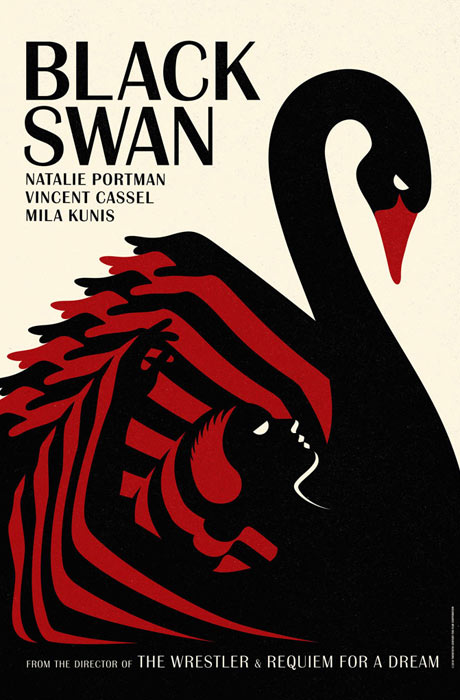
Black Swan


I had the craziest dream last night. About a girl who was turned into a swan. She needs love to break the spell, but her prince falls for the wrong girl and she kills herself.

I had been looking forward to watching this film ever since first hearing about the premise. The professional dance training in my past and connection to the world of ballet combined with my admiration for the films of Aronofsky and his last one, The Wrestler, in particular meant that my usual impatience was magnified as the release date approached. As it happened I ended up watching it around Valentine's Day, continuing my rather twisted take on romance (The first gift I gave my now wife was a copy of Angels by Denis Johnson in which a man and woman meet on a Greyhound bus and both end up in various forms of incarceration) and was pleased that the film managed to survive my high expectations and some of the criticism that has been levelled at it recently. It is by no means a perfect film, and certainly not to all tastes. A bit like going to watch classical ballet itself, if you don't get it then it's going to be a very weird evening, if you can understand the language and go with it then it can be a transcendent pleasure. The film is modelled on Swan Lake itself which is why I've included the quote above. A young dancer perfectly suited to the role of the virginal White Swan has to find within her the sensuality and darkness required to play her evil twin, the Black Swan. Precision and restraint get in the way of passion and her obsessive focus begins to alter her perception of those around her.

Let us be clear first: this is NOT a film about ballet. The recent newspaper articles that packed professional dancers off to the cinema in order to provide their opinion on the veracity of the world depicted and the ballet technique of Natalie Portman were so misguided it isn't even funny. This is a film about madness and obsession, a companion piece to The Wrestler which featured a character similarly incapable of moving away from the world to which he had dedicated himself (and in particular, his body); it is a horror film rather than a realistic depiction of the backbiting and ambition of the American ballet scene. That said, Aronofsky shows in some telling detail the physicality of dance. The shots of pointe-shoes being broken down and customised, the bone-crunching and clicking as dancers adopt these unnatural positions, the sweat, the heavy breathing, the broken toenails, the hard skin; all brilliantly observed and true.

 Natalie Portman has been hailed by some for the training she underwent to portray a ballet dancer (beginning a year before filming) and vilified by others for not being convincingly up to scratch. If that's how you're watching the film then I'm afraid you're missing so much but let me say as someone who trained professionally but hasn't danced in a long while (a bit like Portman) that I couldn't hope to come within a country mile of what she achieves in this film. Her body is starved down to that level that allows you to see the individual muscles moving in her back as she moves her arms up and down and her nervous and frail demeanor is visible in minute detail on her face where tiny muscle twitches and tics express so much. She dances convincingly but more importantly gives a performance of such dedication and commitment that it blows the theory that the role should have been given to a dancer who could act out of the water. Most of the actresses in Hollywood couldn't hope to match Portman here let alone the dancer/actresses.

There is excellent support from Vincent Cassel as the exploitative choreographer and Barbara Hershey as the domineering and bitter mother. Mila Kunis is sultry in her role as the competition and the only bum piece of casting comes in the form of Winona Ryder who has always been beautiful, never been able to act and couldn't convince anyone that she is, was or ever could be a ballet soloist. Aronofsky's handheld camera floats continuously, miraculously avoiding its reflection in the many mirrors and keeping close scrutiny on the actors helping to build the tension as it closes in or Portman particularly. The film is underscored brilliantly by music developed from Tschiakovsky and a sound design that heightens breathing and the sounds of the swan to chilling effect. You might criticise the film for being too insular, perhaps a little repetitive, I wondered whether it might have been a little shorter or even had the bulk of the dialogue stripped away, making it even closer to the ballet from which it is inspired. The overall tone is so heightened that there are even moments that make you want to laugh. We're not used to this tone in film making and certainly weren't prepared for it by The Wrestler but both films however different their styles are driven by the same theme of obsession, something of a unifying theme in Aronofsky's work. Where will it take him, and us, next?

Read more...

Tuesday, 8 February 2011

'the theatre of the world'


Atlas Of Remote Islands
by Judith Schalansky
translated by Christine Lo


I think I came across this book after seeing a photo posted on Twitter somewhere and a quick search for details about it had my fingers itching to order a copy. How do you resist a book named as the Most Beautiful German Book of 2009? I bought a copy first as a Christmas gift for my dad but then couldn't relax with it sat on the shelf and had to get one for myself too (The punchline is that when I visited him to hand over my gift I saw a copy of the atlas on his desk and will now have to think of some other masterpiece to give him - and a worthy recipient of this excess gift). It is a beautiful object; the boards the same duck-egg blue of the ocean on the maps inside, a spine of black cloth with the title and author picked out in bright white, the pages are edged in bright orange and this simple colour scheme is maintained throughout the book with highlighted words in that same bright orange and the beautiful maps, each specially created by Schalansky herself, using that same highlight to point out the infrequent signs of habitation, roadway or settlement on these remote and barren islands.

Born on the 'wrong side' of the Berlin Wall, Schalansky was fascinated by her atlas as a child, the only means by which she could travel beyond the closed borders of her homeland. At that young age she was unaware of the way in which an atlas is a political object, each committed to its own ideology. Her own placed the two halves of Germany on opposing pages so that 'there was no wall dividing the two German countries, no Iron Curtain; instead, there was the blinding white, impassable edge of the page.' In her fascinating preface, printed in large type like an early reference book, Schalansky enlarges on her theme of map-making, the means by which the empires of the past were established and maintained, for 'Only when a place has been precisely located and measured can it be actual and real. Every map is the result and the exercise of colonial violence.'

Many of the 50 islands made real in this atlas are the property of nations that lie several thousand miles away, most are barren and uninhabited but Schalansky uses the page that faces each of her maps to tell a tale about them. I say tale but the exact definition of the factual text is far more slippery.

That's why the question whether these stories are 'true' is misleading. All text in the book is based on extensive research and every detail stems from factual sources. I have not invented anything. However I was the discoverer of the sources, researching them through ancient and rare books and I have transformed the texts and appropriated them as sailors appropriate the lands they discover.
I was reminded of another gorgeous production, A C Tillyer's An A-Z Of Possible Worlds, which created 26 narratives that shared a similar mixture of fact and fantasy. Both read a little like a collection of very short stories and it is hard not to race through them. I had to fight my instincts and try and give this book a bit of time as I was reading it, time to let each island make its mark, appreciate the artistic value of each page and only then make the journey of several thousand miles to the next island through the simple act of turning the page.

Several things are achieved with this kind of 'narrative'. There is a lovely historical reading as each page has a timeline with marks showing the year of discovery and various noteworthy events. One thing this does, a little like that idea of a single day representing the history of our planet and the first human civilisations arriving at less than a second to midnight, is to point out how small a portion of each island's history these events fill. This is no more apposite than on the page for St Helena, found in the middle of the Atlantic ocean almost 2000 km from Angola and site of Napoleon's exile from 1815 until his death in 1821. The diminutive Emperor 'had always failed with islands. Not one battle at sea had he won. Perfidious Albion!" and the timeline shows that his impact on this island was similarly shortlived. Even the text picks up after his death as the frigate arrives to collect his body to return it to France, a somehow poignant end to the humbled conqueror.


As a citizen of the UK there a plenty of hotspots that jump out; just the name of Pitcairn Island throws up the mutiny that preceded its settlement and the scandal of the recent rape trial that exposed how an island's very remoteness had allowed the generations that descended from those mutineers to install a culture of sexual assault. On a more political note we can travel to Diego Garcia in the Indian Ocean almost 2000 km from India itself, a military base for the UK, the atoll itself taking 'the form of two fingers spread in a crooked V, a victory sign in the Indian Ocean. But victory for whom?' Presumably not the five hundred Chagossian families forcibly deported and frustrated in the British courts in their fight for the right to return to their homeland.

Some islands are just plain fascinating like Pingelap in the Pacific Ocean, an island devastated by a typhoon at the end of the 18th century that left just twenty inhabitants behind to maintain a community, one of whom carried the recessive gene for colour-blindness. As a result 10% of today's population carry the same affliction (compared to 1 in 30,000 elsewhere) and as might be expected there are plenty of stories about the special powers this alteration of the senses might have lent them.

One thing you can't avoid is the topic of ecology. First of all we can wonder, as Darwin did, at the miracle of some of these islands very existence. He visited South Keeling Island in the Indian Ocean in 1836. There he discovered new species of plants 'all descendants of the stray seeds the sea has carried here' and we learn the process by which the island itself was created. The cone of a sunken volcano covered in coral which goes through cycles of life and death, leaving behind its limestone skeleton.

'Slowly, an island grew out of the limestone, the tireless work of the coral - builder and material alike. Every atoll stands as a monument to an island that has gone under, a miracle greater than the pyramids, solely created by these tiny, delicate creatures.'

Impressed by his visit Darwin would later come to the conclusion: 'the tree of life should perhaps be called the coral of life'. But the fragility of these atolls is made stark and clear when we visit Takuu in the Pacific Ocean, another atoll but this one threatened by shifting tectonic plates and the changing climate, rising sea levels 'gobbling up' more and more of the land. The older generation fight to save it with dykes and prayers whilst the youngsters avoid thinking about it at all by drinking themselves into apathy on the fermented juice of the coconut palm that they collect in plastic bottles. The hopeless prognosis: 'Takuu will sink - next month, next year.'

Suddenly the atlas becomes a historical document not just of shifting politics and ideologies but possibly of the very existence of some of these islands, giving pause for thought, something I recommend again whilst reading this gem of a book. It is hard to refute Schalansky's claim below, made in her preface. A book which is both fact, fiction, art and reference certainly deserves to take its place amongst the most original reads of recent memory.

It is high time for cartography to take its place among the arts, and for the atlas to be recognized as literature, for it is more worthy of its original name: theatrum orbis terrarum, the theatre of the world.

Read more...

  © Blogger templates The Professional Template by Ourblogtemplates.com 2008

Back to TOP