Random

Tuesday, 25 October 2011

'words are suitcases with false bottoms'


Death Of The Adversary
by Hans Keilson

When reviewing Keilson's other novel, Comedy In A Minor Key, I was quick to quote a review he received from Francine Prose in The New York Times. I'm going to do it again because it's funny as well as accurate.

For busy, harried or distractable readers who have the time and energy only to skim the opening paragraph of a review, I’ll say this as quickly and clearly as possible: “The Death of the Adversary” and “Comedy in a Minor Key” are masterpieces, and Hans Keilson is a genius.

Are we clear? Keilson's fiction may only extend to these two novels but they are both brilliant and if you thought I was impressed by the first one then this novel is the kind of book that makes you want to use words like seminal, definitive and, yes, masterpiece. In fact coming on the back of two other novels set in the Germany and Europe of the 1930's it highlighted all the more the difference between a novel that tells a good story and a novel that is a work of art. With the passage of time one can only hope that whilst there is plenty to enjoy in the former it is the latter that deserve to and simply must survive, for their loss or under-appreciation would impoverish us all.

The most obvious quality that marks this book out as a classic is its rejection of narrative specificity. There is a plot I suppose but as one fellow blogger once commented 'plots are for gardeners' and whilst it is clear that this is Germany in the 1930's and the adversary of the title is Adolf Hitler, neither of them is ever named and the novel therefore retains its power to apply to any time or place where one group  victimises another because of difference. Our narrator explains at the outset that what we are about to read is a manuscript given to him by a Dutch lawyer, obtained along with other important documents from a German client who gave them away for safe-keeping. This lawyer has asked our narrator to have a look over them and so we too read the account of this man's symbiotic relationship with the leader who oppresses, degrades and eventually controls his life. The leader is only ever named as 'B.' but is also commonly referred to as 'my adversary', the 'author' remains anonymous and the identity of his people never explicitly named. The manuscript provides an extraordinarily insightful psychological account that suggests the relationship between Hitler and the Jews, and therefore that between any dictator and his chosen enemy, is tantamount to that of lovers for 'No lover can talk more possessively of the object of his love than he did of me, even though he was cursing me.'

We find him at first almost paralysed by this proximity, fixated to the point of obsession on his adversary's death.

It was the thought of my enemy's death which penetrated me and made me shudder as one does on an icy night. The death of my enemy - I think of it with all the joy a thought can have for those to whom a thought is something vital and alive. The death of my enemy - I think and experience it with all the gravity and sublimity which is due to the thought of an enemy who is worthy of one. At every moment of the day, part of my mind is dedicated to this thought...The death of my enemy - blessed be the thought of my enemy's death. People say that one should approach one's death with longing...But I have seen many who had slowly and painfully accustomed themselves to their own death, and were then destroyed by the death of a friend.

That last line is typical of the kind statement made from experience (Keilson was a German-born Jew who went into hiding, lost both parents in Auschwitz and then went on to become a psychoanalyst famous for his work dealing with trauma brought about through war and with orphaned children in particular), lines that immediately ring true and hit you squarely in the solar plexus with their insight. Maybe Keilson's own work with children informs the sections that deal with the author's childhood, a period where he felt the beginnings of his definitive relationship forming as he was ostracised at school, subjected to rougher treatment on the sports field, made to feel different to his classmates.

So I became more intimately acquainted with him through the insults and injuries of those who called themselves his friends, behind whom he stood, invisible, unknown... He taught me about loneliness, its pain and despair, and only later about its strength. But he himself remained motionless in the distance in which he had placed himself from the beginning, I would have had to aim at a shadow had I aimed at him.

As any child might collect pictures of their heroes and sweethearts the author finds himself scouring magazines for pictures of his adversary for him to study, 'Unblinkingly I stared into this mirror, until I believed that I could recognise there my own image.' As an actor I find that I have to find a way into any character I play. This can be particularly challenging when playing someone who might be easily dismissed as evil. You can't play 'evil' (well you can, it's just not very interesting) you need to find something to explain the humanity behind acts of cruelty and in his own way the author does the same thing with his adversary in his efforts to understand him. A friend makes the point that 'one could deduce from your efforts to think yourself into his mind and to search out and understand his motives that you are not insensible of a certain feeling of sympathy.' Some writers when suggesting that a Jew might sympathise with Hitler would find themselves in very dangerous territory but it is typical of Keilson's sensitivity and subtlety that it never feels sensational or forced. He goes even further into that dangerous territory when he questions the unity of the oppressed people. Apart from the obvious betrayal of those who collaborated I think we often accept that the Jewish people stood united in the face of their destruction but the author's personal approach even forms a barrier between him and others like him so that he resists the community of persecution.

'There is a community that is profounder than that of true believers and greater than that of party members...That of adversaries. The community of those who, in life and death, are indissolubly bound together in their struggle...'

But looking at his people as a group the author is told a fable-like tale that illustrates their plight and his central thesis. Germany's Kaiser was gifted a herd of elk by his cousin, the Czar of Russia. Despite placing them in an area that replicated the habitat they were used to he received, after some time, reports of their gradual deaths. Distressed, he sends for help from his cousin who sends an expert who confirms that everything that could be done for them is being done. Why then have they died out? "They are missing one thing," said the forester. "Wolves." Could it be that without their natural predator the elk had lost their will to survive, might even have died of grief for them? It is no wonder that such a dangerous idea sends our author off into a spiral of doubt and isolation.

Despite the lack of narrative specificity I mentioned earlier there are some very clear moments of drama and acutely personal reaction. In his pursuit of a girl our author finds himself in a flat which is soon filled with her brother and some of his friends. They, it transpires, are all sided with his enemy and one of them, a new young recruit, recounts his evening spent desecrating a cemetery. The horror of the situation is what comes to the fore rather than the horror of the act of violence (which is almost comical in its ineptitude, recalling the bitter tang of the comedy in Keilson's other novel Comedy In A Minor Key) and this extended chapter is a masterpiece of internal monologue as the author struggles with his own identity within this potentially dangerous group.

Keilson also offers a brilliant deconstruction of Hitler's oratorial style and technique in a scene that not only places our author in the same room as his adversary, wrestling with the desire to kill him there and then, but also shows just how symbiotic their relationship is. B. begins with the pronouncement of a few home truths that everyone must agree with and though no one had disagreed 'he behaved as though this nobody were present and had hidden himself somewhere in the hall.' Then come the daring truths, 'which one had to think over for a while, since they did not really make sense at first sight. But no doubt they contained a grain of truth'

Again he gave the appearance of carrying on an argument with the aforementioned nobody. He raised him to the rank of his adversary and began a duel with him before the eyes of everyone in the hall. What a performance!...He attacked, he accused, he ridiculed, tore down, hit out wildly left and right, refuted arguments nobody had put forward, and upset himself terribly. The other one had no one any more to speak for him. He, who had never existed, had been killed by the voice, and since he was silent, everyone assumed that he was dead.
Helplessly I sat in the lounge. I was the nobody in the hall, I was listening to my own extermination.

I've fallen into the trap of quoting huge chunks of this book with little more than a exhortation from me for you to just go out and buy the damn thing but it's that kind of book. If you were here with me I'd simply place the rather gorgeous hardback in your hand and send you off but in the year in which Keilson passed away at the age of 101 I can only ask you to make that short journey to bookshop, library or keyboard and order yourself a copy. It is a genuine classic because it speaks now of a specific tyranny but will continue to sound out in the future about the complexities and humanity of even the most evil kinds of interaction; something that may be difficult for us to read, but also crucial.

Read more...

Thursday, 20 October 2011

'if a picture paints a thousand words...'


Wonderstruck 
by Brian Selznick

Selznick's debut book made a huge impact (as the blurb on my Advance Reader's copy is keen to make clear) winning The Caldecott Medal, making it as a finalist in America's National Book Award and earning that all important No. 1 New York Times Bestseller position. I loved it too and we will all soon be able to see the film version as directed by Martin Scorsese (although judging by that trailer I'd give the film a miss and just get a copy of the rather lovely book) but after all that success you always wonder what an author, and illustrator, will do next. Selznick's new book tells two stories; one with words, one with pictures, the two eventually combining as the plots merge. Selznick may have dazzled with his artwork but does he have the prose to match it when the two are placed side by side?

The story begins with pictures, a pair of wolves run towards us, Selznick's 'camera-eye' zooming in up close to their eyes. After those few pages of pictures we are then in Gunflint Lake, Minnesota in the summer of 1977 and the written story of Ben Wilson. He awakes after a recurring dream where he is being chased by wolves. Ben was born deaf in one ear, has never known who his father was, and now lives with his aunt and uncle after the death of his mother. On a stormy night he finds a blue book amongst her possessions, a history of museums entitled Wonderstruck, with a dedication and a bookmark that suddenly provides what he thinks might be clues to his father's identity. This discovery will set him off on a journey of discovery but not before the power of the storm around him alters the way he will experience the world outside.

The pictures then transport us to Hoboken, New Jersey in 1927 and the story of Rose, a deaf girl who lives separated from her film-star mother virtually imprisoned by her strict father. Being deaf we experience the world just as she does through Selznick's black-and-white drawings as she makes her escape to New York City and the American Museum of Natural History.


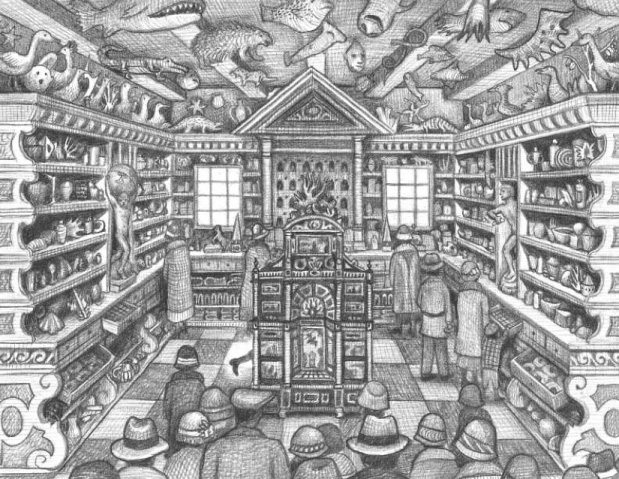
I have included a couple of examples of Selznick's artwork just to give an idea of his lovely cross-hatched pencil drawings. His technique of zooming in close on facial features and details gives the book a very cinematic feel, something that ties in rather nicely with the era of silent film they evoke. It has to be said that those pictures that do take us in close are much better than the wider shots where the lack of facial detail actually makes Rose look completely different to the girl we know in close-up.


So how well do text and picture marry? Well, Selznick's prose is adequate but never leaves the reader wonderstruck, and although he has worked hard to link the different sections, so that as a door opens in one it can literally open in the other too, there is a curious rhythm to the reading experience as pages fly by in Rose's story and then plod along when we get back to Ben. When their stories merge and pictures and words begin to follow the same narrative the effect is actually to take away from the artwork which becomes merely illustrative of things we are reading about rather than the narrative itself, and this too at a point where the narrative is all about the revealing of past story.

So this book is a bit of a disappointment after Hugo Cabret, an easy-read and even an interesting one, especially after having read Selznick's acknowledgements at the back where he details what he discovered about deaf culture, the advent of talking movies and The American Museum of Natural History amongst other things, but nowhere nearly as impressive as the monochrome magic of his debut. To answer the question raised by the heading of this post; if a picture paints a thousand words then why write words at all?

Read more...

Tuesday, 18 October 2011

'a vessel of memory'


All That I Am
by Anna Funder

Following on from her acclaimed non-fiction debut, Stasiland, Funder's first novel has its roots firmly in fact, fictionalising the lives of real people, a group who provided resistance to the rise of Hitler's Nazi party in Germany, including Ernst Toller, Dora Fabian and Funder's own friend Ruth Blatt. Blatt spent the latter part of her life in Sydney, Australia where Funder lived and it is from here that she narrates her tale nearing the end of her life. There is something wonderfully genuine about the descriptions of Blatt in old age, a mixture of belligerence, that causes her for example to make the most of her full name, Dr Ruth Becker ('Ten years ago I decided I didn't like being treated like an old woman, so I resumed full and fierce use of the honorific'), and fragility ('I lift the fork carefully from plate to mouth, a distance which has increased with age and is now full of treacherous possibility'). She is set on the course of remembrance by the arrival of a copy of Ernst Toller's 'shamefully self-aggrandising' autobiography, I Was A German, with sheets of amendments thrust between its pages, these giving life to the one person he had excised from this official account, his lover Dora Fabian.

In his presence, and hers, I am returned to my core self. All my wry defences, my hard-won caustic shell, are as nothing. I was once so open to the world it hurts.

And so Ruth becomes 'a vessel of memory in a world of forgetting', there is something almost hallucinatory about the way in which her failing body and mind drag up these memories from the past in an attempt to piece together one more time what happened to her circle of friends in 1930's Europe.

'...occasionally, as on the edge of sleep, an obscure memory pops up, like a slide in a carousel. My friends and the other people slip off it and into the room, they breathe and fidget and open their mouths.'

Ruth isn't our only narrator however. Her sections alternate with those titled 'Toller' where we are holed up with the playwright in the Mayflower Hotel, New York in 1939, the time and place of his suicide. Before taking his life he is, with the help of a woman named Clara, making the revisions to 'the deceit of words' that Ruth will read several decades later.There are hints at the black depression from which he is suffering when he remembers his wife for example.

When I think of Christiane I feel the blackness coming; my nostrils fill with a stink which is not human but is not sulphur. It is burnt flesh, as in the trenches. I look to the bathroom and this time I catch the last dirty feathers scraping back under the door, dropping filth in their wake.
His worry that those black wings will 'foul this city' keep him confined to his room until he has finished his work. After that he knows that he will have to stop them.

With these alternating perspectives we learn of the group of friends who inhabited the left wing of German politics as Hitler's National Socialists slowly assumed total power. Blatt and her husband, journalist Hans Wesemann, Toller, Fabian and others provide eloquent opposition with the written word until the thuggishness of the Nazi's proves that action speaks louder than words. The Reichstag fire forces them towards exile in London from where they attempt to continue their acts of resistance, using all their available contacts to draw information out from behind the facade of propaganda, even staging their own trial in London to run alongside the show-trial in Germany that found the communist Van der Lubbe guilty and executed him. The threat of violence is ever present, the Gestapo managing to extend their fearful grasp to London itself, and with fears of betrayal also rearing their head the pressures brought to bear on this group of friends and lovers, who had always hoped to live their lives with an open heart and to extend that freedom to each other, reach a feverish pitch.

So with all of this fascinating factual material (there is intrigue, espionage, betrayal, murder, all the ingredients of a political thriller) why has Funder decided to fictionalise her account rather than follow the success of her non-fiction with another factual account. I'm not sure to be honest. Maybe I was looking out for it but there are the odd moments when the research is rather baldly presented and often when it isn't necessary. We can all surely understand hyper-inflation without Ruth explaining that she 'knew hyperinflation was caused by the government simply printing more currency to pay off its war debt, but it was still a shock to see the money worthless in front of me, dipping and tugging at the air.' This isn't always the case however and there are several moments where a well-chosen nugget has the power of documentary evidence to really hit home. We might feel that we already get the violence and cruelty of Hitler's police but sometimes you need a specific example.

When they found eight communists hiding in a cellar in Mitte they simply boarded it up. People walking to work heard their calls from the vent at pavement level but no one dared help. It took two weeks for all the cries to stop.

By focusing on this group of friends, comrades and lovers Funder shows how fear and the instinct towards survival combine to battle against principles and loyalty. The question we often ask about that period of history is how the German people could have allowed and even supported the Nazi project over that decade of systematic killing. Books like Alone In Berlin and Half Blood Blues have provided some interesting angles from which to view Germany from the inside and whilst I might quibble as to whether All That I Am finally succeeds as a work of fiction rather than non-fiction, it does make clear the volatility of regime that could change its mind in an instant. With that kind of an enemy, as it proved, it is almost safer to keep them as an enemy rather than to try and bring them in closer.

It is a mystery to me that people can believe they are being made safer when events clearly show that it is no safer to be a friend than an enemy, and that you might be switched from one column to the other on a whim.

Read more...

Thursday, 13 October 2011

'He deserves it.'


The Death Ray
by Daniel Clowes

The Clowes titles are coming thick and fast from Jonathan Cape recently. After the mental brilliance of Wilson I was satisfied if not blown away by Mister Wonderful. The latter's letter-box format perfectly suited its strip-form genesis but this latest publication (originally published in Clowes' Eightball comic book series - #23) is a gigantic, souped-up hardcover. Does this, and the striking cover, mean that Clowes has written some kind of super-hero comic? Don't you believe it. It may well be some kind of super-hero story but it's a very Clowesian one and anyone who's read any of his work will have an inkling of what that means.


We first meet Andy in 2004 and in the opening two pages he seems like another anti-hero to add to Clowes' stock. Married twice, divorced twice, devoted friend to an eighteen year-old dog called Dianne, Andy's altercation with a litter-dropping pedestrian is much like the first panels of Wilson; personal responsibility is raised immediately as a theme and Andy admits that his attempts to do what's right have become harder than ever of late - 'How the hell does one man stand a chance against four billion assholes?'

We then zoom back to Andy's adolescence in the 1970's for what all super-hero stories require in a spread entitled 'The Origin Of Andy.' Both parents having died he now lives with his 'Pappy' and apart from best-friend Louie is a bit of a nobody in most people's eyes, getting most attention from school bully Stoob. His girlfriend is miles away, he fantasises about his grandfather's carer, Dinah and at 17 he's yet to even sample his first cigarette. And that proves to be the catalyst to his transformation. There are plenty of people who've thrown up after their first cigarette but I'm sure none went on to develop super strength. Pappy hands over a package from his father (a famous scientist) that explains about the experimental growth hormone that he was injected with, activated by nicotine, and also mentions the existence of the death ray.

Together Andy and Louie struggle to work out what to do with this new found power, activated whenever Andy smokes, but their concerns remain pretty small. Saving the world is further down the list than revenge on bullies and getting a girl but through their various bungled attempts we begin to see Andy wrestling with the responsibility that comes with holding the death ray, a gun that only Andy can operate that makes its target disappear in an instant. Louie is a kind of side-kick, there to keep him 'honest' but when only one of a duo has any powers there is bound to be conflict somewhere down the line.

Reading this review you may already have found yourself thinking about some of the classic comics of the past with their orphaned heroes, raised by elderly parents or relatives and even more so of the alternative vision of vigilanteism in Kick-Ass. Does this book aim to pay homage or mock, subvert or simply hijack the super-hero mythology in order to combine it with Clowes recurring themes of inadequacy, bitterness and failure in the face of stupid and cruel world? Whatever the answer to that question I'm afraid there is something deflating about it as a read, particularly when held up against the biting humour of Wilson. It's been diminishing returns with these releases I'm afraid so I can only hope that Clowes' next piece of new material is a return to form. The franchise could do with a re-boot.

Read more...

Wednesday, 12 October 2011

Catch-22

To celebrate the 50th anniversary of Joseph Heller's Catch-22 Random House commissioned an animated video from illustrator Ian Higginbotham with audio excerpts from the book read by. . . erm, me!

Catch-22 50th Anniversary Animation from Ian Higginbotham on Vimeo.

Read more...

  © Blogger templates The Professional Template by Ourblogtemplates.com 2008

Back to TOP