


'Who said there were no surprises left in life?'
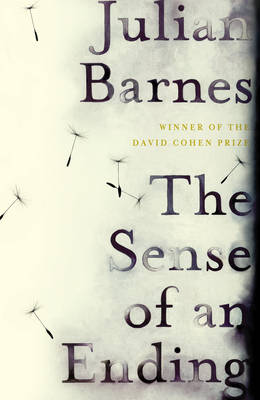
The Sense Of An Ending
by Julian Barnes
Each year there is often a fervour amongst book bloggers to try and get ahead of the Booker game and guess what books might make the longlist, then to read read the entire longlist (or shortlist if you're a wuss) so that you can pick your winner before the panel of judges. I've never fancied a Bookerthon myself, mainly because it seems, in spite of the seemingly wide variety of books that can appear on the list, an unnecessary narrowing of one's reading for a good portion of the year. I happened to read a few by chance and yet weirdly the one I probably should have read, based on having enjoyed his writing before and its eminently digestible size, was one that I didn't get around to until after it had already won the prize. It was seen by some as the only winner capable of mollifying the critics who had picked up on the rather unfortunate phrases used by the judges at various points in the process. As someone who was disappointed in varous ways by the books I read before the announcement I can say now that the eventual winner has its own failings but is a book we can be happy to see brought to more readers, and welcome recognition for a writer who deserves plenty of praise (although maybe for other books......discuss!)
The first thing to enjoy about this book is the feeling of calm and comfort that comes from reading the work of a well established writer (actually the first thing to enjoy is the delicious muted cover design, the dark edged pages...). No tricks or gimmicks, plenty of mature observation and detail, sentences and paragraphs filled with insight that make you want to stop for a moment to savour their import. This short novel wastes no time in introducing its major theme of memory, the opening sentence 'I remember, in no particular order:' followed by six images of relative normality, all of which will be illuminated in the pages that follow. That too is another joy, the way in which Barnes can take an image and make it mean so much more by adding to it experience and loss. Each memory as it is reclaimed and re-examined only highlights the way in which loss and remembrance go hand in hand, for 'Memory is what we thought we'd forgotten."
Our narrator Tony Webster has reached the point in his life where the stasis he always aspired to has been reached. A career ended in retirement, a marriage ended in amicable divorce - 'I had wanted life not to bother me too much, and had succeeded – and how pitiful that was.' Then comes a letter from solicitors dealing with the estate of his childhood friend Adrian, informing him that Adrian's diary has been left to him, although it is currently in the possession of another figure from his past, ex-girlfriend Veronica. The reappearance of these names from the past is nothing less than an exhumation, literally in the case of Adrian who committed suicide, and metaphorically in the case of Veronica who left Tony so hurt he decided to practically erase her from his life (the scant details he passed on about her to his wife have rendered her a caricature - 'The Fruitcake') and whilst this forces him to examine once again his school days and first relationships the diary promises some kind of secret or revelation that may shed light on his whole life. If he can only get a hold of it.
Let's not worry about the plot any more though. As I mentioned in my review of Sebald's Austerlitz there seems to be far more pleasure in the effort to remember than in what is actually remembered. The revelations in this novel, the 'twist' that you may have heard mentioned in other reviews, are probably the parts that I liked least (someone else, who shall remain anonymous, said it was tantamount to the ending of an episode of Eastenders), it is the insight into the idea of remembering, of the narrative we tell ourselves about our life that engages more than the plot itself ('...the longer life goes on, the fewer are those around to challenge our account, to remind us that our life is not our life, merely the story we have told about our life. Told to others, but - mainly - to ourselves.'). Barnes also uses two or three recurring images to great effect in his exploration of time and shows also that the tiniest gesture can have the most profound meaning if we can only see it. As I said earlier, those fleeting images in the first few sentences of the book will all assume a greater significance.
Back in those school days where Tony and his classmates were filled with that confidence that comes with privilege - 'that they had ever been anything like us, and we knew that we grasped life - and truth, and morality, and art - far more clearly than out compromised elders' - he and his two closest friends marked their union in a simple way.
Another detail I remember: the three of us, as a symbol of our bond, used to wear with the face on the inside of our wrist. It was an affectation, of course, but perhaps something more. It made time feel like a personal, even a secret, thing.
This image is typical of Barnes. It resonates immediately as truthful, acknowledges its own pretension straight away and also sets itself up for a payoff later; all in three short sentences. This novel seems to be filled with moments like this. Classroom discussions about who gets to decide what becomes history feedback into the personal relationships we follow. 'History isn't the lies of the victors...It's more the memories of the survivors, most of whom are neither victorious or defeated' but they are presumably damaged and this is a theme that Barnes develops as Tony looks back on his relationship with Veronica.
I certainly believe we all suffer damage, one way or another. How could we not, except in a world of perfect parents, siblings, neighbours, companions? And then there is the question, on which so much depends, of how we react to the damage: whether we admit it or repress it, and how this affects our dealing with others. Some admit the damage, and try to mitigate it; some spend their lives trying to help others who are damaged; and then there are those whose main concern is to avoid further damage to themselves, at whatever cost. And those are the ones who are ruthless, and the ones to be careful of.
Tony's memories of his defining relationship with Veronica are filled with deliciously insightful comments ranging from where she and her family lived - 'in Kent, out on the Orpington line, in one of those suburbs which had stopped concreting over nature at the very last minute, and ever since smugly claimed rural status.' (This is Chislehurst, which is down the road from where I grew up, meaning that the sentence above had me guffawing on the train) - to the ability of a jilted partner to skewer his ex. When Veronica and Adrian partner up after the end of her relationship with Tony he writes a vitriolic letter which will become another of the documents of this novel. But after Adrian's suicide Tony is pithy in his analysis.
The bitch, I thought. If there was one woman in the entire world a man could fall in love with and still think life worth refusing, it was Veronica.
Ow. John Self covers some interesting ground with regard to regretting our harsh words in his own review of this book so I won't say any more on that but return once more to time and memory. Another of Barnes' recurring images is the Severn Bore, a natural tidal surge that sends a sizeable wave the wrong way up the River Severn (follow this link to see some amazing videos of the phenomena). If we look back through our lives, follow the river of our memories, we expect to always see time flowing in one direction. But as Tony is forced to look once again at his life, or the story of his life as told by himself, his very concept of time alters.
I know this much: that there is objective time, but also subjective time, the kind you wear on the inside of your wrist, next to where the pulse lies. And this personal time, which is the true time, is measured in your relationship to memory. So when this strange thing happened - when these new memories suddenly came upon me - it was as if, for that moment, time had been placed in reverse. As if, for that moment, the river ran upstream.
Such are these revelations that some readers may be tempted into their own reversal, turning back to the first page to begin the novel again with a new perspective. Read more...


 Posts
Posts


