The Thousand Autumns Of Jacob De Zoet
by David Mitchell
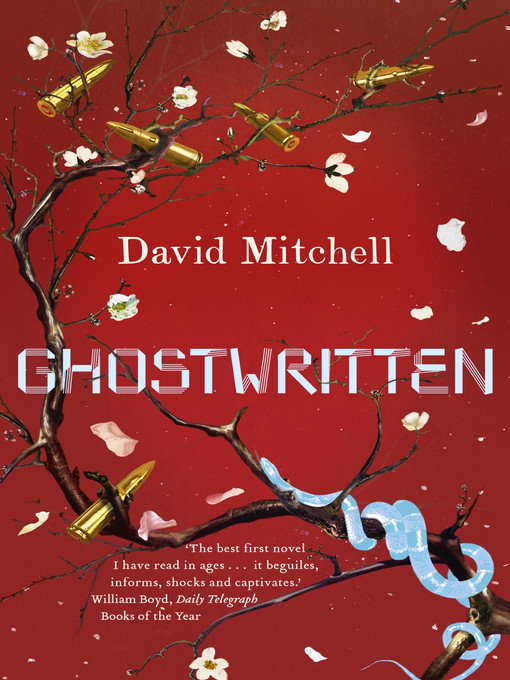
David Mitchell is a writer who attracts an evangelical zeal amongst his fans. He is the chosen one, a writer who manages to combine literary panache with Richard and Judy Book Club appeal. I guess that makes me an agnostic. It's not that I don't believe in him but my first experience of reading him was a paperback of Ghostwritten from a charity shop, a book that failed to light my fire as I was reading some pretty big novels at the time and felt that many connected short stories a great novel did not make. The knowledge that Cloud Atlas had a similar set-up to Ghostwritten just put me off, along with the adulation and awards that attended it's publication.

So I wasn't as excited as everyone else when proofs were circulated of his new novel, although that all changed as soon as it arrived through my door. Whatever prizes may be handed out this year, the award for sexiest proof will definitely go to this baby on the right.
This picture doesn't really do justice to the gold cover and the small text which seems to appear and disappear as you turn the book in the light (and in the same way the picture above it doesn't give an indication of the beauty of the embossed and intricately foiled pictorial boards of the hardback). I have never been asked so many times what I was reading whilst I held this gold brick in my hands at work. It had been glinting at me from a high bookshelf since Christmas and it was only my apathy that kept it there until a few weeks ago when I finally decided the time had come to see whether Mitchell could convert me. I have seen the light. With an epic narrative that runs forward eighteen years from the last year of the 18th century Mitchell has provided me with one of the most unconditionally joyful reads of the year. I know this is the case because when I should have been making notes or marking passages I was too busy turning pages, passing train stations and almost missing entrances on stage. This means that whilst this might not be the most erudite review you'll read of this book it certainly contains a lot of enthusiasm for a big read that flew by effortlessly.
In 1799 Japan is effectively cut off from the rest of the world. During the era of this ruling Shogunate, Christianity in particular is held in contempt, Western civilization and trade shunned for the most part with one small exception being the small man made island of Dejima, a trading post for the Dutch East Indies Company off the coast of Nagasaki.
This tiny umbilicus is the only bridge between East and West with trade strictly regulated and the language barrier exploited by the Japanese to ensure that they are always in control. The Dutch have found their own ways of making a quick buck by cooking the books and carrying out their own private trades on the route home. In order to maintain their empire and the colony of Batavia in particular, the Dutch need Japanese copper more than ever in order to mint the coins that keep the 'native battalions' from melting 'back into the jungle'. The situation has become so rotten that the ship
Shenandoah arrives laden with a new regime to clear out the dead wood, clerk Jacob de Zoet amongst its number. Jacob has travelled to the other side of the world to carve out a career and fortune and make himself a worthier match for Anna, the girl he aims to make his wife back home. But then he meets Orito Aibagawa, a Japanese midwife whom we have already met in a stunning first chapter in which she helps to deliver a difficult birth, a child thought at first to be dead but who then whimpers from under the linen sheet that covers its face and suddenly the 'newborn boiled-pink despot howls at Life.'
After this wondrous act Orito holds a unique position as a female, allowed to study under the tutelage of Dr Marinus, a figure who acts at first as an obstacle to Jacob and his attentions but who later becomes an ally. Their antagonism is brilliantly shown in their opening exchanges culminating in a memorable scene in which Marinus tricks Jacob into volunteering himself as a medical guinea-pig, only to find himself on the receiving end of a 'smoke glister', a kind of enema which sends smoke '"through caverns measureless to man" from anus to oesophagus, whence smoke trickles through his nostrils like incense from a stone dragon, though not, alas, so sweet-scented, given its malodorous voyage...'. The leverage used in his scheme was a meeting with Orito, who has captured the heart of Jacob, taking him even further away from his original plans.
...like a struck tuning fork, Jacob reverberates with the parts and the entirety of Orito, with all the her-ness of her. The promise he gave Anna rubs his conscience like a burr, But Anna, he thinks uneasily, is so far away in miles and in years; and she gave her consent, she as good as gave her consent, and she'd never know... Creation never ceased on the sixth evening, it occurs to the young man. Creation unfolds around us, despite us and through us, at the speed of days and nights, and we like to call it 'Love'.
I don't want to go into too much of the plot; such an epic narrative means I can only spoil by saying much more, but its breadth and the apparent ease with which Mitchell moves from location to location, and idiom, and character, and atmosphere makes the book, for all its literary credentials, read like one of those supremely orchestrated films of myths and legends. There is plotting, intrigue, double-crossing, love, faith, betrayal, hope, sacrifice, imprisonment and escape; there are brilliantly drawn characters, moments of genuine peril and a compulsive need to turn the page and see where he will take us next. Mitchell's coup is to write the kind of book that feels like a guilty pleasure whilst executing the kind of stylistic flourishes that lift it far above that. There are times when the sentences shorten to describe a landscape, becoming like the simple, black brush strokes that typify both the writing and art of Japan. There are times when the effects of opium, or even of love, bend and warp the prose to create a dizzying effect on the reader. And there are times when Mitchell gets the wind beneath his wings and just soars. I am about to lay an almighty extract on you, one I wondered about including, but then I reasoned that if I can be bothered to type it all up then the least you could do is have a little read of it.
Gulls wheel through spokes of sunlight over gracious roofs and dowdy thatch, snatching entrails at the marketplace and escaping over cloistered gardens, spike topped walls and treble-bolted doors. Gulls alight on whitewashed gables, creaking pagodas and dung-ripe stables; circle over towers and cavernous bells and over hidden squares where urns of urine sit by covered wells, watched by mule-drivers, mules and wolf-snouted dogs, ignored by hunch-backed makers of clogs; gather speed up the stoned-in Nakashima River and fly beneath the arches of its bridges, glimpsed form kitchen doors, watched by farmers walking high, stony ridges. Gulls fly through clouds of steam from laundries' vats; over kites unthreading corpses of cats; over scholars glimpsing truth in fragile patterns; over bath-house adulterers, heartbroken slatterns; fishwives dismembering lobsters and crabs; their husbands gutting mackerel on slabs; woodcutters' sons sharpening axes; candle-makers, rolling waxes; flint-eyed officials milking taxes; etiolated lacquerers; mottle-skinned dyers; imprecise soothsayers; unblinking liars; weavers of mats; cutters of rushes; ink-lipped calligraphers dipping brushes; booksellers ruined by unsold books; ladies-in-waiting; tasters; dressers; filching page-boys; runny-nosed cooks; sunless attic nooks where seamstresses prick calloused fingers; limping malingerers; swineherds; swindlers; lip-chewed debtors rich in excuses; heard-it-all creditors tightening nooses; prisoners haunted by happier lives and ageing rakes by other men's wives; skeletal tutors goaded to fits; firemen-turned-looters when occasion permits; tongue-tied witnesses; purchased judges; mothers-in-law nurturing briars and grudges; apothecaries grinding powders with mortars,; palanquins carrying not-yet-wed daughters; silent nuns; nine-year-old whores; the once-were-beautiful gnawed by sores; statues of Jizo anointed with posies; syphilitics sneezing through rotted-off noses; potters; barbers; hawkers of oil; tanners; cutlers; carters of night-soil; gate-keepers; bee-keepers; blacksmiths and drapers; torturers; wet-nurses; perjurers; cut-purses; the newborn; the growing; the strong-willed and pliant; the ailing; the dying; the weak and defiant; over the roof of a painter withdrawn first from the world, then his family, and down into a masterpiece that has, in the end, withdrawn from its creator; and around again, where their flight began, over the balcony of the Room of Last Chrysanthemum, where a puddle from last night's rain is evaporating; a puddle in which Magistrate Shiroyama observes the blurred reflections of gulls wheeling through spokes of sunlight. This world, he thinks, contains just one masterpiece, and that is itself.
It's a list, but one that becomes poetic and lyrical, hopefully carrying you through it without any effort whatsoever and painting a richly detailed picture in the process. It's possible that it's exactly the kind of passage I might have used against him in the past. But I was so taken with this book, so impressed by its scope, style and heart that I'm kicking myself slightly for having left him out in the cold for so long. This is the first really big book of the year to really deliver for me and if anything else comes along to entertain, excite and move me more before the year is out then I shall consider myself a very lucky boy indeed.
Read more...


 Brecht Evens makes the most gorgeous graphic novels. His first, The Wrong Place, had me smiling and admiring at the end of 2011. His latest built on that promise at the end of last year and showcases yet again his glorious watercolour work and fresh approach to graphic storytelling. Watercolour is an odd medium for graphic work, especially in the free-flowing style that Evens employs. Character is often simply delineated by colour or distinguishing features and it is an incredibly effective technique. One character has large hands for example, always dominating his exchanges. 'You should see my Dad's' he says and sure enough when he visits him in his hospital room on the next page what we see are those huge hands waving back. The novel follows an artist, Peterson, as he travels to a small village to work as part of a biennial festival. It's a much smaller operation than he anticipated but what follows is a hilarious exploration of artistic inspiration, expression and shortcomings. Fabulously diverse characters, artwork that leaps off the page and somehow manages to escape it at times, Evens is one to keep watching.
 Roelof Bakker is a photographer who focused on the disused Hornsey Town Hall for one project which ended in an exhibition of photographs entitled Still. Bakker then approached several writers to select an image and then write a story based on it, relocating the image so that it wouldn't be about its original location but more about what that image suggested to the author. The anthology is incredibly diverse, featuring some writers I had heard of and read before like Richard Beard, Nicholas Royle and Evie Wyld. Others were completely new to me and that of course is the joy of an anthology. The pictures are wonderful and each reader is sure to find new voices they will want to keep an eye on.


 Posts
Posts


