


The Misfortunates - Dimitri Verhulst
'a funny kind of love'
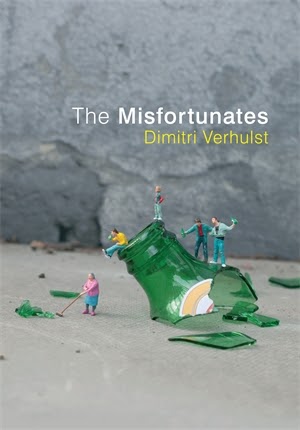
translated by David Colmer
I discovered Verhulst by accident after taking a punt on his rather wonderful novella Madame Verona Comes Down The Hill. I knew back then when I read it that it was something of a departure from Verhulst's previous output and Portobello Books are now publishing the autobiographical novel that he published in the same year. At the bottom you will be able to see a trailer for the film version from 2009 which confirms the shorthand precis on the back of my proof: Think Shameless with mayo on the chips. This coming of age tale is narrated by Verhulst himself (yes, he uses his own name) beginning at the age of thirteen when he lived with his father, his uncles and his grandmother in the onomatopoeically named Aresendegem (presumably the arse-end of some small town) in Belgium, 'a town the great cartographers forgot, an ugly backwater, but a great place for drizzle and pigeon fancying.'
Now, I nearly gave up on this one, I'll be honest. After the first couple of chapters I got the sense that what I was going to read were a series of vignettes based on Verhulst's own chaotic upbringing. Colourful characters, entertaining set-pieces, all very good but not enough to maintain my interest throughout. What comes along to save it at first is the set-piece to end all set-pieces. We've all played some kind of drinking game in the past I'm sure but the Verhulst's have slightly larger ambitions. In a chapter entitled The Tour de France an extraordinary drinking competition is created by the young Girder, ruled out of the official world-record drinking competition by his age, in line with the famous bike race. 19 stages with 5km equal to a standard glass of alcohol, meaning that 'even a reasonably short stage of 180 kilometres would involve drinking 36 standard glasses of alcohol. Against the clock' There are even three jerseys to earn.
The yellow jersey was for the leader and eventual winner...the greenn jersey for the explosive sprinter: the neck-it king. And the polka-dot jersey could be captured in the mountains, where you proceeded by guzzling strong drinks like whisky and vodka.
What follows is a drinking marathon of epic proportions during which Girder's mother, seeing her son return home each night looking 'as pale as a corpse and with a beard of dried vomit' worries about his new found enthusiasm for cycling and buys him a brand new racing bike (which eventually finds its way to scrap metal dealer to help pay for all the booze). The descriptions of this sustained drinking binge come with all the seriousness of sports commentary and for Girder it is all about the pursuit of what Dino Buzatti called The Idea, all of this mock-seriousness providing plenty of entertainment for the reader.
There is another strong chapter to follow in which, after a visit from the bailiffs and the removal of their television, the family visit the house of some Iranian neighbours ('So these were foreigners') so that they can watch Roy Orbison's comeback concert, A Black and White Night, Dimitri's father being a die-hard Orbison fan. What follows is something of a culture shock for the Iranians and an emotional high point for the Verhulsts, one of the many episodes in which joy and triumph are found in the most unlikely situations. These peaks and the liberal sprinkling of humour are important in what could have been a grim book and even something like the memory of helping his mother (absent now and referred to as a whore) with her moustache removal - 'an enormous operation that always made me think of a religious rite in a country I don't ever want to visit.' - is one filled with some kind of love.
And that's what this novel ends up expressing: a funny kind of love. Near the end we hear the famous family story about Dimitri's birth, how his father was down the pub after too many false alarms, finally cycled to the maternity hospital and left 5 minutes later with baby in hand to take his newborn son on a tour of the town in the basket of his bicycle.
Sister Philomena in the corridor, barking at my father: 'Where do you think you're going with that child?'
Me in his arms.
'It's my son, I'll take him wherever I like.'
'Mr Verhulst, he was only born this morning.'
'He's my son. If you want kids of your own to boss around, chuck your wimple over the hedge and hike up your dress, the rest'll take care of itself.' And he carried me out the door.
This is not a particularly responsible family and yet they have their moments. For all the high jinks there are of course serious moments. There is no doubting the concern on the day when his father announces he wants to go into rehab.
My father now tasted like beer and his armpits smelled like it too. Maybe he had already noticed the whites of his eyes growing yellow, his steady loss of weight. A drinker's coffin is seldom a heavy burden, undertakers are always glad to carry them, and our family would have saved a lot of money if we'd been able to pay for our funerals by the pound.
And along with death it is of course the promise of new life that also heralds the need to grow up and become responsible. When Dimitri stupidly gets someone pregnant it marks the beginning of a new life, particularly as it is someone whom he doesn't really love and with whom he has no future.
How could I have been so sure, for all those years, that my fertility would adjust itself to my convictions, that the unwillingness in my brain would metastasize in my testicles? A character like me could only have been devised by Greek tragedians or by the scriptwriters of the kind of soap operas that put the logic of character development on the back burner in favour of general stupidity.
There is a general stupidity to this novel and a sense that it isn't really a novel at all, falling somewhere between memoir and short stories, all of which means that I wasn't nearly as enthused by this book as Madame Verona. That said, I'm glad I gave it a chance. Like the Tour de France it has various stages, some of which suit some riders better than others.
Read more...


 Posts
Posts


