Random

Tuesday, 30 August 2011

'a legend never dies'


Ascent
by Jed Mercurio and Wesley Robins


I bloody loved Mercurio's novel Ascent. It made me feel like a kid again, reigniting those dreams of being an astronaut, and combined high-octane excitement with moments of nail-biting tension to leave me thrilled and exhausted by the end but also incredibly moved. With such boys-own thrills you can imagine my excitement when I learned that the novel was going to be turned into a graphic novel, it being the perfect material for the comic treatment. Wesley Robins is the artist with the task of sending Yefgeni Yeremin, aka Ivan The Terrible, on his trajectory out into the stars and he manages to condense much of the excitement from the novel into his 120 pages. It remains one for the boys but, in this graphic form particularly, a book likely to appeal to boys from 9 to 90.

In 1946 Yeremin emerges from the 'Great Patriotic War' orphaned and alone. In the opening panels we quickly learn that in amongst the hardships of rebuilding the shattered country and the even harsher challenges of life in the state orphanage there is one hope for a boy like Yeremin: the scholarship for the best pupil to the air school at Chkalov. This is something he will have to fight for, literally, but we are quickly moved with him from the brutalities of Stalingrad to skies above Korea where a new conflict offers the opportunity for one orphan to transform himself into legend. The Soviet Air Force (VVS) was never officially in Korea. Blank uniforms and virtual radio silence allow these jet aces to compete with the Americans for supremacy but whereas their American counterparts are feted like movie stars the Soviets remain anonymous, 'phantoms', their only glory coming from amongst each other and for Yeremin the comforts of a woman known only as 'the widow.' The dogfights are brought vividly to life by Robins beginning with the contrails that tempt each side into conflict, the speeding jets passing through the frame so that we get a sense of the difficulty of catching one in your sights, and the extraordinary physical pressures as pilots battle against g-forces followed by the thrill of seeing your prey burst into flames.


Yeremin steadily progresses into becoming the most feared of the Soviet pilots, dubbed Ivan the Terrible, but his only reward for becoming ace of aces is exile to Franz Josef Land in the Arctic Circle. In this frozen isolation the fighter pilot who had never officially existed begins to feel the effects of his anonymity, begins to feel a lack of purpose even whilst a family with 'the widow' grows up around him.


He may be isolated but he is aware of the rapidly progressing space race. Russia's greatest success is a moment of desolation for him, a single flight that eclipses every single one of his many successes and brings him to the point of suicide. But a moment of his old tenacity brings him back to the attention of the authorities who happen to need at that moment a man capable of flying 'an untested vehicle to the moon, alone, and land it, alone' as well as being the kind of man whose very existence can be denied if it should all go wrong.


And so we head into space, Yeremin is launched in advance of the Apollo 11 mission, out into the unknown, the ultimate exile. Robins' palate, which has never been vibrant, becomes even more monochromatic. The harsh sunlight and total darkness of space bring a wonderful contrast to the panels of this final third and in a similar way to the original novel we feel the privilege of sharing the cramped space within that vast expanse, and all the moments of high drama and tension that follow. The stakes couldn't be higher. Perhaps only a man who has achieved so much in his life and yet never seen his name attributed to any of it would contemplate such a suicidal mission, Yeremin has begun with nothing after all and has the chance to write his name in the history books for all time. Does this broken man continue to fight for himself, for his country, or for something else?

I would still recommend unreservedly that you read Mercurio's novel. There is obviously so much detail there that it isn't possible to capture in a graphic adaptation. But Robins does a fine job in bringing that story to life. A muted palate that matches the period and feel, panels with movement, and some genuinely beautiful artwork in the final third make this graphic novel so easy to enjoy and appreciate. If you've ever had the same enthusiasm as me to be up amongst the stars, ever stood and looked up at a night sky and tried to place yourself up there then you've got the right stuff for this story of epic but silent achievement.


Come back on Thursday to read my interview with Robins, where we discussed the process of adaptation, and to see his unique contribution to my six-word story collection...

Read more...

Thursday, 25 August 2011

'there is a price for everything'

On Canaan's Side
by Sebastian Barry

Sebastian Barry has been something of a Booker bridesmaid, short-listed for both The Secret Scripture and A Long, Long Way but yet to scoop the prize itself. He's been at least long-listed again for this latest novel which follows the fortunes, and otherwise, of another of the Dunne family and only time will tell whether this is the one that brings the prize home (all this flirting with authors like Barry and Barnes leads you to think that it's only a matter of time). Barry remains the only author to have reduced me to tears, the final pages of A Long Long Way being read through eyes that refused to stop weeping despite my deep, manly breaths and furious wipes with the back of an increasingly wet hand. He is unafraid of wearing his heart on his sleeve, unashamedly sentimental, but always prepared to examine frankly a life filled with distress and pain as well as love and laughter (I'm in danger of sounding like the lyrics to Aussie soap Sons and Daughters there). That said, there was something about the plot twist at the end of The Secret Scripture that really rankled; it was too neat, too implausible and, it seemed to me, unnecessary, stopping a good book being great. Before beginning the new book I was already aware that there was something similar in it too, a fact that had me worried from the outset as well as of course wondering as I read if I could work out what it was. Not the best way to read a book for sure.

On Canaan's Side is narrated by Lily Bere, daughter of Thomas Dunne (from his play The Steward of Christendom), sister to Willie Dunne (from A Long Long Way) and Annie Dunne (from, erm . . . Annie Dunne). I'm being a bit flippant but actually the cumulative effect of Barry's focus on family groups means that, for those who have already some or all of his previous work, there is an immediate familiarity at the beginning of a new book. I already knew something of Lily's childhood so that even the innocent mention of her brother's name in the opening pages reminded me of everything that had caused those tears years ago. As she recounts the feeling that something of her brother had been lost in the trenches and battlefields of France and her memories of how he would appear suddenly in their house (none other than Dublin Castle) whilst on leave 'dressed in shadows, disguised by the thin dust of terror he carried on him', how could I not feel the prickle of those tears once again?

So, read as part of a body of work, there is something undeniably powerful from the outset but for anyone coming to this novel afresh, with no knowledge of Barry's other work there is still something immediately involving. The first chapter has been headed by Lily as 'First Day Without Bill', her first words 'Bill is gone.' And then the question, 'What is the sound of an eighty-nine-year old heart breaking?' Bill is her grandson, who returned from war in the Gulf only to take his own life, the pain of surviving a child doubled by another generation passed. Lily has decided to take her own life too but not before setting down her story, an extraordinary tale of flight, disappearance, love realised too late, and sorrow upon sorrow. As I mentioned we are thrown right into it emotionally, even her happiest memories are tinged with a certain pain or as she far more poetically puts it, 'I am dwelling on things I love, even if a measure of tragedy is stitched into everything, if you follow the thread long enough.'

Yet I will confess there is a certain pleasure in this. I scratch away at the Formica table, coming down the pages of this account book with my pencil. I seem to see everyone and everything I write. I am able in some strange way to greet my father again. I would like say to him, Papa, I do not know where you are buried, I am sorry.

The Dunne family experience is that of those who remained loyal to the Crown at exactly the wrong moment in Ireland's history; fighting with the King's troops to earn a victory in Europe that would not be celebrated back at home. For Lily, allied with her sweetheart Tadg Bere, who joined the Black and Tans after his time at the front line, the shifting politics of Ireland finds them both with a contract out on them and fleeing for the refuge 'on Canaan's side.' It is a measure of the sorrow to come that Lilly looking back at that moment can think that, 'Perhaps in that moment, as Ireland stirred like a great creature in the sea, and altered her position, we should all have been taken out and shot, as a sort of kindness, a neatness.' Their first experience of America is of course New York and for this young Irish girl a shock to the senses.
How were the ladders long enough to get bricks up so high? And every road in spate, with a flood of angry cabs, people shouting and calling, plunging along, horns raking through the noise; it was already a kind of assault, a terror you had to learn.
The threat that hangs over them both soon catches up with Tadg in an art gallery in Chicago where he is gunned down and Lily flees to find refuge first in Cleveland. Beginning again from scratch Lily finds a life in service but suffers loss after loss in a period of American history punctuated by conflicts that extort a terrible price from her. As she says much later, 'There is a price for everything, even in a story. How much truer that is in real life.' Lily, it is fair to say, suffers terribly. Her love for Tadg realised only just before he is taken away, love and companionship found once again with policeman Joe only for him to disappear with his secrets just as she becomes pregnant, the combination of hardship and joy in raising her son Ed laid to waste by the effects of his tour in Vietnam, an experience that leaves him 'Like an empty house with a ghost in it,' and finally the same process again with her grandson. Bereavement, disappearance, love and loss; this is a novel that piles on the pain as Lily remembers.

To remember sometimes is a great sorrow, but when the remembering has been done, there comes afterwards a very curious peacefulness. Because you have planted your flag on the summit of sorrow. You have climbed it.

If this is a novel of memory and remembrance ('How strange, how strange. We may be immune to typhoid, tetanus, chicken-pox, diphtheria, but never memory. There is no inoculation against that.') then it is also specifically a novel about not forgetting. Lily remains troubled and pursued by Tadg's killer, 'the man in the shadows', not literally to her knowledge, but the spectre of that still current death sentence leads her to wonder whether 'that man always with me? Was he a sort of secret husband, always creeping along near me, or finding out bits of news about me, and coming to find his prey?' Memory it seems has many ways in which it can attack.

The lyricism and poetry of Barry's writing makes it a pleasure to read as always. There is joy as well as sadness, even moments of humour too, but it is the humility, stoicism and kindness of Lily that warms the heart. And what of those worries about implausible plot points? Well, as he points out in this interview much of his plot is based on real events (and Barry it seems does literally wear his heart on his sleeve, tearful emotion is always at the surface) but there are still a couple of things that made me wince slightly. I thought I had worked out the troublesome moment only to find that there was another before the novel's end. I won't divulge either except to say that the first is a secret that I found hard to believe when I read it in another novel and again here, the second is another example of Barry's recent need to neaten his endings by tying it all up. He's a playwright too after all, structure is everything, so I know where the impulse comes from, I just wish he wouldn't! That's just me though. You will have to decide for yourself how much you can credit or how comfortable you are with such an open heart. Imagine if a stranger where to begin relaying their life story to you, a story that brought tears to their eyes. It would feel uncomfortable I'm sure, but what an extraordinarily brave and generous thing to do.

Read more...

Tuesday, 23 August 2011

'a glimpse right into the wreckage'


Solace 
by Belinda McKeon

Some bold claims have been made for this début novel (but when is that not the case!). Début novels come and go and whilst they can often provide an exciting read the conversion rate for these writers of promise remains pretty low. How do you know when you've found a writer who will endure and more importantly a novel that will truly stand the test of time? David Hayden of The Folio Society is a man with an eye on the longer term so when he said that this novel was the real deal I couldn't wait to get hold of a copy. Is it a truly great novel? After finishing it I'm not so sure but we'll come back to that later and why that isn't necessarily a bad thing.

McKeon herself grew up on a farm in Co. Longford before studying English and Philosophy in Dublin. It is therefore no surprise that her protagonist Mark Casey follows the same trajectory in a novel that deals with the conflict between town and country, the complications of family politics, a story of love and loss set against the background of the recent Irish financial collapse. In a prologue we meet Mark's father, Tom, who owns and works a farm in Co. Longford in the middle of Ireland. His son Mark has spent the whole summer with him, working the farm each day and we get a sense of the slight strain in their relationship. There is also something unspoken, communicated in the glances of girls in the local shop when Tom takes his infant granddaughter out with him on an errand, a look that tells us something significant has happened to this family.

It was as familiar to him by now as the sight of his own eyes in the bathroom mirror, the look that he had caught on their faces: fear and thrill and greed and pure excitement; a glimpse right into the wreckage on the side of the road.

That strain between father and son has its roots in Mark's move away from his rural upbringing. In spite of Tom having spotted in his young son the right signs, 'the solid way of looking, the air of already knowing it all. Of being born to it, and for it,' Mark's education has taken him to University in Dublin where he currently languishes, blocked in the middle of his doctoral thesis on novelist Maria Edgeworth, who lived in the village near to where he grew up, a fact which hasn't helped him to produce much more than 'some kind of nineteenth-century version of a celebrity magazine as his thesis.' We find him first in a pub garden, realising with another pint that yet another day of potential work has slipped through his grasp and that he hasn't really been working for a while.

Because there was on that desk no sign of the scuffling and flittering and leafing and scrambling it took to really get through a piece of academic work, with its footnotes and its quotations and its weavings in and out of elements from every scrap of paper touched and filed and vanished over the course of long months and years. It would be useless, Mark thought, but he would be better off there, so he drained his pint and went to say goodbye to Mossy, pushing his way through the crowd, elbows and tummies and tits and arses and pint glasses raised and pint glasses slopping.

I've quoted that extract to show how McKeon's tendency towards a meandering, list-like sentence attains almost self-parody in the early pages, something that had me frankly very worried about the rest of the book, but thankfully it is at exactly this moment that Mark spots the green-eyed beauty Joanne Lynch, decides to stay in the pub (but stop the meandering) and begins a love affair that might not reach the heights of Romeo and Juliet's but finds similar conflict in 'ancient grudge' and 'the continuance of their parents' rage.' Joanne, it appears, grew up in the same area as Mark and whilst she has no remembrance of any enmity Mark knows all too well of the dark cloud the Lynch name casts over his father's farm, Tom having been well and truly shafted by Joanne's tricky father in the past, a grudge that he maintains to this day. But that is not for these young lovers to worry over as they fall into each other in the beautifully depicted early days of a new relationship.

Joanne's work in law brings her into contact with a case involving another family dispute and this engaging sub-plot takes another look at the themes of family inheritance, responsibility and memory. But her work life will be forced to take a back seat when, after only a month or so together with Mark, she discovers that she is pregnant. This naturally throws the Lynch name back into the Casey household, re-inflaming former tensions, but it is a tragedy yet to happen that will create that unease we sensed in the novel's prologue. McKeon is very even handed in her handling of plot and characters, each is given due time and focus and she has that non-judgemental empathy that allows the reader to make up their own minds and reminded me of reading Kent Haruf's superb novels Plainsong and Eventide. Even the temptation to evoke a rural Irish idyll is nicely avoided, not simply by depicting the realities of Irish farming in the midst of financial meltdown but by hinting at perils behind every farmhouse door - 'Inside those houses on those hills were people, and people made everything difficult; tripped over one another and tripped one another up.' There is at least one moment however which feels like a pulled punch. In a novel about the tensions between father and son it is a strange decision to describe the mechanics of their inevitable showdown rather than to write the actual row. With so much kinetic energy built up, so much that had remained unsaid, this reader felt a little cheated at not being able to hear the actual blows traded.

As well as giving her characters room and not dominating too much as an author McKeon also shows strengths in description and humour. A frosted tractor window that looks like it's not 'one pane of glass but a thousand tiny chips, held together for one last moment within the square of the frame.' isn't just a nice turn of phrase but a description that hints at the fragilities contained within the novel. And the way in which Mark's mother contemplates the sex antics of the younger generation 'with a mixture of envy and exhaustion' is just perfect. All of this is why a novel that felt good rather than great doesn't worry me at all. I've read plenty of 'outstanding' débuts from authors who disappointed with their next book (and even with the one after that if I bothered) but I feel very encouraged by the lack of pyrotechnics in this début, charmed instead by some subtle characterisation, touched by the sensitive handling of its topics and eager to know what McKeon might produce next. Go on, don't let me down...

Read more...

Thursday, 18 August 2011

Tom McCarthy Interview

Tom McCarthy has gone from being a writer who endured rejection from the major publishers (but then found a cult readership through the publication of his debut novel, Remainder, by a Parisian art outfit) to one given something like mainstream acceptance after being included on last year's Booker Prize short list. As someone with a particular interest in one of his major themes I was very pleased to have the opportunity to ask him about his work and the idea of authenticity.

My reading of Remainder couldn't help but be hugely influenced by the fact I'm an actor. I was fascinated by the ideas of authenticity and repetition, especially as repetition can be the very enemy of authenticity when performing a long run onstage. What attracted you to those themes and what were you hoping to say in writing about them? 

Repetition is the enemy of authenticity indeed. Authenticity is a pernicious meme that needs to be dismantled brick by brick, and repetition has always been a battering ram well-suited to the task. Repetition is beautiful, lyrical and seductive. It's the basis of all poetry.

I have to ask, have you seen 'Synechdoche, New York' and what did you make of it (and its similarities to Remainder)? 

I haven't seen it I'm afraid.

(Another film I wonder whether you have seen or not is Certified Copy which deals with notions of originality, copying, authenticity and fakery. I think you might like it)

I haven't seen that either... But Dennis Hopper's 'The Last Movie' is great in this respect. And so is Tarkovsky's 'Solaris'.

The theme of authenticity runs through your work; the art forgery of Men in Space, the parodic work of the International Necronautical Society and even the sale of 'genuine copies' of their documents. Is it likely to remain a recurring motif in your work?

I'm interested in doubles, forgeries, mediations and displacements of all kinds. I imagine they'll continue to feature, although hopefully mutating as the books progress.

You have said in previous interviews that you are influenced by writers such as Blanchot, Derrida, Beckett.... With such strong influences I might ask another writer if they have ever worried about escaping those influences to assert the authenticity of their own voice but I don't think you're that kind of writer. How would you describe the authenticity of your work?

I'd never use that term. Literature is about modes of inauthenticity, and always has been - look at Hamlet or Don Quixote if you doubt this. I'm influenced by lots of other writers, as were all those other writers themselves. My voice was never mine in the first place, and I'd never want to make that claim.. I'd like to think I'd built some good echo-chambers though.

You haven't much time for the 'sentimental humanism' prevalent in a lot of fiction. Could you explain what you mean by that?

I mean a cultural ideology that posits the self as the origin and source of all experience, and language as a tool for self-expression. It's a reactionary dead-end. It's the default ideology of almost the entire cultural industry (visual art being a notable enclave of exception), but all good work subverts this in some way or other.

There tends to be a fair bit of it on fiction prize shortlists. C was nominated for the Booker last year. What was your experience of being part of that bandwagon?

The ice-cream desert at the dinner was very good.

Do you have any thoughts on this year's recently announced longlist?

You're asking the wrong person: I've never read a novel on the Booker list in my life.

What are you working on at the moment and how does it fit in with the rest of your work?

I'm working on a book about pollution and mutation. It will end in a zombie parade. I'm interested in the insistent return of the material, and the dead.

Is there an underappreciated book that you would like to recommend to readers of this blog?

'The Adventures of Mao on the Long March' by Frederic Tuten.

I always ask my interviewees to 'do a Hemingway' and write a story in just 6 words. Would you have a go?

'For sale: shotgun, one previous owner.'


'C' is now available in paperback.

Read more...

Tuesday, 16 August 2011

'nothing happens that cannot happen'


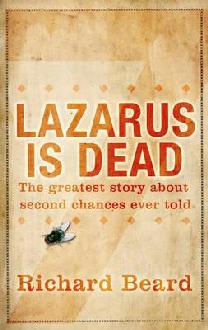
Lazarus Is Dead
by Richard Beard

We all know the story: Lazarus dies, Jesus weeps, Lazarus walks from his tomb. This most spectacular of Jesus' miracles is only reported in the gospel of John, who uses it as the confirmation of Jesus' divinity, the most powerful of the seven miracles that frame his narrative, the moment where Jesus shows his power over the one thing none of us can avoid. And no, I don't mean taxes. In his new novel Beard also uses the number seven to frame his narrative. Seven chapters count down to the death of Lazarus, then seven more continue after his resurrection. This structure gives the book a pleasing mathematical neatness but also manages in itself to contribute to the narrative tensions. We all know where that arc is heading but to have it actually countdown somehow removes inevitability and replaces it with a tension I shall describe for the moment as the literary equivalent to the ticking clock on the TV series 24. The real kick is entirely literary though. This book has an intriguing viewpoint and posits some bold ideas so that as the chapters begin to count up again there's almost nowhere Beard is afraid to go.

Let's begin with the one certainty in the story of Lazarus. He is dead. 'He died, he came back to life, but then he died again. If he were alive today, we would know. I think' This is the only certainty (we think), everything else is up for grabs more or less and the unique viewpoint of Beard's novel is to allow the narrative voice to present its factual research alongside the narrative. The novel is an investigation into the sketchy details of the Bible narrative that uses artworks, later fictional representations like those from José Saramago and Karel Čapek, and theory to arrive at a new telling of the story. You might call it the most complete version of events but even Beard knows that 'Even outside the story, beyond time, with the benefit of hindsight and foresight, it can be very difficult to fit every factor together.'

I might have made that sound a little dry but it is anything but. It is an engaging style and always easy to understand. It just feels like common sense. We know for example that Lazarus is described as a friend of Jesus, the only man in the whole bible to have that accolade bestowed on him. But how are they friends? The bible cannot help us but the prevalence of Lazarus in artistic depictions, out of all proportion to 'his brief appearance in a single gospel', means that perhaps they were long time friends, since childhood. Go back to the moment when Joseph heard that the children of Bethlehem were to be slaughtered. Morally he'd want to save more than just his own son but he can't save them all. But he could save a friend's. And so we join Joseph as he hustles his own best friend and their family along with his own away from the impending massacre, unable to explain.

'The children. They are very special.'
'I know that.' Eliakim understands instantly that they can't go back. 'Every child is special.'
'The boys needed saving. Our boys.'

Yes, that would make them the firmest of friends. And so we follow their childhood together where it is Lazarus who excels both at synagogue and at play, 'Jesus looks before he leaps. Lazarus likes to leap.' In one extraordinary scene the two boys along with Lazarus' younger brother Amos climb the scaffolding that surrounds the construction of a new amphitheatre. It is raining. Lazarus makes his precarious progress to the top and then offers to help his more cautious friend up.

Jesus reaches up but not far enough, and he falls. His hands and his arms and his body detach from the scaffold and out he goes, into the air, clear space all around him. Lazarus swipes at his clothes and clings on, hauls him up and over and onto the safe flat roof. It is an impossible achievement, an unbelievable rescue.

How nearly Jesus might have perished as a child. How miraculous was the intervention of Lazarus? But we can come back to that later. Whilst we follow the logical assembly of Lazarus' back story we also read about the more immediate construction of his death. What did Lazarus die of? Again, the Bible never makes it clear and having investigated the most common illnesses of the period Beard reaches the only rational conclusion:

The story demands that Lazarus suffer. The more hideous his death the more impressive his revival ... his sickness should be horrific, definitive, undeniable. It should be both recognisable and worse than anything anyone has ever seen.
Yes, this is how it was done. Lazarus did not die from one of the seven prevalent illnesses of ancient Israel. Not enough. He has to contract them all.
Lazarus is cast firmly as an agent in the narrative of Jesus the Messiah. It is not only the miracle of his resurrection that confirms this status but it seems possible that their whole lives together have provided the foundations for the grand construct that is to come, 'If Jesus is the son of god, then all stories both before and after exist in the service of this one incredible story.' One of the boldest aspects of this novel is to allow the life of Lazarus to underpin the miracles he didn't even play a part in. Perhaps the second most spectacular miracle was Jesus' walking on water. The act in itself is miraculous but it is important not to forget that it comes during a storm that threatens the lives of his disciples and we have to understand the very real danger of that water. So Beard creates a scenario that does just that as well as providing the conflict that means it is the sisters of Lazarus who eventually send for his help rather than his once close friend. If Jesus never learned to swim but watched as his friend swam out with his younger brother, deeper and deeper, until the dangerous currents put them both in jeopardy, what would, or could, he do? And for Lazarus there will first be the immediacy of guilt but then much later, with the talk of Jesus' divinity and miraculous intervention, there must also be blame, or disbelief.

He wanted to help Amos, with his whole heart he wanted to save him, but only to the point where he had to save himself. That was as far as his saving would go. Ahead of him Amos went under. Lazarus thrashed with his arms. Amos drifted away from him. Lazarus felt the nearness of death and he knew, with absolute certainty, that above all else he wanted to live.
Jesus stood on the shore. He didn't help because he couldn't swim. He patiently watched Amos drown. He watched Lazarus save himself. He did not intervene.

...Jesus walks on water. Jesus stands on the shore with their clothes in his arms, watching Amos drown. The gap between these two events is the emptiness into which Lazarus falls.
No wonder he didn't send for his friend when everyone else believed that Jesus could provide the miraculous healing required, even when he was suffering so terribly; the prospect of Jesus holding that power was too painful to contemplate. If he had it then why hadn't he used it?

The approach is unusual, the narrative bold and exhilarating and this is before we have even reached the moment of Lazarus' death, let alone what comes after. The political and social pressures of the time will have their moment and we will learn just how parallel the lives of Jesus and Lazarus might be perceived. In fact, and here perhaps is the novel's boldest conceit, how can you be sure that you've picked the right man for the job? When Lazarus finds himself being interrogated after his return from the dead he states the bare facts of his existence in order to refute the notion that he might be the Messiah predicted in the scripture. But so closely has his life mirrored that of his best friend that his interrogator can only reply, 'Exactly. You're everything the scriptures said you would be.'

Reading this novel is exhilarating for many reasons. As Beard himself says, 'A point of stagnation has been reached in scholarly and theological studies. A new approach is needed' and this book with its melding of fiction and non-fiction, critical analysis and detective work, consolidation and controversy, is a potent combination that breathes life not only into the 'imaginative representations' of historical events but also into the possibilities of what we think a novel might be able to achieve. And at the just the time when some people out there would love to be able to announce the death of the book. Oh, the irony.

Read more...

  © Blogger templates The Professional Template by Ourblogtemplates.com 2008

Back to TOP