Random

Thursday, 15 December 2011

2011 - Books of the Year


Yes, you may have already noticed that 2011's end of year post is just about books rather than also including my favourite music, films and other cultural highlights. The reason for this is quite simple: I've barely listened/watched/been to any as any regular readers will have noticed over the year. It has in fact been all I could manage to maintain a steady stream of book reviews this year and I have my fingers crossed about being able to do the same next year. It hasn't been easy. But every time I think I'm about to throw in the towel something comes along to make me persevere and I'm always glad that I do. The books below are all brilliant for different reasons and a couple of them are so good that they're worth writing the blog for alone. And then of course there's you and your comments.....

Many thanks to every single one of you who has read my blog this year and a seasonal hug and kiss to everyone who's left a comment. I can't tell you how much I appreciate it.


A Taste of Chlorine by Bastien Vives

It may be at the bottom of the pile in the photo above but this graphic novel is right at the top of my books of the year. If you want to read a graphic novel that truly uses pictures to tell a story that words wouldn't have been able to then this book is perfect. The story of a boy using swimming to help treat curvature of the spine is all about body-language, gesture and movement. There's hardly any text and yet volumes are spoken in Vives' exquisitely drawn panels, with the underwater environment particularly well presented, you can almost smell the chlorine. Like reading a perfect short story it is enigmatic, moving and left me with a warm glow in my heart.


A genuine masterpiece about tyranny and control from a writer who may only have produced two novels in his long lifetime but who made sure they were both in their own ways completely brilliant. This novel examines the symbiotic relationship between a man who is clearly Jewish (though never named as such) in 1930's Germany (though this is never made explicit) and the leader, or adversary, (clearly Hitler though again he is not named) who tyrannises him. Brave in its hypotheses, brutal in its psychological insights and honesty, this novel is a classic because it manages to be about all situations in which one group makes a pariah of another. Indispensable.

Great House by Nicole Krauss

This novel is by no means perfect but its failings come from ambition rather than lack of talent which Krauss seems to have in spades. There is a feeling that comes from reading the work of a mature writer, an ease that you are in the hands of someone who has something to say. This usually comes from writers far more experienced than Krauss but her maturity is just one of the attractive features in this novel about a desk and the various hands it passes through, characters created with such detail that they cease to feel like characters at all, and the novel as a whole written with a complexity that forces the reader to slow down and appreciate the thought, intelligence and humanity that has gone into creating it.


A collection of stories so unique, so specific, so perfect as to need little more than that from me to send you straight out to buy a copy. Pancake died without ever really knowing just how good a writer he was and too young for us to know just how good and influential he might have become. As it stands several writers cite him as an influence and the warmth and reverence with which they do this is worth noting. His stories embody the area of West Virginia in which Pancake grew up, with authentic details and voices but these aren't simply stories rooted in a particular geography so that we can indulge in a kind of literary tourism, he also shows with a couple of stories just how formally inventive he might have been. Just buy the damn book, ok?

The Summer Of Drowning by John Burnside

I have no shame in admitting that I am a fan of Burnside and take a small amount of pride in being one of the voices that has helped convince John Self over at Asylum to read more of him and realise just how good he is (although in his own end of the year round-up he mentions that he did so in order to shut people like me up). This latest novel shows a writer at the height of his powers returning to a story he failed to complete a decade ago and delivering a novel filled with atmosphere, unease, myth, storytelling, artistry and writing so good it sometimes make you want to take a moment and nod your head in appreciation. Set in the Arctic Circle and drawing on the folk myths of the area this is a book infused with the spectral light of the midnight sun; deeply unsettling, wonderfully complex, another weapon in my arsenal to make sure that you all make the effort to pick up one of his books. Soon.


An unalloyed pleasure from first page to last, Towles debut is a perfectly mixed dry Martini. Set in 1920's New York it tells the story of a life-changing year for Katherine Kontent, the only fictional character I have ever fallen in love with. Taking inspiration from Walker Evans' candid subway photographs Towles effortlessly recreates an era and peoples it with characters in which I believed totally and couldn't hope to forget. It's the kind of novel where you genuinely care about what happens to them and can't help but wonder what happens to them after the final page. Witty, funny, smart and beautiful: that's just Katey Kontent, but also a good description of the novel as a whole.

Lazarus Is Dead by Richard Beard

One of the most exciting reads of the year for the way in which its form was hard to pin down, Beard's 'novel' is a re-examination of the story behind one of Jesus' miracles. By taking an almost forensic approach Beard manages to tell the story more fully than ever before, bravely hypothesising about the childhoods of both men, drawing inspiration and evidence from other artistic sources, research into the period and of course the invention of the author. Structured around the number seven the chapters count down to Lazarus' death and then back up again after his resurrection, where Beard is brave enough not just to imagine what happens to the story of Lazarus after its usefulness in the Bible ends but to posit an even greater significance for the man who came back from the dead. If you want to know why fiction can still be exciting then pick this book up.


If I had a pound for every novel that takes a male protagonist, wipes his memory and then starts from there then I'd have a load more money to spend on books, but this novel from linguist Marani is ingenious and far smarter than most. A man is found badly beaten on the quay in Trieste in 1943. When he comes to he has no memory of who he is or even which language he speaks. The Finnish doctor on a German hospital ship that treats him presumes that he is also Finnish after spotting a name inside his coat and an initialled handkerchief and so begins to re-teach him his language in the hope it will unlock memories and lead him to recover his identity. This relatively slim novel covers huge themes around memory, identity and truth and manages to intrigue even further with the perspective from which it is written. Exactly the kind of novel I would hope to unearth on this blog (although Nicholas Lezard gets the credit on this one).

I Am A Chechen by German Sadulaev

A book that melds memoir with fiction, folk tale with fantasy, Sadulaev's account of the conflict in Chechnya doesn't fit into any easy categories and is all the more exciting for it. It may not be consistent but the early sections in particular are stunning in the way they weave Chechen myth with personal testimony to create something that manages to be grand and specific at the same time. Infused with the guilt of a man who wasn't there when things were at their worst, Sadulaev uses his creativity instead to speak on behalf of a people and give voice to a conflict the like of  which all too easily passes us by on the ticker tape of rolling news.


This is hardly news to anyone as the book was already well regarded by the time I came to read it at the very beginning of this year but it has remained very strong in my mind, a perfect example of why we should all read more literature in translation. Bakker's novel is written with the kind of quiet confidence that let's the reader relax in the knowledge that they are in safe hands. Reserved to the point of repression, the prose mimics the flat landscape of rural Holland but gives little hints along the way of the power that lurks beneath the surface. A farmer and his father inhabit a lonely farmhouse and the son's appalling treatment of his father leads us to wonder what might have happened in the past. Bakker expertly releases fragments from the past in his examination of love, loss and the special bond between twin brothers.

The Horseman's Word by Roger Garfitt

I don't tend to read an awful lot of non-fiction but I'm lucky that when I do it tends to be first rate. This memoir was literally forced into my hand by an excited publicist and her enthusiasm wasn't misplaced. The prose is beautiful as you might expect from a poet and its evocations of childhood innocence are heart-warming and comforting. When it follows Garfitt's misadventures at university and beyond it becomes a fascinating portrait of a mind unravelling and the writing shows the tissue-thin barriers between lunatic, lover and poet. A book that took many years to write and hone, and the passion of one publisher in particular to finally bring to print, this is a labour of love and madness that rewards the effort.


Over a decade after it was originally published and won the Booker Prize I finally get over my Coetzee hoodoo and discover just why this book, and writer, are so well regarded. A Cape Town university professor is forced to leave in disgrace after an affair with a student and goes to stay with his daughter on her smallholding. When the two of them are subjected to a brutal assault by three black men South Africa's fragile new politics are laid bare for examination. A brave and uncomfortable read that retains its ability to shock, this is a novel filled with anger and love, containing so many ideas and themes that you could happily discuss it for hours and hours. It has also of course made me want to read more Coetzee. Ah well, there's always next year....


And a few books that came close and deserve honourable mentions: At Last by Edward St Aubyn, A Visit From The Goon Squad by Jennifer Egan, From The Mouth Of The Whale by Sjón and Today by David Miller.

Read more...

Tuesday, 13 December 2011

'Who said there were no surprises left in life?'


The Sense Of An Ending
by Julian Barnes

Each year there is often a fervour amongst book bloggers to try and get ahead of the Booker game and guess what books might make the longlist, then to read read the entire longlist (or shortlist if you're a wuss) so that you can pick your winner before the panel of judges. I've never fancied a Bookerthon myself, mainly because it seems, in spite of the seemingly wide variety of books that can appear on the list, an unnecessary narrowing of one's reading for a good portion of the year. I happened to read a few by chance and yet weirdly the one I probably should have read, based on having enjoyed his writing before and its eminently digestible size, was one that I didn't get around to until after it had already won the prize. It was seen by some as the only winner capable of mollifying the critics who had picked up on the rather unfortunate phrases used by the judges at various points in the process. As someone who was disappointed in varous ways by the books I read before the announcement I can say now that the eventual winner has its own failings but is a book we can be happy to see brought to more readers, and welcome recognition for a writer who deserves plenty of praise (although maybe for other books......discuss!)

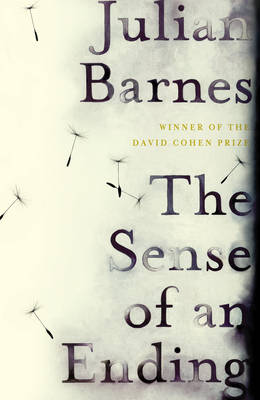
The first thing to enjoy about this book is the feeling of calm and comfort that comes from reading the work of a well established writer (actually the first thing to enjoy is the delicious muted cover design, the dark edged pages...). No tricks or gimmicks, plenty of mature observation and detail, sentences and paragraphs filled with insight that make you want to stop for a moment to savour their import. This short novel wastes no time in introducing its major theme of memory, the opening sentence 'I remember, in no particular order:' followed by six images of relative normality, all of which will be illuminated in the pages that follow. That too is another joy, the way in which Barnes can take an image and make it mean so much more by adding to it experience and loss. Each memory as it is reclaimed and re-examined only highlights the way in which loss and remembrance go hand in hand, for 'Memory is what we thought we'd forgotten."

Our narrator Tony Webster has reached the point in his life where the stasis he always aspired to has been reached. A career ended in retirement, a marriage ended in amicable divorce - 'I had wanted life not to bother me too much, and had succeeded – and how pitiful that was.' Then comes a letter from solicitors dealing with the estate of his childhood friend Adrian, informing him that Adrian's diary has been left to him, although it is currently in the possession of another figure from his past, ex-girlfriend Veronica. The reappearance of these names from the past is nothing less than an exhumation, literally in the case of Adrian who committed suicide, and metaphorically in the case of Veronica who left Tony so hurt he decided to practically erase her from his life (the scant details he passed on about her to his wife have rendered her a caricature - 'The Fruitcake') and whilst this forces him to examine once again his school days and first relationships the diary promises some kind of secret or revelation that may shed light on his whole life. If he can only get a hold of it.

Let's not worry about the plot any more though. As I mentioned in my review of Sebald's Austerlitz there seems to be far more pleasure in the effort to remember than in what is actually remembered. The revelations in this novel, the 'twist' that you may have heard mentioned in other reviews, are probably the parts that I liked least (someone else, who shall remain anonymous, said it was tantamount to the ending of an episode of Eastenders), it is the insight into the idea of remembering, of the narrative we tell ourselves about our life that engages more than the plot itself ('...the longer life goes on, the fewer are those around to challenge our account, to remind us that our life is not our life, merely the story we have told about our life. Told to others, but - mainly - to ourselves.'). Barnes also uses two or three recurring images to great effect in his exploration of time and shows also that the tiniest gesture can have the most profound meaning if we can only see it. As I said earlier, those fleeting images in the first few sentences of the book will all assume a greater significance.

Back in those school days where Tony and his classmates were filled with that confidence that comes with privilege - 'that they had ever been anything like us, and we knew that we grasped life -  and truth, and morality, and art - far more clearly than out compromised elders' - he and his two closest friends marked their union in a simple way.

Another detail I remember: the three of us, as a symbol of our bond, used to wear with the face on the inside of our wrist. It was an affectation, of course, but perhaps something more. It made time feel like a personal, even a secret, thing.

This image is typical of Barnes. It resonates immediately as truthful, acknowledges its own pretension straight away and also sets itself up for a payoff later; all in three short sentences. This novel seems to be filled with moments like this. Classroom discussions about who gets to decide what becomes history feedback into the personal relationships we follow. 'History isn't the lies of the victors...It's more the memories of the survivors, most of whom are neither victorious or defeated' but they are presumably damaged and this is a theme that Barnes develops as Tony looks back on his relationship with Veronica.

I certainly believe we all suffer damage, one way or another. How could we not, except in a world of perfect parents, siblings, neighbours, companions? And then there is the question, on which so much depends, of how we react to the damage: whether we admit it or repress it, and how this affects our dealing with others. Some admit the damage, and try to mitigate it; some spend their lives trying to help others who are damaged; and then there are those whose main concern is to avoid further damage to themselves, at whatever cost. And those are the ones who are ruthless, and the ones to be careful of.

Tony's memories of his defining relationship with Veronica are filled with deliciously insightful comments ranging from where she and her family lived - 'in Kent, out on the Orpington line, in one of those suburbs which had stopped concreting over nature at the very last minute, and ever since smugly claimed rural status.' (This is Chislehurst, which is down the road from where I grew up, meaning that the sentence above had me guffawing on the train) - to the ability of a jilted partner to skewer his ex. When Veronica and Adrian partner up after the end of her relationship with Tony he writes a vitriolic letter which will become another of the documents of this novel. But after Adrian's suicide Tony is pithy in his analysis.

The bitch, I thought. If there was one woman in the entire world a man could fall in love with and still think life worth refusing, it was Veronica.

Ow. John Self covers some interesting ground with regard to regretting our harsh words in his own review of this book so I won't say any more on that but return once more to time and memory. Another of Barnes' recurring images is the Severn Bore, a natural tidal surge that sends a sizeable wave the wrong way up the River Severn (follow this link to see some amazing videos of the phenomena). If we look back through our lives, follow the river of our memories, we expect to always see time flowing in one direction. But as Tony is forced to look once again at his life, or the story of his life as told by himself, his very concept of time alters.

I know this much: that there is objective time, but also subjective time, the kind you wear on the inside of your wrist, next to where the pulse lies. And this personal time, which is the true time, is measured in your relationship to memory. So when this strange thing happened - when these new memories suddenly came upon me - it was as if, for that moment, time had been placed in reverse. As if, for that moment, the river ran upstream.

Such are these revelations that some readers may be tempted into their own reversal, turning back to the first page to begin the novel again with a new perspective.

Read more...

Tuesday, 6 December 2011

'Not a bad man but not good either'

Disgrace
by J. M. Coetzee

I mentioned my trepidation when approaching Sebald in my review of Austerlitz last week but that was nothing compared to the downright anxiety I felt about making a start on Coetzee. I knew I had to read him but with each successive publication my sense of where to start with him got more and more confused. Step in the Folio Society with another lovely edition that gives the Booker Prize winning Disgrace a well deserved re-appraisal more than 10 years after its original publication. I still feel a certain anxiety about Coetzee but it is now that I will find his later work as intimidating as ever whilst secretly wanting to read more of his earlier work, so brilliant was this intelligent, brave, angry and confused novel. As someone who began to find their reading maturity on a diet of Philip Roth's more passionate novels I felt as though I had found a replacement source of that fervour now that Roth has begun to focus so much on mortality and death. Disgrace is every bit as risky and controversial as I expected but also richly symbolic, brutal and exhilarating. What an introduction.

The man at the centre of the novel is David Lurie, a professor in a Cape Town university where modernisation has seen him move from teaching Literature to 'Communications' a title that doesn't sit well with this lover of the Romantic poets. His life has achieved a kind of stasis; he has been married and divorced, remaining on good terms with his ex-wife; sex has become a transaction as easily managed as any utility bill with his weekly visits to a woman named 'Soraya'; and a personal project to write an opera about Byron is always simmering away on the back burner.

Is he happy? By most measurements, yes, he believes he is. However, he has not forgotten the last chorus of Oedipus: Call no man happy until he is dead.

This routine is ruptured when Lurie spots Soraya in the street with two children who can only be hers and the two of them catch each other's eye. This intrusion of her personal life into their private arrangement is never mentioned by either of them at their next appointment but they both know something has changed and their arrangement comes to an end. Lurie's solution to this problem is to fall back on the tried and tested formula of sleeping with one of his students. The girl he selects, Melanie Isaacs, is 20 years old 'small and thin, with close cropped hair, wide, almost Chinese cheekbones, large, dark eyes', and whilst he finds himself falling rather harder for her than he intended she never seems to be fully committed. One sexual episode in particular highlights what we might call acquiescence rather than real participation.

Not rape, not quite that, but undesired nevertheless, undesired to the core. As though she had decided to go slack, die within herself for the duration, like a rabbit when the jaws of the fox close on its neck. So that everything done to her might be done, as it were, far away.

A complaint is made, probably by or at least at the encouragement of Melanie's boyfriend; a tribunal is held at which Lurie refuses to kowtow to the demands of some of the board to show penitence or do more than simply admit guilt and he is dismissed from his position, eventually leaving in disgrace to stay with his daughter on the smallholding she owns on the Eastern Cape.

This retreat doesn't offer the solace that he might have hoped for. Not only is there the slightly fractious relationship between father and daughter but in a moment of shocking violence the two of them are subjected to an ordeal that further polarises their positions as well as forcing the reader to confront an uncomfortable image of the new South Africa. As a reviewer I might chose to skirt around the details of the incident in order to avoid spoilers but Coetzee keeps things unclear by placing Lurie in a different room to his daughter as she endures what he presumes to be rape by one or all of the three (black) men who attack them in their home. Lucy's refusal to discuss what actually happened or seek any recourse to the law leaves Lurie baffled and frustrated but she is quite clear about her stance.

'...what happened to me is a purely private matter. In another time, in another place it might be held to be a public matter. But in this place, at this time, it is not. It is my business, mine alone.'
'This place being what?'
'This place being South Africa.'

Coetzee's genius is that an event that would be shocking and painful enough on its own is given a far deeper resonance by the circumstances that surround it. What kind of guilt or pressure is it that forces Lucy to endure her shame rather than challenge it? Is David right to question whether Petrus, the (black) neighbour who has gone from worker to co-owner of the smallholding, has any connection to the attack? How can David hope to talk to his daughter fully about her ordeal when we consider the charges that brought him to her home in the first place? It's no surprise that this book caused controversy in South Africa. In its bluntest interpretation we might see a brutal justice being administered to the white population after the end of apartheid, a vicious illustration that 'The past is never dead. It's not even past.' This metaphor becomes even more concentrated if we think that Melanie, whose ethnicity is never specified beyond the enigmatic description I gave above, might herself be black. If, within this tight narrative framework, we have seen father bear down on a black student and then his daughter assaulted by three black men we have a pressure of almost unbearable degree, a potent symbol of racial division as well as one of ownership, control and power. It is that kind of pent-up energy that had me thinking of (and rejoicing) Roth's angriest novels when reading this one. Lucy's personal disgrace is to endure the attack and then to hear the story version of it of it spread across the district unchallenged.

That is what their visitors have achieved; that is what they have done to this confident, modern young woman. Like a stain the story is spreading across the district. Not her story to spread but theirs: they are its owners. How they put her in her place, how they showed her what a woman is for.

And the question she is left asking herself comes when considering the personal animosity she witnessed - 'Why did they hate me so?' Surely only as a symbol of something wider.

And what are we to make of the novel's protagonist? Christopher Hope in his introduction gives us a little guidance in trying to seek out his motivations and wondering what kind of sympathy we might have for him as a character (it is also worth noting that Hope, who hasn't always given Coetzee the easiest of rides, is in no doubt about the virtues of this novel). We might consider the way Lurie speaks to his students about one of his life's passions, Byron, and the way in which Byron describes Lucifer in particular.

'He doesn't act on principle but on impulse, and the source of his impulses is dark to him. Read a few lines further: "His madness was not of the head, but heart." A mad heart. What is a mad heart?'

That is the question both we and Lurie must ask of him and nearer the end of the novel, when he begins to reckon himself it doesn't seem as if even that has been enough.

Not a bad man but not good either. Not cold but not hot, even at its hottest. Not by the measure of Theresa, not even by the measure of Byron. Lacking in fire. Will that be the verdict on him, the verdict of the universe and its all-seeing eye?

A novel then filled with potent images, difficult questions, complicated motivations and a good dose of anger (just my cup of tea); as challenging to read now as it was when published and a pleasure as ever to do so in this quality edition from Folio. Right, what Coetzee next...?

Read more...

Tuesday, 29 November 2011

'the reverse of a shadow'


Austerlitz
by W.G. Sebald

Well it took almost two years to make good on my promise to read some more Sebald after The Emigrants but I got there in the end. It took a fair bit of planetary alignment: a lovely hardback found in a charity shop for a bargain price of £3, a passing comment in a conversation I had with an author about one of my favourite books of the year, and the publication of an essay by James Wood in the LRB. All those nudges finally pushed me headlong into Sebald's final book before his premature death at just 57. In the spirit of the trepidation that accompanied my move to read it I have also been terrified of writing up my thoughts on it, this is after all a vast book by a supremely intelligent writer, chock-full of weighty themes and ideas and the considerable weight of the Holocaust bearing down on it too. I shall therefore focus on a couple of aspects that I found interesting and leave you safe in the knowledge that there is far more to discuss than I could hope to cover right here for the moment (if you'd like to read a lengthier post from another book blogger then may I recommend Tom's over at A Common Reader).

As ever we have a narrator that it might be too simple to presume is Sebald himself, this is 'fiction' after all, and a chance meeting that provides the book's narrative. In the late 1960's, during a period of regular trips to Belgium, Sebald meets on several occasions the same man, Jaques Austerlitz. The pair meet first in the waiting room of the central station in Antwerp where they discuss their shared interest in architecture. The anatomy of buildings, their cultural and political significance, the ways in which they express something about the humans who created and built them will all be discussed and as someone whose general interest in architecture extends to watching the odd episode of Grand Designs it's worth noting that some of these extended thoughts are fascinating. The grandness of some of these buildings is forbidding and yet at the same time, as Austerlitz notes, revealing.

Yet, he said, it is often our mightiest projects that most obviously betray the degree of our insecurity. The construction of fortifications, for instance....clearly showed how we feel obliged to keep surrounding ourselves with defences.

As the two men enjoy each other's company, bumping into each other repeatedly, we sense that we are being prepared for the real narrative and so it is twenty years later that the two men meet again, in a rail terminus once more, this time London's Liverpool Street Station, and Austerlitz reveals that he has been looking for someone 'to whom he could relate his own story, a story which he had learned only in the last few years and for which he needed the kind of listener I had once been in Antwerp.' This is because Jaques Austerlitz had actually been raised as Dafydd Elias, evacuated from Europe on the Kindertransport and raised by a pastor and his wife in Bala, Wales. It is just before his school exams that he receives the shocking news that the name he must legally write on the papers is not the one by which he has gone for so long, but a name which feels immediately alien.

At first, what disconcerted me most was that I could connect no ideas at all with the word Austerlitz. If my new name had been Morgan or Jones, I could have related it to reality. I even new the name Jaques froma French nursery rhyme. But I had never heard of an Austerlitz before, and from the first I was convinced that no one else bore that name, no one in Wales, or in the Isles, or anywhere else in the world.

His discovery soon afterwards that Fred Astaire was actually born to a Viennese father with the same surname comes as scant consolation. What Austerlitz is left with, what any of us would be left with where we to be told that everything we thought we knew about ourselves was built on shaky foundations, is a gigantic void which he needs to fill. I couldn't help but be reminded of one of my favourite books of the year, New Finnish Grammar, which tells the story of a man rendered a blank slate after a terrible beating, presumed to be Finnish, who learns from scratch the language he hopes will unlock who he really is. It is this aspect of Austerlitz that I found fascinating and it is a sense that there had always been something not quite right that he latches onto immediately.

It is a fact that through all the years I spent in the manse in Bala I never shook off the feeling that something very obvious, very manifest in itself was hidden from me. Sometimes it was as if I was in a dream and trying to perceive reality: then again I felt as if an invisible twin brother were walking beside me, the reverse of a shadow, so to speak.

In his search for memory, for that is what he must undertake in order to learn and understand from where he came, Sebald's trademark photographs play an important role. These photographs are presented throughout the text to illustrate people and places that 'Sebald' or Austerlitz make reference to. We cannot help regard at least some of them as genuine as the text that accompanies them describes the photo exactly as we see it and yet we know that apart from a few which look as though they have been taken by Sebald for the book, most of these images are found and have been appropriated for this fiction. That striking photo on the front cover for example of the young Austerlitz dressed for a ball, 'the unusual hairline running at a slant over the forehead...the piercing, inquiring gaze of the page boy who had come to demand his dues, who was waiting in the grey light of dawn on the empty field for me to accept the challenge and avert the misfortune lying ahead of him.' So convincing and yet of course Austerlitz is a fiction, this is some other boy, the only clue on the back of the photo in Sebald's archive are the words "Stockport: 30p" The book is filled with moments like this where we have to remind ourselves that what we are both reading and seeing is not real, but it is also worth reminding ourselves that whilst the construction isn't 'real' every episode of fear, exile and death within the book was someone's reality.

When Austerlitz travels to the Czech Republic, quite literally going through the phonebook Austerlitz's, and meets Vera, a woman who had served his family, a slew of photographs, testimony and memory comes back and with the pictures in particular we get a real sense of 'the mysterious quality peculiar to such photographs when they surface from oblivion.'


...as if the pictures had a memory of their own and remembered us, remembered the roles that we, the survivors, and those no longer among us had played in our former lives.


Photography is also used as a metaphor for memory itself.

In my photographic work I was especially entranced, said Austerlitz, by the moment when the shadows of reality, so to speak, emerge out of nothing on the exposed paper, as memories do in the middle of the night, darkening again if you try to cling to them, just like a photographic print left in the developing bath too long.

This emergence of memory is clearly a classic Sebald theme and the murk that surrounds it is repeated several times in the recurring image of the darkening light of dusk. When the two men first meet in Antwerp 'Sebald' has already compared the dusk of the station to the light in the Nocturama at the local zoo. The shadowy space of that waiting room has an otherworldy quality perfect for memories to emerge from and much later in the book, when the scene shifts to Liverpool Street Station, the concourse is cast as some kind of entrance to the underworld.

Even on sunny days only a faint greyness illuminated at all by the globes of the station lights, came through the glass roof over the main hall, and in this eternal dusk, which was full of a muffled babble of voices, a quiet scraping and trampling of feet, innumerable people passed in great tides...

The book is haunted by these passing ghosts; the weight of the Holocaust I mentioned earlier is a very real and oppressive thing, and in fact as Austerlitz's story is revealed I found myself becoming less and less interested in the actual details but rather more fascinated by the descriptions of the mechanics of their recovery. The waiting room in that metropolitan underworld for example becomes the place where memories come flooding back.

In fact I felt, said Austerlitz, that the waiting room where I stood as if dazzled contained all the hours of my past life, all the suppressed and extinguished fears and wishes I had ever entertained, as if the black and white diamond pattern of the stone slabs beneath my feet were the board on which the end game would be played, and it covered the entire plane of time.

Austerlitz is a book I could go on discussing for much longer as I said but I hope that what I have already raised is enough to recommend it. It isn't perfect by any means; some have suggested it is in fact his 'least best' book, and as well as having to surmount the challenge of the often relentlessly paragraph-less pages I definitely thought the book was strongest in the first third and collapsed under its own weight at times later on. But there is no doubt that Sebald is a writer who has to be read by any serious reader, I just hope it won't be another two years before I pick up another of his volumes.

Read more...

Thursday, 24 November 2011

'a veritable powder keg'


Bye Bye Babylon
by Lamia Ziadé

When I was growing up I remember the news frequently made mention of Beirut and Lebanon accompanied by pictures of a city almost entirely devastated by shelling, rocket attacks and gunfire. I never had any real inkling of what the conflict was about or where it was happening, just that it seemed to be unresolvable and endless. This may be because the civil war in Lebanon  began in the same year I did and continued almost until I left home and in any conflict that lasts that long, and that so devastates a region, it is easy to forget that Beirut was once a thriving and prosperous capital city. Lamia Ziadé was born in Lebanon seven years before the conflict began and moved to Paris at the age of eighteen where she became a fabric designer for fashion houses like Jean-Paul Gaultier and Issey Miyake as well as an artist and illustrator of everything from children's books to album covers. In this hybrid book, described as 'part artist's sketchbook, part travel notebook and part family album', Ziadé shows us Beirut in the first four years of the civil war through the eyes of a child seeing her city and family torn apart.

In 1975 I was seven years old and loved the Bazookas my mother bought for Walid and me at Spinney's in the Ramlet al-Baida neighbourhood.
Ziadé uses bright watercolours infused with a Pop Art sensibility, perfect in the opening pages to highlight the obsessions of a young girl in thrall to 'the best of what the Western world can offer' in Spinney's supermarket. Trolleys, escalators, marshmallows and Kellog's cereals are all lovingly recreated in their garish glory but just as we might be falling for the lure of nostalgia an upended bottle of blood-red ketchup heralds the beginning of violence and the pages of consumer goods turn into  several pages of munitions, each described with the same verve, as if the allure of these weapons provoked the same feeling in the various militias around Beirut as the sugary sweetness of processed food did to Ziadé.
This feeling is important because what came before violence was the fervour of arming oneself up, the joy of getting more and more hardware, and the inevitability of violence when groups of men are fully equipped and dying to give it a go. The sheer number of different groups and their conflicting interests and aims may excuse in some part my immense confusion at the time this was all happening. And this is also the reason why Ziadé's account is so accessible, because she, as a child in that same period, was as confused as I was. Living as part of the Christian community, her father a lawyer, her grandfather the owner of a fabric shop in the Muslim area, she goes from living somewhere where two cultures seem to mix to a place divided along simple lines but with several factions fighting their own battles. At one point when she asks her father whether the Palestinians are indeed, as she has been told by her nanny, scum she gets a response which in its attempt at clarity only goes to illustrate the impossibility of that aim
He closes the door and right then and there I get a short, age-appropriate geopolitical class on the Middle East. Palestine, the English bastards, Balfour, Zionism, Jerusalem, the King David Hotel, David Ben-Gurion, the state of Israel, refugees, the Israeli bastards, the settlers, the camps, Gamal Abdel Nasser, the Six-Day War, Moshe Dayan, the Yom Kippur War, Hussein of Jordan, Black September, the PLO, the American bastards, terrorism, armed struggle, the weakness of Lebanon, the mistakes the Palestinians made, the Christian fears, the beginning of the war...
The various factions of the struggle are illustrated with characteristic colour, as are important objects from a period that involved virtual siege within one's home. So radios, batteries, camping stoves and Enid Blyton paperback's are all accorded the same iconic status in Ziadé's mind as the supposed icons of the struggle. The various leaders tend to be represented in far more muted tones for these are the villains of the piece, in fact Ziadé even goes as far as to develop their portraits into something far more sinister when comparing the heroes of her dreams to the serpent-tongued, bloody-clawed politicians. It isn't all naïveté though, some of the violence, especially in the head-rush of the early period is pretty gruesome and there is a telling moment when Ziadé considers the veracity of what she hears.

In Lebanon, the violence takes on legendary status...Torture and mutilations are common practice...The Phalangists carve crosses into their victim's skin while their opponents commit murder with axes...Walid and I hear these stories and other similar ones from Tamar, our nanny; from Salim, the grocer; or from neighbours gossiping in the kitchen. But I think they're wrong, as neither my mother nor my father ever talk about this sort of thing. I conclude that this information must fall into the category of tofnis, fabrications, and I don't dare speak to my parents about what I hear for fear of making a fool of myself.
We need to protect ourselves as children of course, perhaps I can use that as excuse for my own ignorance too, and whilst that means that this is an account that barely scratches the surface of the conflict (and lacks the kind of easy insight that makes Joe Sacco's work so indispensible) it is also the reason for the book's charm and appeal.

Read more...

  © Blogger templates The Professional Template by Ourblogtemplates.com 2008

Back to TOP