Random

Thursday, 13 October 2011

'He deserves it.'


The Death Ray
by Daniel Clowes

The Clowes titles are coming thick and fast from Jonathan Cape recently. After the mental brilliance of Wilson I was satisfied if not blown away by Mister Wonderful. The latter's letter-box format perfectly suited its strip-form genesis but this latest publication (originally published in Clowes' Eightball comic book series - #23) is a gigantic, souped-up hardcover. Does this, and the striking cover, mean that Clowes has written some kind of super-hero comic? Don't you believe it. It may well be some kind of super-hero story but it's a very Clowesian one and anyone who's read any of his work will have an inkling of what that means.


We first meet Andy in 2004 and in the opening two pages he seems like another anti-hero to add to Clowes' stock. Married twice, divorced twice, devoted friend to an eighteen year-old dog called Dianne, Andy's altercation with a litter-dropping pedestrian is much like the first panels of Wilson; personal responsibility is raised immediately as a theme and Andy admits that his attempts to do what's right have become harder than ever of late - 'How the hell does one man stand a chance against four billion assholes?'

We then zoom back to Andy's adolescence in the 1970's for what all super-hero stories require in a spread entitled 'The Origin Of Andy.' Both parents having died he now lives with his 'Pappy' and apart from best-friend Louie is a bit of a nobody in most people's eyes, getting most attention from school bully Stoob. His girlfriend is miles away, he fantasises about his grandfather's carer, Dinah and at 17 he's yet to even sample his first cigarette. And that proves to be the catalyst to his transformation. There are plenty of people who've thrown up after their first cigarette but I'm sure none went on to develop super strength. Pappy hands over a package from his father (a famous scientist) that explains about the experimental growth hormone that he was injected with, activated by nicotine, and also mentions the existence of the death ray.

Together Andy and Louie struggle to work out what to do with this new found power, activated whenever Andy smokes, but their concerns remain pretty small. Saving the world is further down the list than revenge on bullies and getting a girl but through their various bungled attempts we begin to see Andy wrestling with the responsibility that comes with holding the death ray, a gun that only Andy can operate that makes its target disappear in an instant. Louie is a kind of side-kick, there to keep him 'honest' but when only one of a duo has any powers there is bound to be conflict somewhere down the line.

Reading this review you may already have found yourself thinking about some of the classic comics of the past with their orphaned heroes, raised by elderly parents or relatives and even more so of the alternative vision of vigilanteism in Kick-Ass. Does this book aim to pay homage or mock, subvert or simply hijack the super-hero mythology in order to combine it with Clowes recurring themes of inadequacy, bitterness and failure in the face of stupid and cruel world? Whatever the answer to that question I'm afraid there is something deflating about it as a read, particularly when held up against the biting humour of Wilson. It's been diminishing returns with these releases I'm afraid so I can only hope that Clowes' next piece of new material is a return to form. The franchise could do with a re-boot.

Read more...

Wednesday, 12 October 2011

Catch-22

To celebrate the 50th anniversary of Joseph Heller's Catch-22 Random House commissioned an animated video from illustrator Ian Higginbotham with audio excerpts from the book read by. . . erm, me!

Catch-22 50th Anniversary Animation from Ian Higginbotham on Vimeo.

Read more...

Tuesday, 11 October 2011

'Ain't no man can outrun his fate'


Half Blood Blues
by Esi Edugyan

He was a Mischling, a half-breed, but so dark no soul ever likely to guess his mama a white Rhinelander. Hell, his skin glistened like pure oil. But he was German-born, sure. And if his face wasn't of the Fatherland, just about everything else bout him rooted him there right good....
Hieronymous Falk, known as Hiero, is an Afro-German, a result of the French occupation of the Rhineland after the First World War, where soldiers from African colonies were sent instead of Frenchmen - dubbed The Black Shame - and any children fathered by them assumed to be the result of rape or prostitution. Once the soldiers went home their offspring were a reminder of that shame, just one of the cultural stains that Nazism would attempt to whitewash from history, but given a fabulous focus in this, my favourite Booker title so far. The novel is narrated by Sid Griffiths, an Afro-American 'so light skinned folks often took me for white' who happened to be in 1930's Berlin along with Hiero and bandmate Chip Jones. As the thuggery of Hitler's brownshirts begins to make life uncomfortable Sid and the rest of the Hot Time Swingers made their escape to France only for war to be declared and for them to have to go into hiding whilst exit visas and passports were acquired. Before they could all make their escape Hiero was arrested by the Gestapo, interned in a camp from which he was eventually released only to pass away shortly after.

In the Berlin of 1992 Sid and Chip are reunited to attend the screening of a documentary about Hiero and we begin to get a sense of the buried history and bitter secrets of these two men. Chip may only stand at five foot four but with a booming voice that 'overwhelmed the air, shoved it aside like oil in a cup of water' and his status as a now world-renowned drummer he has a bullying influence over Sid, a bassist for whom it never quite happened. The sense of unease that has been with Sid since he got to Berlin achieves something of a climax at the screening itself when he hears the voice of Chip himself name him as the man responsible for the arrest of Hiero over their competition of a woman. If that isn't enough Chip also has a letter. Hiero it seems may not have have died at all and Chip wants them both to travel to Poland to visit him; a journey that will force Sid to confront all those demons from his past and the terrible secret he has carried since then and also allow him to tell us the story of what really happened in wartime Paris.

Sid provides a enjoyable, idiomatic narrative voice, filled with jazz slang, where a man is a 'gate', a woman is a 'Jane' and the word ain't makes more appearances than in an EastEnders omnibus. Crucially this voice isn't overplayed, it never feels forced, which means that it rang true to this reader anyway. It works in much the same way as the dialogue in another music heavy narrative, David Simon's TV series Treme, where love of music and the language of the black culture it emerges from are given due prominence. I cannot stress how brilliant the dialogue in this book is. The banter between the men is hilarious, witty and brilliantly observed in terms of the way creatives know how to get a rise out of their contemporaries. The characters are well drawn too. There's a giant of a man and a Jew so blond and blue-eyed he looks like the perfect Aryan. There's the cheeky and outspoken Chip, ever confident of his viewpoint no matter how misguided it might be. Hiero remains an almost silent presence throughout, not saying much unless it's with his horn, with which he can render almost anyone silent and awestruck. Sid struggles with the limits of his own talent and his recognition of what Hiero represents and in fact it isn't until quite late in the novel that accepts what the real difference is between them.

...cut him in half, he still worth three of me. It ain't fair. It ain't fair that I struggle and struggle to sound just second-rate, and that damn kid just wake up, spit through his horn, and it sing like nightingales...Geniuses ain't made, brother, they just is. And I just was not.

The theme of talent and genius is developed throughout the book and the performance of jazz music and what makes it genuine or not is made painfully clear in Hitler's Germany where a state-sanctioned jazz band is rightly regarded by our heroes as going entirely against the grain of what jazz music is all about. For the Hot Time Swingers, exiled in Paris, and with a lead trumpeter effectively rendered stateless by the colour of his skin, jazz is a form of resistance, a protest, and nowhere is this more evident than in their attempts to subvert the Nazi Party anthem into 3 minutes and 33 seconds of jazz greatness, the Half Blood Blues of the title. This idea comes from their meeting with the great Louis Armstrong himself, a meeting which again allows us to consider the attributes that make a man great.

A man ain't never seen greatness till he set eyes on the likes of Armstrong. That the truth. Those hooded lids, that blinding smile: the jack was immense, majestic. But something else too: he looked brutally human, like he known suffering on its own terms. His mouth was shocking. He done wrecked his chops from the pressure of hitting all them high notes over the years. His bottom lip hung slightly open, like a drawer of red velvets. He lift a handkerchief to his mouth, wipe off a line of spittle. I seen something in him then: a sort of devastated patience, a awful tiredness. I known that look. My mama had it all her life.

I don't want to say any more about the plot, there's plenty of it and the book is wonderfully structured in the way it alternates between the two time periods, revealing its secrets along the way. We know that Sid is journeying towards a reckoning of some kind but it doesn't make the reveal of it any less painful. Like Armstrong, these men are also brutally human, each have suffered in some way and there is something very touching about the way in which time and suffering interact. Treme worked for me because its love for music was infectious and the music itself became a way of expressing not just joy and love but anger and hatred too. Half Blood Blues shows how music can be a protest against oppression and a cry for equality, even whilst those who make it struggle to accept each other. I don't want to put the mockers on it now but if this book were to triumph on the 18th October I'd be very happy to know that more people would read this entertaining, informative and ultimately moving novel.

Read more...

Thursday, 6 October 2011

'musical movement'


The Conductor
by Laetitia Devernay


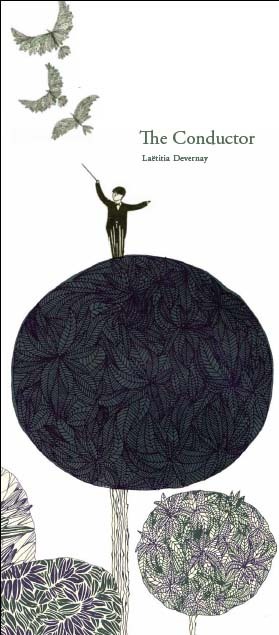
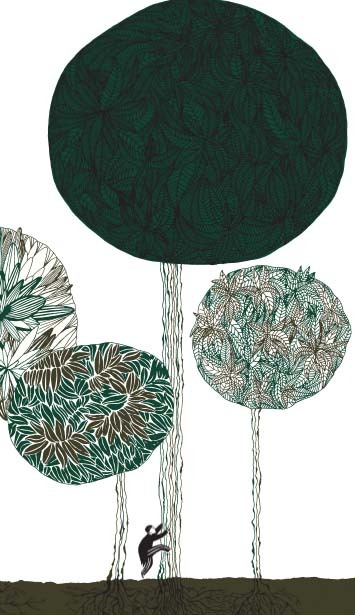
Well here's a curious thing. This hardback book is an extraordinary format for a start. Almost 13 inches high (33cm) and 6 wide (15cm), this is a tall book. Not quite as long and thin as the case a conductor might carry his baton in but not too far off and very apposite that would be. It is certainly the right format for a book that takes trees and turns them into something else entirely. Laetita Devernay is an award winning artist and author of several books for children. This volume would suit all ages and particularly those with a love for classical music or art and design. Told without words, this is the story of a conductor who walks into a forest, climbs a tree and creates a symphony of movement and pattern from the trees around him.


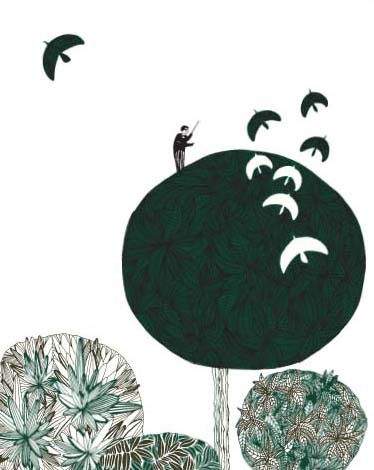
Devernay deftly lifts the leaves from her trees and transforms them into flying birds. Slowly at first, just one, then a few more, the movement building just like a piece of classical music.

And just as with an orchestra there are different tones to be struck with the differing patterns and designs of the neighbouring trees and as they all slowly achieve flight and combine in the air they leave behind their earthly stability and luxuriate in the open space of the sky.


For the reader this actually means the page becomes dominated by the patterns of these 'birds' in much the same way as the decorative patterns of William Morris. There is an easy visual pleasure to be enjoyed from flicking through the pages of this book that comes not just from the aesthetic beauty of Devernay's illustrations but also from the movement she has been able to 'orchestrate.' Your eye moves about the page just as I'm sure she intended it to and though the book may be short and its lasting impact limited it is a fascinating combination of book, art, narrative and movement.

Read more...

Tuesday, 4 October 2011

'Fuck 'em'


Made In Britain
by Gavin James Bower

I know I'm just an arty-lefty-ponce but I'm sure I wasn't the only person to wrinkle their nose when Kenneth Clarke talked about a 'feral underclass' in the wake of the riots and looting that appeared across the country this summer. I won't get into any kind of analysis of those events (we get on so well here talking about books, let's leave politics out of it) but Gavin James Bower has written, with the kind of prescience that novelists probably dream of, a novel that gives us direct access to the lives of three teenagers who are exactly the kind of person that Mr Clarke would like to put in a box and forget about.

I live on Every Street, in a town that's so common it might as well be called Every Town.

The town remains unnamed throughout this novel and that of course is the point. It could one of many towns in the north of England, the kind of place where old industrial buildings aren't turned into fancy flats but are left to fall into ruin. In this town we meet three teenagers, all on that frightening cusp of early adulthood; the period of exam cramming, raging hormones and dangerous experimenting with the world of the adult. Russell Crackle lives with his mother who suffers from depression, his father no longer living with them. As well as a curious surname Russell is saddled with another disadvantage amongst his bullying and brutish peers: intelligence. There is one glimmer of hope in the form of his cousin who lives in Leeds and where Russell might be able to realise his potential if only he can slip the bonds at home. His sections are addressed to a friend of his who commited suicide although we sense that Russell has always struggled to make real friendships with those around him and his sense of alienation is palpable when he considers their drug-taking, drinking and sexual exploits, 'When did enough stop being enough?'

Hayley is also living with a single parent, but it is her mother who is absent having died of cancer, her father combining work and care. Like many of her friends she dreams of being famous without any clear idea of what she'd like to be famous for. In her struggles to keep up with the bragging of other girls in the school she begins an ill-advised relationship with a teacher, something which threatens to distract her from those upcoming exams. She also has the hots for Charlie who could be said to be the novel's linchpin. Charlie still has both his parents at home but his father is drunken and abusive to both wife and son and his mother is understandably a shell of her former self. Charlie is the classic example of a kid far cleverer than he realises but who doesn't have the right outlet for that intelligence He also articulates the hopelessness felt by many children growing up in a society where the usual standards of work and reward seem to be leap-frogged by others.

...nobody from round 'ere ever amounts to owt, unless they become a Premiership footballer or win the lottery. I'm only OK at football and don't play the lottery - so basically I'm fucked. 

It is from a Pakistani drug dealer that he gets respect and encouragement and Charlie becomes the acceptable (white) face of that operation amongst the non-Pakistani community. Will he manage to use that opportunity to build up the stash of cash he wants to give his mother to allow her escape or will he be another life absorbed into the violence of drug gang culture?

That theme of escape is very important. All three of the teenagers in this triangle have notions of escape from their circumstances, no one wants to remain trapped in this Every Town, and our teenage years are in themselves all about escape from childhood into adulthood (and sometimes even back again when things become too much). But there is another subtler way in which these children are trapped which whilst not a modern phenomenon certainly seems at odds with our concept of parental care today. Each of them is in some ways trapped by their parents and the demands they make for care from their own children when it should surely be the other way round. Russell is most obviously prevented from making his escape by the suicidal threats of his mother, Charlie by his duty to earn enough money to finance his mother's escape from domestic abuse and even Hayley is paralysed slightly by the remorse that comes from her mother's death and the impact that has on her widowed father. It is possible it seems in our attempts to make all roads open to our children to leave them with little choice to make at all.

Whilst reading this book I wondered what sort of classification it fell into, it seems to straddle some kind of line between YA and adult fiction. There are some fantastic observations about the lives of school children, the strict code of school coach seating arrangements being just one (hint: if you're anywhere near the front then you are very low in the food chain) but it's possible that some adult readers might find a want of complexity in the teenage narrators. I personally struggled to remain much more than an observer having experience a childhood so far removed from that described but that lead me to wonder whether this book might usefully straddle that invisible line between age groups, providing a useful insight into the worries and occupations of today's youth whilst also speaking directly to at least some of the very varied people who found themselves caught up in a wave of disaffection that could only find expression in broken windows and stolen merchandise. It is those that feel frustrated enough to take direct action like that who might most benefit from reading this novel, proving once again that art has the ability to speak to and influence young people in a way that politics never has.

Read more...

  © Blogger templates The Professional Template by Ourblogtemplates.com 2008

Back to TOP