


Showing posts with label comics. Show all posts
Showing posts with label comics. Show all posts
Tuesday, 25 November 2014


Monday, 27 October 2014
Tuesday, 7 October 2014
Monday, 8 September 2014
Monday, 30 June 2014
Monday, 3 March 2014
Saturday, 25 January 2014
Wednesday, 11 December 2013
Friday, 18 October 2013
Graphic Novel Roundup
The Park by Oscar Zarate
The Encyclopedia of Early Earth by Isabel Greenberg
Lighter Than My Shadow by Katie Green.
Friday, 16 August 2013
Tuesday, 4 June 2013
Wednesday, 20 March 2013
The Silence of Animals - Montague Terrace
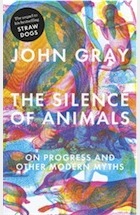 The Silence of Animals - John Gray
It was over a decade ago that I read John Gray's provocative book Straw Dogs: Thoughts on Humans and Other Animals. It really was like a shock to the brain filled with incendiary thoughts that infused and infuriated me in equal measure. Its hard after the intervening years to remember much of the detail of the book (it's hard after those years and the arrival of two children to remember much at all) but one thing remained very clear in my mind and that was Gray's huge mistrust in the Enlightenment idea of progress. This he felt was the biggest lie that we humans tell ourselves; not only that we are by nature different from the other animals on the planet but that our achievements in science and technology are making our lives anything more than superficially better. As he expresses in this new book - 'Lacking a self-image of the sort humans cherish, other animals are content to be what they are. For human beings the struggle for survival is a struggle against themselves'. The Silence of Animals is billed very much as a sequel to that book, developing on those same themes to further illustrate how we delude ourselves with notions of progress and content ourselves with fantasy and myth in order to support those thoughts.
Whereas Straw Dogs read like the thoughts of the author, backed up by occasional literary sources, this follow up is far more like a companion piece with much deeper references from other works of literature. Borges, Orwell, Ballard and Conrad are all cited and having read some of the writers he quotes in the intervening years I was able to confront the thoughts head on and find them stimulating in a different way to those I had had to take for granted when reading the first book. But my overall impression on finishing the book was that this was less a development of his ideas than a reinforcement of them. It was as though Gray had spent the last decade finding support for his personal philosophy in the literature he read and now wanted to share it as if to say, 'See, I'm not the only one.' This is fine, naturally, and there are lots of interesting thoughts along the way, particularly when examining our propensity to fiction and how it shapes our lives and Gray's thoughts on how the whole concept of talents might be a terrible straitjacket on our personal potential rather than the best way to realise it. It just means that this volume lacks some of the fire of its predecessor and will probably further annoy anyone who took exception to his thoughts from then too.
There is an interesting battle as well with biblical references and images. Gray frequently aims to show that there is very little difference between the comforts of organised religion and religious faith alongside the faith that accompanies the Enlightenment ideal of progress. If religion is the opiate of the people then 'like cheap music, the myth of progress lifts the spirits as it numbs the brain'. We must all have at least occasionally wondered about the very meaning of life, the reason for us being here, and Gray is determined that we should let that thought go
Why do humans need a reason to live? Is it because they could not endure life if they did not believe it contained hidden meaning? Or does the demand for meaning come from attaching too much sense to language - from thinking that our lives are books we have not yet learnt to read?
We fictionalise our own lives and if we could only accept that, Gray asserts, and also that our world is without meaning we might discover not a loss of value but that 'this nothingness may be our most precious possession, since it opens to us the world that exists beyond.' How you may react to that and other thoughts will be entirely personal of course. Gray I'm sure will content himself that T.S Eliot said it best in Burnt Norton - human kind cannot bear much reality.
Published now by Allen Lane
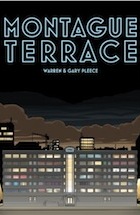 Monatague Terrace by Warren and Gary Pleece
Animals also feature in this graphic novel from the Pleece brothers in the form of an unforgettable rabbit, Marvo the magic bunny, companion and co star to a rather shambolic magician called Marty. They are just two inhabitants of the fading Art deco housing block that gives the novel its name and which contains more nuttiness than a Reece's peanut butter cup.
 The book is made up of 12 main stories and a few interludes and through them we meet the varied inhabitants of this bonkers building. Each of the stories is as tenuously linked as we all might be to the comings and goings of those around us but also by something slightly deeper relating to the building itself. There is a faded singer who sits around listening to his biggest hit, a bright young thing novelist with writer's block, a genius scientist with a price on his head, someone calling himself The Puppeteer, and an old special forces operative who may look like a granny but who hasn't quite given up the fight yet.
Given all the craziness this is a pretty disparate novel and how well it all holds together will depend on how many of the stories you really connect with. The device that holds them all together might come across as a bit silly and even nostalgic, and that's the prevailing feeling I was left with; something like the curious quality that comes with watching Tales of the Unexpected. This book is easy to read and to enjoy but there's not enough beneath that Art deco facade to send me back in again.
Published now by Jonathan Cape Read more...
Tuesday, 19 February 2013
Give Me Everything You Have - Eustace - Benediction
Give Me Everything You Have: On Being Stalked
by James Lasdun
 Well here's a powder keg of a book. Let us start with a quick summary of what it is. In 2003 the poet and writer James Lasdun was teaching a fiction workshop at 'a place I'll call Morgan College.' Among the students there was a woman 'I'll call Nasreen.' Lasdun praised a piece of her writing in one class and after the course ended an email correspondence began in which Lasdun hoped to help her in some small way with the novel which she was writing and also he hoped to maybe make a friend of someone he found interesting and different. So far, so innocent. Or is it? Lasdun is at pains in the opening chapters to examine his behaviour at the outset because what developed was a prolonged campaign of obsessive emails, abuse and cyber-bullying in which she tried to besmirch his name and character in a variety of ways leaving Lasdun himself not just shaken and confused but ill as well.
The book is peppered with excerpts from these emails (Lasdun aware of the irony that in quoting so freely from this private correspondence he is behaving in exactly the way that he so deplored in her when she copied other people in on her own emails to him and used the public sphere of Amazon reviews and Wikipedia entries to further muddy his name) which start off friendly and funny, gradually becoming amorous and slightly inappropriate, before becoming suddenly vitriolic, violent and filled with hatred, anti-semitism and delusion. These emails are as baffling for us to read as for Lasdun, if not as personally upsetting. They also caused me a certain amount of unease. Firstly that they were obviously selected from a larger body of correspondance; then that they were often quotes or excerpts and one wondered about any possible context within the rest of the email. Jenny Turner in her Guardain review said that this is a book plagued by too much information and also at times not enough. It was the not enough part that concerned me most.
Taken at face value this book makes clear that this was a campaign of 'verbal terrorism' that Lasdun suffered. The reasons for Nasreen's behaviour are never satisfactorily explained and Lasdun even prefers not to think of her as being mentally ill but someone motivated by a motiveless malice. But how can we not regard her as someone clearly suffering from some kind of mental distress? We just don't know enough about her from this one-sided account of course, and I don't say one-sided in a purely pejorative sense - what else could Lasdun write, however balanced a writer he may aim to be, when attempting to tell such a fraught tale and one in which he is implicated? Reading this as an account of something with a quasi-legal standing (we feel as though this is in many ways a book about a crime being comitted, a book with a victim, protagonist and law enforcement officers) makes for a lot of frustration, Nasreen cannot defend herself and even if we accept Lasdun's inference that she couldn't add anything of any value we can only do that if we accept it all.
If it doesn't quite work as a book of true crime then there are two other ways in which it potentially succeeds. The first of these is probably closer to the way the book is being sold: as a memoir. Lasdun uses this event to write about several other works of literature (you may never need to read another book about Gawain and the Green Knight for example) that illuminate the experience and these sections are fascinating, lucid and wonderfully written. There is another riskier suggestion, a million miles away from the way in which the book is being marketed and that is as a piece of extraordinary experimental fiction. I drop that here merely as a catalyst for discussion, it was something that came up during a little conversation of Twitter the other day, and whilst it may not be true it certainly adds a completely different way of approaching what is an interesting, complex and very troubling reading experience.
Pubished now by Jonathan Cape
Eustace by S J Harris
This debut graphic novel from cartoonist Steven Harris may have some colour on the cover but every page inside is black and white, or rather the many shades of grey in between thanks to his deft and detailed pencil drawings. Eustace is a sickly young boy, exiled to a lonely room in a large house where he is really only visited by the maid, Mrs Perichief, each day as she brings him his stable fare of soup ('not even any kind of soup, just "soup". It's thin and yellowy like old skin.'). Through the novel however he is gradually visited by an ever-growing array of grotesques, beginning with his dreaded great Aunts with their sloppy kisses and secret gifted sixpences. What exactly is going on in Eustace's family is never fully clear although we gather there is some trauma related to his brother Frank, who served in the Great War. Eustace's mother makes a ghostly appearance, ravaged by life, and his father even stumbles into the room, barely able to recognise the son he never sees.

It is the sudden appearance of Eustace's uncle Lucien however that really gets the party started and Eustace's bed becomes the focal point of a congregation of crazies whilst all the while in the background is the hint of something dark and dangerous in Lucien's past that is slowly closing in on him. To my mind Harris's drawings combine the long lines and monochrome of Aubrey Beardsley with the sunken-eyed macabre of Tim Burton. There is something feverish or nightmarish about the procession that passes through the room and one wants to constantly put an arm around poor Eustace and sneak him away somewhere. There is nothing we can do however to protect him from the novel's surreal and comically absurd ending.
Published by Jonathan Cape in March
Benediction by Kent Haruf
 It's been a while since Kent Haruf featured on this blog but then it's been a while since he wrote anything, almost ten years in fact since he last wrote about the residents of his fictional town of Holt in Colorado. You can read my thoughts on Plainsong and Eventide and imagine my excitement when I heard that he had written a new novel that would take me back amongst those familiar faces. I was worried I might need to familiarise myself with the previous books but his new novel stands alone and in fact has little to do with any characters from the previous books. The main focus is on 'Dad' Lewis, owner of the hardware store, who receives the news that he is sick with cancer and has just a few weeks left to live. We will also follow the descent of the new preacher and the way in which the women of the town envelop a young girl without her mother but it is Dad Lewis who forms the novel's heart and around whom the people of the town will congregate.
The surprise is that about a hundred pages into the book I wasn't sure that I wanted to carry on. I'm so glad that I did. Haruf's style is deceptively powerful you see. The prose is simple for the most part, the speech direct, the situations fairly everyday, we observe along with the new preacher 'these everyday lives', but what builds inside that structure is a wave of emotion that overwhelms the reader as the book progresses. There are moments that edge toward the melodramatic and the whole novel flies dangerously close to sentiment but in the central story of Dad Lewis in particular you have a sensitive, truthful and painfully affecting story of life, work, relationships, family, alienation, ageing and mortality; the stuff of life in other words. The way in which it manages to combine both the dignity of the way we behave with the indignity of the way our bodies betray us is masterful and there was at least one occasion when I was powerless to stop the tears welling in my eyes.
Published by Picador in April
Read more...
Thursday, 3 January 2013
The Explorer - Doppler - First Novel - The Making Of - Still - Kandak - Ghostwritten
Short of time but keen as ever to talk about the books I read you will have to indulge me a little as I compromise with a quick round up of several books that are worth mentioning. I apologise for not being able to go into as much detail as I normally would but I hope that something will be better than nothing (but please let me know if you disagree!)
The Explorer by James Smythe
 Towards the end of last year I entered a proper reading funk. I couldn't engage with books I was reading at all, gave up on one after another, often knowing that they were probably really good. I was just too tired and stressed to read, a big worry for someone so keen on reading. I had a little break and then picked up this new novel which a couple of other bloggers had mentioned favourably and which I thought might be just what I needed. It really was. Smythe's novel is narrated by Cormac Easton, a journalist chosen to document a groundbreaking journey into space that will take humans further than they have ever travelled before. However, the crew of the Ishiguro gradually perish one by one until Cormac is the last survivor. What follows is a brilliant examination of fear and grief, remembrance and memory, loneliness, exploration and time. I love space movies but the problem most of them seem to suffer from is that whatever interesting themes they set up in the beginning they nearly always dissolve into humans being chased about by something or other and once you've seen Alien that can't really be topped (yes, Sunshine, I'm looking at you). Smythe's novel does almost the opposite. In a breakneck opening we witness the demise of the crew and the reader is left wondering how on earth he might fill the rest of the novel. I won't give away the brilliant device that is this novel's twist but only say that it is a coup that allows Smythe to make the novel far more philosophical, interesting and moving than I suspect most 'science fiction' to be (I know, I'm probably wrong on that). This novel, very similar in feeling to Duncan Jones' film Moon, comes highly recommended and a huge thank you to the author for breaking my funk and getting me reading again.
Published by Harper Voyager now
Doppler by Erlend Loe
 The cover to your left makes this look like a perfect Christmas book and in many ways it is but not at all in a traditional sense. The eponymous Doppler is a man who seemed to be leading a successful life in Oslo until an accident whilst on his mountain bike leads him to reappraise things altogether and determine on leading a solitary existence in the woods where he will live off the land. His resulting hunger leads him to kill an elk in the novel's opening pages and whilst he is successful in that endeavour providing himself with food to eat and meat with which he can barter for other supplies he also finds himself encumbered with that mother's baby elk as a surrogate child. Soon christened Bongo, Doppler uses his new companion as a sounding board for his various foibles with modern society and the two of them struggle to maintain their Eden in the wilderness as various other characters encroach on it. The quirk factor might put off some readers but I found it to be both funny and sharp-witted, a perfect antidote to the commercialisation of Christmas and a great (if belated) stocking filler for anyone in your family who tends to say bah humbug around tis time of year.
Published by Head of Zeus now
First Novel by Nicholas Royle
 Already an early contender for cover design of the year, Nicholas Royle's latest novel has far more going for it than that. That title and those very recognisable 'clean white spine with plain black lettering' paperbacks on the cover might lead you to think this is his debut published by Picador but it is actually Royle's seventh novel, albeit his first under the Jonathan Cape imprint. There's lots of other bookish fun along the way as we follow writer, Paul Kinder, author of a novel which didn't do terribly well, now a teacher of creative writing and avid collector of first novels. This meta-fictional novel has many strands to it and part of the fun is trying to work out where you are half the time. Along the way we will encounter, housebreaking, dogging, fighter pilots and loss of various types, in a novel which shows how we all use narrative to shape the story of our lives. A strange, unsettling brew that simply entertains at first before revealing darker and more dangerous depths as it progresses; a dark and delicious treat for lovers of literary fiction who like to have their grey cells tickled.
Published by Jonathan Cape now
 Brecht Evens makes the most gorgeous graphic novels. His first, The Wrong Place, had me smiling and admiring at the end of 2011. His latest built on that promise at the end of last year and showcases yet again his glorious watercolour work and fresh approach to graphic storytelling. Watercolour is an odd medium for graphic work, especially in the free-flowing style that Evens employs. Character is often simply delineated by colour or distinguishing features and it is an incredibly effective technique. One character has large hands for example, always dominating his exchanges. 'You should see my Dad's' he says and sure enough when he visits him in his hospital room on the next page what we see are those huge hands waving back. The novel follows an artist, Peterson, as he travels to a small village to work as part of a biennial festival. It's a much smaller operation than he anticipated but what follows is a hilarious exploration of artistic inspiration, expression and shortcomings. Fabulously diverse characters, artwork that leaps off the page and somehow manages to escape it at times, Evens is one to keep watching.
Published by Jonathan Cape now
Still edited by Roelof Bakker
 Roelof Bakker is a photographer who focused on the disused Hornsey Town Hall for one project which ended in an exhibition of photographs entitled Still. Bakker then approached several writers to select an image and then write a story based on it, relocating the image so that it wouldn't be about its original location but more about what that image suggested to the author. The anthology is incredibly diverse, featuring some writers I had heard of and read before like Richard Beard, Nicholas Royle and Evie Wyld. Others were completely new to me and that of course is the joy of an anthology. The pictures are wonderful and each reader is sure to find new voices they will want to keep an eye on.
Published by Negative Press now

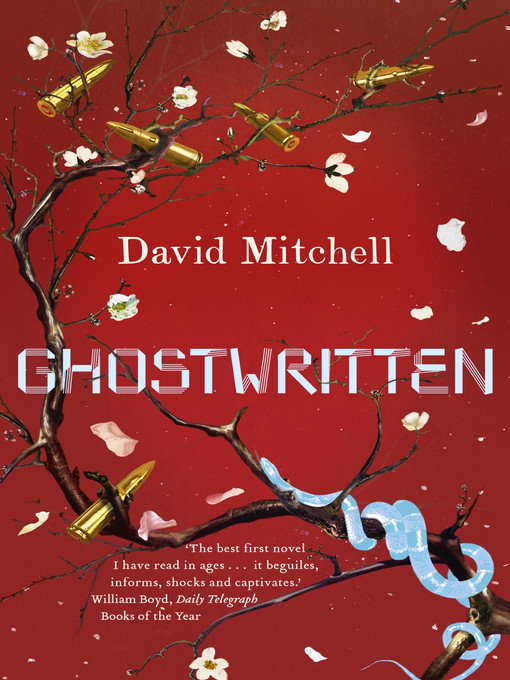
Upcoming Audio Books
Kandak by Patrick Hennessey
Ghostwritten by David Mitchell
As some of you will know I sometimes get the opportunity in my work as an actor to record audio books and I am in the process of recording a couple right now. Patrick Hennessey had great success with his first book The Junior Officer's Reading Club and Kandak follows his exploits training and fighting alongside the fledgling Afghan National Army. What comes across clearly is the confusion of the project, the clash of cultures and the suspicion that develops when things go wrong and soldiers even find themselves under attack from their own side. Hennessey is keen to write however about the bravery, integrity and comradeship that he experienced, something that brought him back to Afghanistan after he had finished in the army to search out those that had clearly become friends during his time there.
Ghostwritten was Mitchell's debut novel and after I recorded the bonkers number9dream last year I now have the task of doing justice to this multi-layered novel. Having read it before but a long time ago it was interesting to see how I felt on a second read. I was pleased to discover that I had roughly the same opinion of it as a novel, slightly daunted by the prospect of narrating effectively its very different sections but always pleased to have something challenging like that to keep me honest.
Both of these will be available unabridged later in the year from Whole Story Audio and W F Howse. Read more...
Monday, 17 December 2012
Books of the Year - 2012
Last year I made a stack of my end of year picks and took a photo to head the post. This year, having moved house and with books scattered all over the place, I'd struggle to know where exactly to locate most of the books I want to bring to your attention and indeed it was a source of considerable anxiety to me that one of them, packed specially due to its unique qualities, went missing for nigh on a month before it was finally relocated and hurriedly placed on a special shelf for safekeeping.
Anyway, 2012 has been a year filled with enjoyable books, some of which have been very special indeed. Keeping up the blog has been a struggle at times but messages of support have turned up often just when I need them and the enthusiasm of others has always been helpful when a shot in the arm has been required. I'll be absolutely honest and say that next year really will see my posts becoming more sporadic but as long as you really want to hear what I have to say then I will try and make the effort when a book really demands it. Twitter remains an exciting place to learn and share about books and when I pretty much lost the ability to update the blog recently it was there that I managed to keep talking and enthusing about what I was reading.
Below you'll find my picks of the year, a varied collection as always, books that I found in a variety of ways. I've summarised why they made the cut below but please click on the titles to read my in-depth reviews and hopefully you'll find something that you hadn't wanted to buy... until now.
Absolution by Patrick Flanery
 I read this debut near the beginning of the year but it has stayed in my mind as one of the year's best new novels, heralding the arrival of a nicely matured voice in fiction. Perhaps the most conventionally 'literary' novel on my list it actually has a rather complex structure with four narrative strands and changing viewpoints. Flanery tackles South Africa's fraught politics but also the weight of personal history and the very nature of truth itself. Ambitious and well executed it's a great read now and a very positive indication hopefully of what's yet to come.
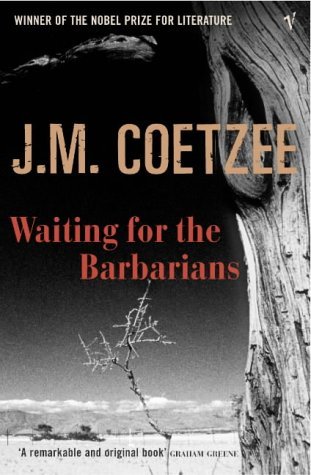 It's not all about new books and this novel from Coetzee helped to cement him in my mind as a true master. This allegorical novel of violence, oppression and control is written with the kind of universality that makes it feel like a classic; names of people or places are not important, neither is a sense of when or where exactly the novel is set. The unflinching manner of Coetzee's approach makes for an exhilarating and uncomfortable read. A novel that challenges the reader with its views and opinions but leaves you to draw your own conclusions; what more could you ask for?
A Death In The Family by Karl Ove Knausgaard
 Not many books made such an impact on me as this controversial novel and that's why when I was asked to pick just a single book from this year's output by Kim over at Reading Matters, this is the one I plumped for. Knausgaard made a Faustian pact when he decided to write about himself and his own family and the notoriety that has accompanied the publication of his six-volume, fictionalised autobiography is as impressive as the sales figures in his native Norway. Part one looks at drunken adolescence, the death of his father and the alcoholism of his grandmother. The final third is about as a grim a piece of writing as I have ever come across. A book that had me scratching my head about half way through had me itching for more when I finished the final page and with part 2 due next year I can only hope that there are plans to translate and publish the following four books.
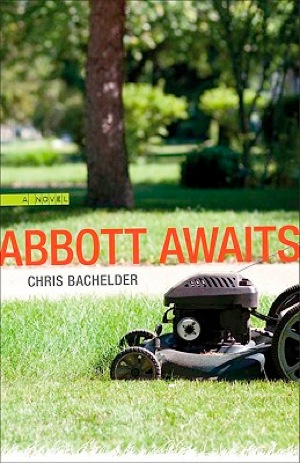 Humour. Let's be honest, it's all too often missing from the books of many 'serious' readers apart from the odd flash here and there so when a book comes along that makes you actually laugh and smile with recognition throughout then what a joy that is. Bachelder's take on modern fatherhood is hilarious, beautiful, touching and true. Little vignettes, often of just a page in length cover the final three months of Abbot's wife's second pregnancy. Just the titles of some chapters are enough to elicit a laugh and the real skill is in not allowing the book to suffer any slumps along the way. A perfect gift for any men you may know who are perhaps expecting another arrival anytime soon.
All Quiet on the Western Front
by Erich Maria Remarque
 A genuine classic that will have you mouthing the familiar refrain of those who finally tackle one of those books they always knew they should have read: 'why didn't I read it sooner?' There's not much for me to say here about Remarque's classic war novel other than that it gave me something completely fresh to think about after I'd been performing in War Horse for a couple of years, that it was a distinct pleasure to give copies of it away on World Book Night and that it's exactly the kind of book that was never in any danger when I had a book cull before moving house recently.
Open City by Teju Cole

If I'd got my act together a little sooner then this book would have appeared on last year's book list (along with lots of other people's). It is a frighteningly accomplished novel, bursting with intelligence and written in the kind of fluid prose that makes you want to devour it in a single sitting. A man wanders the streets of New York, meets friends, has a picnic and at one point gets mugged, that's about all you'll get as far as plot goes, but this book is filled with ideas and culture that keep you're brain nourished throughout and there's even a twist of sorts near the novel's end that makes you think all over again about the man with whom you've been wandering.
Leaving The Atocha Station by Ben Lerner

Hawthorn & Child by Keith Ridgway
Swimming Home by Deborah Levy
 My favourite read from this year's Booker list was a triumph for small publisher And Other Stories and I very nearly included another of their titles, Lightning Rods by Helen De Witt, in this list but decided to mention it here and free up one of these limited berths for another fabulous book (very briefly, Lightning Rods is a whip smart satire that is funny, clever and shocking - read this review for more). Levy's novel is slim but packed full of resonant images, enigmatic characters and telling details. There's a wonderful darkness that clouds proceedings and seldom has there been such an enjoyable sense of being unsettled.
Train Dreams by Denis Johnson
Look, I don't know how many times I have to tell you to read Denis Johnson but will you please just READ DENIS JOHNSON. The fact that the Pulitzer board didn't award a fiction prize this year is bad enough but the fact that they did it when a novel(la) like this landed in their laps in downright scandalous. Johnson's collection of writings is so eclectic and varied that it's difficult to say exactly where this fits in the cannon but as a fan of his I can say that I was surprised by the richness and reward that came from such a slim book, previously published as a story in the Paris Review, thankfully given the proper treatment by Granta who had a storming year with three titles in this best of list.
Building Stories by Chris Ware
Also worthy of note: Mrs Bridge, Dr Haggard's Disease, Seven Years, Days of the Bagnold Summer and so many more.
Emperor's New Clothes: HHhH and The Yellow Birds.
Read more...
Tuesday, 16 October 2012
The Nao of Brown - Glyn Dillon
'hafu'

Self Made Hero is an independent publisher of graphic work that has been quietly getting on with things for 5 years now. Making a name for themselves first with graphic versions of classic novels and manga Shakespeare they have widened their net to include crime, sci-fi, biography and more. I'm really interested in the project they began last year however: Original Fiction. I've already reviewed David B's Black Paths and the unsettling Sandcastle from Pierre Oscar-Levy and Frederik Peters (another piece from Peters, Pachyderme, is published this month too) and now comes another to trump them both; a stonkingly good book that deserves its 'original' tag.

Nao Brown is the heroine of novel. That's her on the left. That unusual name comes from her being a 'hafu', half-Japanese, half-English but also seems important when we learn a bit more about her; living in the now, the present moment, is going to become an important notion as we read her story. Nao suffers from Obsessive Compulsive Disorder (OCD) although her variant is purely obsessional, not the hand-washing and door checking that we might be familiar with but morbid fantasies about sudden violence towards those she interacts with which require a locked cutlery drawer at home and several meditation techniques to try and control those urges.
This is where Dillon makes great use of the graphic format. As our eyes follow the panels, Nao's sudden obsessional thoughts take us by surprise as much as her. They may flood the picture with a red wash or simply appear as a calm extension of her surroundings as in the panel below where a simple airplane flight is fraught with danger with her having been sat right next to the emergency exit.

Nao works in a specialist, boutique toy-shop with her close friend Steve and it is while she is working there one day that she meets Gregory, a washing-machine repair man who will become her latest obsession. This is in part because of his resemblance to a character in her favourite comic series, Ichi by Gil Ichiyama. Both Ichiyama and his comic series are another invention of Dillon's and function as a comic within a comic, allowing him to showcase an entirely different graphic style to the watercolour that dominates the main story (There is even a specially created Ichi website). The contrast in styles is marked and shows Dillon's love for Japanese comic art. You can read more about his two artistic approaches and indeed see how he builds up his artwork in another fantastic 'Director's commentary' on the Forbidden Planet site.

Anyway, Nao's story is firstly one of the ways in which she deals daily with her disease; the constant marks she gives herself out of ten to rank her mental state (with 10 out of 10 being the worst end of the spectrum) and the repeated mantra, 'Mum thinks I’m good' there to remind her that she is not the person who actually breaks the taxi-driver's neck or pushes someone in front of a train. It is also one of her search for love, failing to see where it has always been and struggling to recognise the obstacles that stand in the path she tries to follow. Nao is a character that the reader cannot help but have huge sympathy for mainly because Dillon draws her with such a brilliant knack for character through expression that I found myself completely charmed by her raised eyebrow, her winning smile, her innocent eyes and her desperate need to find some control. In fact Dillon's skill at capturing expression and gesture is worthy of significant praise, as is his beautiful watercolour work. A brilliant quote on the back of the book comes from Jamie Hewlett (creator of Tank Girl and Gorillaz) who says 'The artwork makes me jealous, the storytelling makes me even more jealous and the watercolour painting just pisses me off!' Admiration from one's peers is always welcome, their envy must mean you're really doing something right.

It's also worth pointing out that Self Made Hero have done an amazing job in the production of this book. Beneath the dust-jacket one finds not only a wonderful design embossed onto the white boards beneath but a large map that covers the inside of the dust-jacket when folded out. The paper inside is a wonderful high-quality matt that perfectly suits the watercolour artwork and the pages have even been stained red at their edges to continue the red, black and white colour scheme. All in all, a publication to be applauded, but more importantly than that: read and enjoyed. Read more...
Thursday, 4 October 2012
Building Stories - Chris Ware
'in pictures revealed'
The space above the first line of my reviews is for the cover image of whatever book it happens to be. A review of a graphic novel will often be accompanied by a few other pictures of the work itself to give you an idea of the artwork and design. Both of those features seem somewhat inadequate when writing a post on Chris Ware's latest, an opus that he has been working on for years. Building Stories is a collation of strips previously published in the Nest Magazine, The New Yorker, Kramer's Ergot, and the Sunday New York Times Magazine. These diverse strips may have been finally brought together but this is a graphic novel with no clear beginning or end. Published as 14 separate books, booklets, newspapers and something that resembles a game board this is a cornucopia for Ware enthusiasts. It is a vast and beautifully produced collection of work, boxed with great attention to detail. This is just what you might expect if you have read Ware before or if McSweeney's has ever popped through your letterbox. In fact this book reminded me very much of a combination of McSweeney's issue 13 (a collection of comic strips curated by Ware) and 17 ("Made To Look Like It Came In Your Mailbox") and it's important from the off not to let the presentation of this work blind us to whether it is actually any good or not. This kind of thing has been done before and we should ask whether the box of goodies adds anything to the reading experience, becomes an inherent part of it, or whether it possibly detracts from its impact.

I'm being a bit unfair there. Not to Ware, but to you because I'm making it sound like I might start criticising this amazing work when in fact I love it. I loved it when it arrived via courier and I removed it from the world's largest jiffy bag. I actually hugged it to my chest once I had it in my hands. I then spent several weeks working my way through it at a leisurely pace, rationing myself to make sure that I didn't rush through it and find myself bereft too soon. I won't say it was a joy to read, anyone who has read any Ware before will now that joy isn't an emotion that appears to easily, but it was a pleasure and a privilege to be able to read it before anyone else's opinion appeared, savouring each section and allowing the work to come together in my own mind in the way I had happened to assemble it through the choices I made in which booklet to read next. This is the most remarkable thing about it. It has no set beginning or end and it is up to the reader to decide which order they read things in. If it is true that we impose a narrative on our own lives then the really revolutionary thing about this graphic work is that we the reader impose the structure of the narrative onto the lives of its three main characters. How we read about them and the order in which we do so cannot help but alter the way in which we experience their stories and so each reader is going to experience the book in a different way, something that would be true of any book of course but even more so with this one that doesn't determine the way in which the reader might read it. But the fact that there is no set order doesn't mean that there isn't an order. Reading against the strict chronology can throw up some interesting conflicts. It would for example be interesting enough to read about a woman who desperately wants a child and who finally achieves it but it's even more interesting to read about a woman struggling with the realities of motherhood and then to see how much she desired it in the past.

Building Stories focuses on a three-storey building in Chicago. It has three main tenants beginning with the old lady who owns it on the ground floor, a couple breaking apart on the first floor and woman who longs to be a mother on the top floor. Ware doesn't stop there, he also gives us two comics dedicated to 'Branford, the Best Bee in the World', a worker bee who tries to be a good husband even whilst he fantasises desperately about having it off with the queen. He also allows the building itself to become a character, not in the usual literary sense that reviewers are fond of noting to show how well written a location or locale might be but in a very real sense; the building is given a voice, it narrates the odd panel, intrigued by its inhabitants having seen so many come and go.
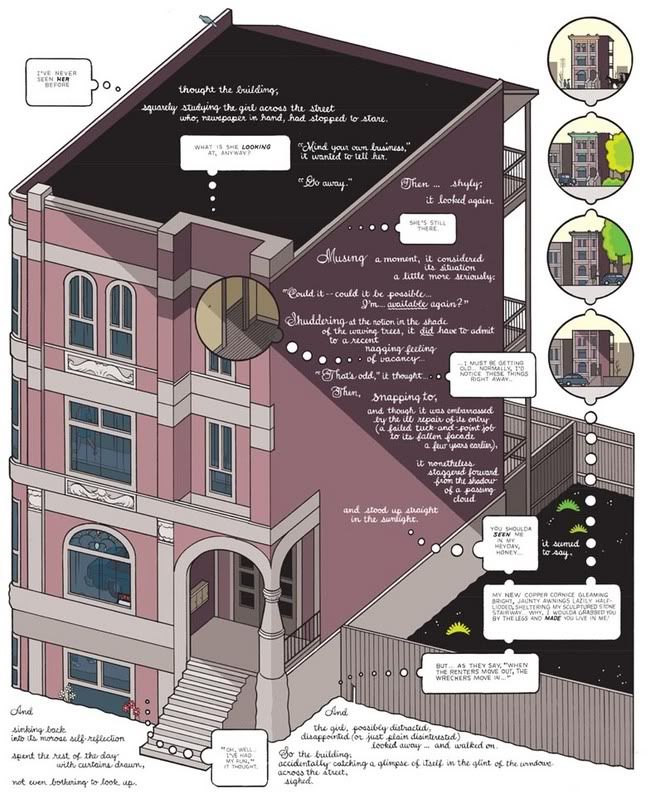
I don't really want to say to much about the trajectories of the main characters but for those unfamiliar with Ware's work it might be worth mentioning some of his preoccupations. The spinster on the ground floor spends much of her time thinking about the past of course, providing a link with the building's own beginnings and a different era in Chicago. She isn't the only though. The woman on the first floor who has such an abusive relationship with her boyfriend naturally thinks back to when they were happier and she felt more attractive. Even the woman on the top floor, who eventually comes to dominate the piece as the main protagonist, who seems to be so forward thinking with her wishes for the future cannot help but look back on her past relationships and family life even at the very moment that she begins to achieve some of what she has always longed for. She will eventually move out to the suburbs with her partner and daughter but this only brings a new set of anxieties and troubles

This is not a book to be reading if you're at a low ebb. Let us be very clear about that. Ware's world view makes for pretty depressing reading. A friend of mine picked up a small booklet when I first unwrapped the bundle at work and started to read it. It is a narrow letterbox of a booklet that details in small panel after small panel nothing less than the spiritual vexation of motherhood. It is a tough thing read even though it contains very little to actually 'read', leaving you exhausted and heavy by the end and like you need a lie down. My friend handed it back almost shaking her head, very unsure of what it was she had just experienced (she is a mother herself) but certain I think that she wouldn't be rushing back for more. It isn't just the format of this book that requires time of the reader but the content of it too. It isn't the kind of book that you're going to want to rush through, it takes time to absorb the detail of each page, the aesthetic of each section, the assimilation of the whole and even after you've finished the work in its it's going to take some time to process. Once you've done that though I think you're actually going to want to read it again. How does he do that?!

I said at the beginning that we should be careful not to just say 'Ooh, pretty' and proclaim this as a work of genius before looking a little deeper at the content. If you will accept from me that there is plenty of content to be getting stuck into then we can now go back and praise this book for how damn good-looking it is too. Yes, it has been beautifully produced; yes, you are going to want to handle all of it an awful lot; yes, you are going to spend every minute required to read the painfully small text on some pages and follow some of the equally small panels on their waltz around the page. The construction of some pages, the eye for detail and symmetry, the architecture of the comic itself is breathtaking at times. There are several large double-page spreads which will take a good reading session to take in and at the end of it I found myself actually sighing with contentment, even at the same time as I might be wincing with regret and pain at what I had just read. The sheer number of hours that must have gone into making this book are perfectly reflected in the hours of enjoyment that you will receive in reading it. That is a rare occurrence in the graphic medium, where all too often the long stretch of an artist's endeavours can be flicked through in a matter of minutes so that even if we really enjoy them it is hard to really savour them.
I also questioned in my review of The Tale of Brin and Bent and Minno Marylebone where we might find the graphic work that utilised modern technology in its production. Ware's work isn't using any boundary breaking technology in its execution but it does engage with the modern world and its use of technology. Mobile phones, text messages, laptops, e-readers and tablets all make an appearance but so too does the loneliness and isolation that accompanies them. He shows the absurdity of couple sat opposite each other, each focused on their own screen, their faces illuminated by the glow that emanates from them. He shows the impossibility of reading tone in text communication and the huge frustration that often lies disguised behind it. There is a heartbreaking section in which our heroine stands naked before her partner, the awkwardness of her nakedness and the fact that this is something of a pre-arranged assignation based on the daily timetable of a pair of parents with a short gap in their responsibilities made even more acute by the fact that her partner (himself lying naked on the bed with his penis lying flaccidly on his thigh) is so wrapped up in the cool glow of his iPad that he hasn't noticed her standing there at all.
If you've read Ware before then this is probably on your Christmas list already but if it isn't or if you're reading this with an interest in his work or in graphic novels in general then do yourself a favour and get it on there. You can buy it from today for less than twenty pounds. That is bonkers, frankly. It's a beautifully made thing that would be worth the money even if the content wasn't as good as it is, but the fact that Ware shows once again that he's an innovator of the form, able to direct the eye around the page quite unlike anyone else, and that he puts so much of the decision making power into the reader's hands is probably the biggest gift of all. Treat yourself, or someone else. It even comes ready-boxed. Read more...
Tuesday, 7 August 2012
The Tale of Brin and Bent and Minno Marylebone - Ravi Thornton and Andy Hixon
'dreadful desires'

I am, as you will know if you read this blog with any regularity, a fan of the graphic novel. This is partly to do with the form and its possibilities when compared to prose but I would have to be honest and say that a lot of the time it has to do with aesthetics. I like pictures, I like artwork, I am often drawn to graphic novels whose artwork does something for me. But for all their innovation with storytelling techniques the vast majority of comics and graphic novels that I see remain very traditional in their execution. They are drawn, sketched, occasionally painted but more often than not firmly rooted in the artistic techniques that have existed for many, many years. Where then are the graphic works that utilise the tools of the modern era?
Well, one look at the front cover of this new work from writer Ravi Thornton and illustrator Andy Hixon tells you that this is a book that has little to do with pen and ink. That said, it would be wrong of me to say that this is imagery created solely in a computer processor, far from it, as Andy Hixon's work is all sculpted from clay of one sort or another, decorated with a dab of paint before being photographed and then 'taken into Photoshop for arranging, colouring and texturing.' This combination of traditional sculpture and computer manipulation gives the images a look that I have never seen before in graphic novels, looking both real and impossible, hyper-real or dream-like, unsettling throughout. This book is also a riposte to those who think comics are only for kids. This is a very adult and disturbing tale that manages to be both terrifying and almost romantic by its final pages. On a first read it is almost too upsetting but each subsequent experience shows the beauty of the work that has gone into it.
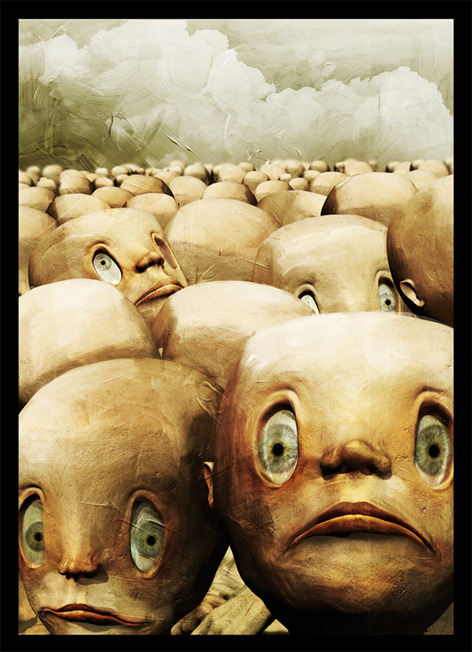
Before they met Brin and Brent were considered dysfunctional, 'Disordered, destructive, sexually shambolic. She is rattled. He is loose.' When they meet and come together 'they are truly insane' and yet they manage to present themselves at The House of Care for the Grossly Infirm where they are employed together. Set within spare grounds the house holds Those Committed and another building called the Rehabilitation Pool. It is in the pool that Brin and Brent work, keeping the tiled floors clean with bleach that burns the soles of Those Committed and the water chlorinated above safe levels so that they flail and moan whilst Brin and Brent retire to their den to watch through holes drilled in the wall and to 'celebrate disgust' with sessions of 'hard beating, hard sex.'

Into this dark set up comes an innocent looking child called Minno Marylebone who lets herself through the back door into the pool each night and bathes in the waters there. This regular ritual of hers happens unbeknownst to the pool's guardians but we have a nagging sense that she will not be able to keep her visits a secret and a creeping unease about what might happen to her if she is discovered.

I won't spoil it any further by telling what happens in the third section of the book, only that we are told in that final chapter, 'That Brin and Bent catch Minno Marylebone is perhaps the most fortunate thing.' Italics are the writer's own. Perhaps the most intriguing thing about the book is that it is prefaced by a comment from Thornton in which she confesses that the tale is a metaphorical rendering of 'something bad' that happened to her in the past. It is one of those things I am both keen to know and scared to even ask about. Both Thornton and Hixon have provided a director's commentary on the making of the book which is an interesting read, particularly the part about images being censored by the printers. The book is also much more than a simple book having already spawned a musical score and with a ballet app in the pipeline. A ballet app? I hear you ask. I have no idea, but everything about this partnership and this book has me yearning to know more. You too hopefully.
Read more...
Tuesday, 19 June 2012
Days of the Bagnold Summer - Joff Winterhart
'her beautiful boy'
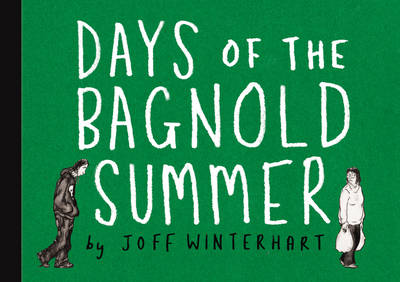
I had a sneak peek of this graphic novel many months ago and there was a very warm buzz about it in the Jonathan Cape offices. Joff Winterhart was the runner up in the 2009 Observer/Cape graphic short-story prize (you can see some panels here which appear in the finished book in a slightly altered format) and this book exhibits a humility which goes beyond the page and onto its letterbox format and unassuming cover. It's a charming collection of strips that I read with a smile on my face and finished with an immense sense of satisfaction.
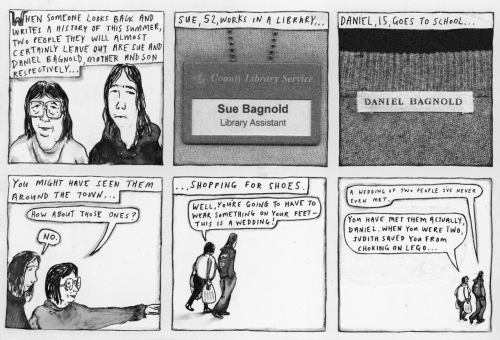
Daniel Bagnold is a 15 year-old fond of all-black clothing and Kerrang! magazine. The summer in question was one he was supposed to spend with his father, his father's pregnant new wife (who'd "rather be seen as a friend") over in Florida. But with that baby nearly due the plans are cancelled and Daniel instead faces six weeks at home with his mother, Sue, and dog, Maisie. What follows is a beautifully nuanced portrait of the mother/son relationship in those awkward teen years and Winterhart is equally adept at portraying both mother and son. Daniel is one of those boys you've seen shambling around, long hair, black attire, obsessed with heavy metal; his mother is a drab-looking library assistant. As the panel above says, 'You might have seen them around the town . . . shopping for shoes', Sue's quest to buy Daniel some sensible shoes for a family wedding is one of the book's constants, a useful marker in their relationship.
The time they spend together is time in which they will each discover more about the other as a person outside of their role as 'mother' or 'son'. Sue will learn how this 'big, black sad kangaroo' is related to the little boy he seemed to be just a couple of years ago but also the adult he is growing up to be. She also confronts her own ageing and spends a lot of time thinking about her past, her problematic relationships with men (particularly husband and father) and her sadness. Daniel pursues his dream of joining a band, hangs out with his friend KY and slowly, slowly begins to understand a bit more bout his mother.
The other relationships are brilliantly done too. Daniel and KY communicate awkwardly, KY's new-agey mum is hilarious, coming on a bit strong for both Daniel and Sue but helping to unlock some of those all-important emotions, and even the smallest walk-on parts (like some kids in a chip shop or some others in a band) are pitch-perfect. I sometimes find the problem with strips collated into a book is that they remain episodic and never fit together as a whole but Winterhart manages to make a virtue of this. Each vignette is beautifully observed and seems to reveal a truth of some kind or other. We smile or nod to ourselves as we read before moving on to the next page. But we are also aware of the structure, the six-week holiday, the countdown to that wedding and the return to school; and what had felt at first like an uncomfortable eternity for both of them slowly changes so that we sense they might even wish the summer holiday could be extended by the end.
The artwork, layout and approach remain simple throughout - as I said, Winterhart isn't trying to do anything clever with the graphic novel here - but there is so much to enjoy and a genuine sensitivity to adolescence and single-parenthood that makes the book a joy to read. Below is a film written and directed by Joff Winterhart to further whet your appetite. He's one to watch.
Tuesday, 29 May 2012
Are You My Mother? - Alison Bechdel
'Do you love me?'
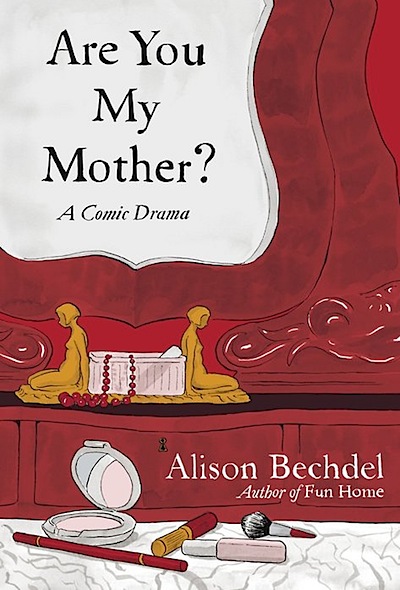
Alison Bechdel's Fun Home is often lauded as one of the best graphic novels of recent years. Having missed the boat first time around I was prompted to give it a read when I got wind of the publication of a new book. In Fun Home Bechdel tells the story of growing up in the family's funeral home business and focuses on her father who could be reserved and wrapped up in his creativity one moment, aggressive and cold the next. After his untimely death Bechdel discovers that he had been a closeted homosexual who had slept with men and been in trouble with the law. At the same time she deals with her own burgeoning homosexuality. The book is almost like a family scrapbook and avoids a strict linear narrative opting instead for something far more complex and satisfying. It's a fabulous book and well worth reading if you haven't already in preparation for her latest graphic memoir.
It's useful to have the context because, as you can guess from the title this new book focuses on Bechdel's mother and that also includes the impact of the publication of Fun Home on both her and Bechdel. This book also rather brilliantly is about the writing of itself, Bechdel struggles with her attempts to write the opening section, so that the opening section becomes about her struggle to write it. This meta-textuality is common now in fiction but less so in graphic work and I found it not only entertaining but also far better suited to this medium. I gave HHhH a hard time for this kind of authorial commentary at the beginning of this month, mainly because it was so repetitive and irritating; reading this book shortly afterwards vindicated my thoughts as it showed the same game could be played (to greater effect) in just a few clever panels.

Now, I would have to write a lengthy post to really do justice to this book's complexity. Bechdel aims to get under the skin of her relationship with her mother, in fact of all her relationships, and we follow her long conversations with her, her therapy sessions and her wide reading around the subject of the relations between parent and child. This leads her to the work of psychoanalyst Donald Winnicot who pioneered the theories of the true self and false self (familiar to Bechdel already through the two sides she saw in her father) and the transitional object - that item of comfort like a teddy bear or blanket with which a child (or indeed adult) can form an important bond to substitute for that with their mother. The book is fascinating for this aspect alone, providing a wonderful summary of his ideas, theories and life but also looks wider than that as Bechdel mines her past for clues to explain not only her relationship with her mother but the series of relationships she goes through with various girlfriends.

Photographs, old letters and journals, even a very specific cartoon from Dr Seuss are all used as evidence and the non-linear structure again provides an amazingly satisfying reading experience. In fact for an author who claims to have struggled with the writing and structure of the book it is a deceptively accomplished piece. The sheer volume of what she is able to include is staggering. We learn about her, her mother, her girlfriends, her writing process, Winnicot, psychoanalysis, listening, love and acceptance. And that's before we mention the artwork.

Even the pages that are made up of standard panels are varied in their appearance and design but every now and then Bechdel opens up a double page spread into something else entirely. The three pages I've reproduced here give you an idea of what I mean, and how a shift in perspective is not just a huge visual treat but an opportunity for Bechdel to do something interesting with content too. The book also has a cumulative pleasure. Not only do we sense Bechdel getting closer to some kind of understanding and resolution (and therefore something like happiness) but we too benefit from her obvious intelligence and erudition. As I worked my way through the book I felt like I was being treated on so many levels; it just works harder than most 'graphic novels' so that as I finished the last page I was glad I'm no artist myself - I'm sure I would have felt very lazy indeed. Together, both books provide an intimate look at Bechdel's intriguing family, so different to our own and yet from which we could all probably learn something. I heartily recommend both. Read more...
Subscribe to:
Posts (Atom)

 Posts
Posts

