Random

Tuesday, 17 January 2012

Habibi - Craig Thompson

'the Divine Pen'


I love it when a publisher says 'Do you know what, this book is beautiful, we should make sure it looks really beautiful.' The pleasure from Craig Thompson's latest graphic novel comes as soon as you pick it up. In fact it comes even before you do that. A soon as you see its beautifully designed cover the old pleasure receptors start firing and once it's in your hand then you can add a sense of import to the pleasure. It's fitting that this book, which I was aware drew on stories from both the Qur'an and Bible, has a biblical heft to it. Over 650 pages are contained within the intricately detailed, embossed and foiled cover and holding a book of that size feels very significant. A quick glance at the pages within and you can see you're in for a treat. This is a big, bold and ambitious book about love, religion, storytelling and mythology and it contains the very best and the very worst of human behaviour. Arabic calligraphy combines with religious symbols, spiritual visions with nightmares, opulent harems with pollution-choked slums. The novel manages to be ancient and modern at the same time so that the primacy of storytelling comes to the fore. We feel for most of the book as if we are reading an ancient story of slavery and redemption until the latter stages when the modern world intrudes making its themes suddenly very contemporary.

In a land choked by drought nine-year old Dodola is sold into marriage by her parents. Her husband is a scribe who teaches her to read and write and through his work she learns 'the Sacred Qur'an and the hadiths, One Thousand and One Nights, and the woks of the great poets.'


These amazingly detailed panels at the beginning with their decorative frames are gorgeous but the idyll they describe and come from is rudely interrupted when her husband is murdered and she is abducted. About to be sold for the second time in her short life, this time into slavery, Dodola manages to escape with an apparently abandoned baby boy, Cham. The two of them make a home for themselves on an old boat 'afloat on an ocean of sand' in the desert and when Cham finds a small spring of water Dodola renames him Zam after the well of Zamzam found by Ishmael, son of Abraham. This change of name is symbolic for Cham, named after the third son of Noah who was born black and later cursed, and represents freedom as much as their escape into the desert. Dodola becomes mother, sister and teacher to him, passing on her own knowledge of writing and storytelling to her eager young pupil (whom she calls Habibi or beloved one). His discovery of a source of water is also as significant as that created by the kicking feet of young Ishmael. Water is incredibly important in this novel as a source of life, salvation and power.


The two of them manage a relatively safe and isolated existence in the desert, Zam protected from the knowledge that their supplies come from Dodola's visits to the travelling caravans and the exchange of her body for food. In fact it isn't the outside world that threatens to ruin their solace but the natural changes that come from within as they grow older and in particular as Zam nears adolescence. Having always been able to share both bed and bath, Zam's quite natural burgeoning desires threaten the safe roles they have been assigned. When he is 12 he becomes aware of what Dodola has been doing to keep the two of them fed all these years. His anger at the sexual violence of other men and his guilt about his own desires lead him to undertake the journey out of the desert to find supplies in her stead. When he returns, Dodola has been abducted once again and the two of them will remain apart for many more years.
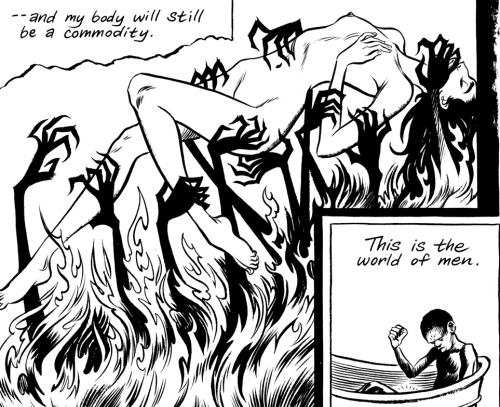


Separated from one another each undergoes their own extraordinary and physically torturous journey. Dodola becomes part of a Sultan's harem, prized as the 'phantom courtesan of the desert', challenged to satisfy the famously fickle Sultan for 70 nights in a row to earn her freedom and, after she only just fails to do that, later to turn a jug of water into gold for the same prize. This latter challenge is a fabulous set-piece in which Dodola draws on her learning and ability to read at first and her cunning and guile when she is frustrated. Zam in the meantime is forced to leave the desert when starvation threatens his survival and falls in with a group of eunuchs in the city. It is amongst them that he is introduced to the idea that he might be able to purify himself of the thoughts that he sees as responsible for driving them apart.


I don't think it's a spoiler to say that the two of them will be reunited (the cover illustrations show them older together) but I won't specify exactly how or what happens then. What is important is that these two 'orphans' who looked after one another in a world of scarce resources find themselves just as much at the mercy of them when they emerge into the thoroughly modern looking environment of the novel's final third. Water, which has always been precious, is now bottled as a commodity, its discarded plastic containers contributing to the waste and pollution that chokes the natural waterways. In fact there is a huge environmental message underneath this tale and panels which echo those created by Nick Hayes for his book, The Rime Of The Modern Mariner, which carried a similar warning. Thompson shows throughout the novel how humans exert power over each other by controlling those resources and how men in particular can exert their power over women. What chance is there for the meek in a world like that? Zam and Dodola are allowed a measure salvation but only after having paid a huge price personally. The reader is left exhausted and exhilarated by such an arduous journey, a witness to all the suffering who cannot help but be uplifted by the glimmer of hope offered in the closing pages.

Many graphic novels feel like well-realised shorts. By being pictorial the number of pages shrinks in reading time so that even some of the better ones can still feel a little slight. Habibi is epic in every sense. A big book, yes, but also a grand one with ambition, range and detail to make it a satisfying read from cover to cover and a treasure trove to delve into afterwards. Some of the larger panels have enough detail to keep the eye happy for minutes at a time, the manner in which Thompson threads themes and combines stories is quite brilliant and the structure of the novel as a whole is immensely satisfying, eschewing a straightforward linear trajectory for one that moves backwards and forwards in history just as memory does. If Christmas hadn't already passed then I'd be recommending this as a brilliant gift. There's nothing to stop you getting it as a gift for yourself of course...

Read more...

Thursday, 12 January 2012

Coltrane - Paolo Parisi

'In the beginning, there was sound.'


Graphic novels I've read. Graphic memoir, graphic reportage, even graphic novel/travelogue/cookbook. But this is my first graphic biography. Right at the outset I have to say that I had concerns about the suitability of the form to the content. We are used to seeing great doorstops of books in the biography section; how could a graphic treatment provide anything other than the sketchiest of details? Perhaps by choosing the right subject. John Coltrane was a well-known jazz saxophonist, the iconic image on the cover a copy of that from his Blue Train album, recognisable to even those with the scantest interest or awareness of Jazz. I knew next to nothing about his life however and whilst my initial worries about this book are born out (I would still need to pick up a weighty tome to really know the details of this man's life) that would be to criticise it for not being a book it never claimed to be. What it does achieve is enough biographical detail to entice you to pick up a more thorough book but also within its 118 black-bordered pages, to create something of the sound of Coltrane, something of the feeling behind his music, and a real shot at the spiritual dimension behind that innovative sound.


Immediately I thought of another graphic book, Bluesman by Rob Vollmar and Pablo Callejo, which uses the structure of a traditional twelve bar blues song, three sections each with four chapters, to frame its narrative (I say this without having read the damn book which I keep meaning to do, I'm waiting for Max over at Pechorin's Journal to write a post about it and convince me). A book on Coltrane, one of the pioneers of free jazz, has no such order to it. We zoom about from one period to the next; different bands, different problems, different rhythms. This free association takes us from Coltrane's highs to his lows; moments of unity to moments of solitude; love, pain and addiction; but always, always: the music.


It is of course incredibly tempting to put some of his music on whilst reading and if you have the chance this can only enhance the experience, especially when looking at those panels in which he and his band play. It also helps to (almost) make sense of the book's structure and for those who aren't that keen on jazz I think it might help them to take the music more seriously. Reading about Coltrane's poverty-stricken and discriminated childhood you can't help but get behind him when his extraordinary talent begins to show itself and offer a way out. His personal troubles, both physical and emotional, are seen in a greater context when the spirituality of the music is added to them (how many great artists have struggled to be great human beings?). So perhaps a graphic treatment of his life makes some kind of sense after all. The book isn't enough on its own to be a proper biography and it may fall between two stools: too slight for those who already know him and never going to convince those who have little knowledge or interest. Personally it piqued my interest in the man and was enjoyable enough to read. Will I follow up on it however...? I'm not convinced.

Read more...

Tuesday, 10 January 2012

All Quiet On The Western Front - Erich Maria Remarque

'it must never happen again'


translated by Brian Murdoch

I should really have read this classic novel of war well before now; not just because it was recommended reading when I first joined the comapny of War Horse over two years ago but also because it was the title I chose to give away to 48 lucky members of the audience on the innaugural World Book Night last year. I've said before that you sometimes need a bit of planetary alignment to nudge you towards reading a particular book and when the technical rehearsals for the latest cast change at work (traditionally a good time to get some reading done) happened to fall the day after Remembrance Sunday and after a fortnight of collecting for the Royal British Legion then there really did seem to be no excuse any longer.

So, where to begin? Remarque's novel, based on his own experiences at the front, is a classic piece of war literature, importantly providing for all of us British readers a German perspective on the bloodshed and even more importantly than that a voice of dissent from the trenches. It is this that made the book so notorious in his native Germany, that encouraged the Nazis to add it to the list of books to be consigned to the flames, and that makes it such an important novel today as we approach a century since the war to end all wars began. The novel is narrated by Paul Bäumer, whom we follow with a few of his school friends as they are encouraged to enlist and are sent to the front to fight. Instilled with homespun rhetoric and the idealism of their teachers and elders it isn't long before the realities of conflict alter their view. Not only has schooling provided them with little of practical use in a war zone ('Nobody taught us at school how to light a cigarette in a rainstorm, or how it is possible to make a fire even with soaking wet wood - or that the best place to stick a bayonet is into the belly, because it can't get jammed in there, the way it can in the ribs.') but all of the certainties, their very reasons for fighting in the first place quickly fall away.

While they went on writing and making speeches, we saw field hospitals and men dying: while they preached the service of the state as the greatest thing, we already knew that the fear of death is even greater...all at once our eyes had been opened. And we saw that there was nothing left of their world. Suddenly we found ourselves horribly alone - and we had to come to terms with it alone as well.

What we gain from the narrative is not so much specifics about the military campaign (I was never entirely sure where I was along the western front, nor which specific battles where being described) but an insight into what it felt like to be one of the confused, young men in those trenches. The different sounds of the various munitions, the poor conditions, the new values that make tobacco or rare foodstuffs worth more than all the money in the world, the camaraderie, the humour, the landscape where a hundred yards of brown, churned-up earth can contain the whole world.

...the power to defend ourselves flows back into us out of the earth...The earth is more important to the soldier than to anybody else. When he presses himself to the earth, long and violently, when he urges himself deep into it with his face and with his limbs, under fire and with the fear of death upon him, then the earth is his only friend, his brother, his mother, he groans out his terror and screams into its silence and safety, the earth absorbs it all and gives him another ten seconds of life, ten seconds to run, then takes hold of him again - sometimes forever.
For these young men who 'had just begun to love the world and to love being in it' the effect of being forced 'to shoot at it' is an almost immediate alienation. Isolated from civilisation, brutalised by fighting, numbed by bombardment, the idea of progress disappears to be replaced by nothing other than the belief in war itself. When that happens even the terror of fighting recedes into the background; these once green recruits find themselves feeling like experienced soldiers, amazed in turn by the inexperience and inadequate training of the next batch coming through. There is also time for other highlights to shine through; the men's visit to a house over the river to see three French women, their revenge on the brutal corporal Himmelstoss, and Kat's frequent ability to scavenge food whenever required including a goose at one point which he and Paul roast. This last event provides a moment for Paul to reflect on the unlikely intimacy of war.
What does he know about me? What do I know about him? Before the war we wouldn't have had a single thought in common - and now here we are, sitting with a goose roasting in front of us, aware of our existence and so close to each other that we can't even talk about it.

Perhaps the defining moment of the novel is Bäumer's trip home on leave, which is almost unbearably moving. There are tears as soon as he walks through the door but the awkwardness of his renewed contact with his family is brilliantly described by Remarque. His mother is dying from cancer and the two of them have so much they might say to each other but can't, his father doesn't know how to speak to his son of his experiences and Bäumer finds that the place where he grew up is no longer a one where he feels he belongs. For fellow bibliophiles there is a telling moment when Bäumer goes through the book collection that once gave him so much joy and finds that he can't read any of them - 'Words, words, words - they can't reach me.'

The true impact of this trip home is felt when he returns to the fray. First comes the return of fear, particularly in one scene that finds him stuck in a shell hole during a bombardment, paralysed by that fear of death, rescued finally by hearing voices in the trench behind him ('Those voices mean more than my life, more than mothering and fear, they are the strongest and most protective thing that there is: they are the voices of my pals'). Then comes his first real engagement with the reality of fighting when he kills a French soldier in hand to hand combat and watches him die slowly. Realising how little separates them he makes a vow.

'Your turn today, mine tomorrow. But if I get out of all this, pal, I'll fight against the things that wrecked it for both of us: you life and my -? Yes, my life too. I promise you, pal. It must never happen again.'

This might have led to Bäumer becoming some kind of crusader for reform or political settlement post-war but as his friends are slowly picked off by Death a hopelessness sets in and we see how Paul has been utterly destroyed by his experience. All the more reason to make sure that we heed the vow he made, for this great war novel is of course a great anti-war novel. One that retains a devastating impact and fully deserves its classic status.

Read more...

Thursday, 5 January 2012

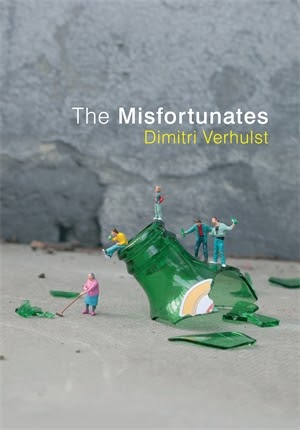
The Misfortunates - Dimitri Verhulst

'a funny kind of love'

translated by David Colmer

I discovered Verhulst by accident after taking a punt on his rather wonderful novella Madame Verona Comes Down The Hill. I knew back then when I read it that it was something of a departure from Verhulst's previous output and Portobello Books are now publishing the autobiographical novel that he published in the same year. At the bottom you will be able to see a trailer for the film version from 2009 which confirms the shorthand precis on the back of my proof: Think Shameless with mayo on the chips. This coming of age tale is narrated by Verhulst himself (yes, he uses his own name) beginning at the age of thirteen when he lived with his father, his uncles and his grandmother in the onomatopoeically named Aresendegem (presumably the arse-end of some small town) in Belgium, 'a town the great cartographers forgot, an ugly backwater, but a great place for drizzle and pigeon fancying.'

Now, I nearly gave up on this one, I'll be honest. After the first couple of chapters I got the sense that what I was going to read were a series of vignettes based on Verhulst's own chaotic upbringing. Colourful characters, entertaining set-pieces, all very good but not enough to maintain my interest throughout. What comes along to save it at first is the set-piece to end all set-pieces. We've all played some kind of drinking game in the past I'm sure but the Verhulst's have slightly larger ambitions. In a chapter entitled The Tour de France an extraordinary drinking competition is created by the young Girder, ruled out of the official world-record drinking competition by his age, in line with the famous bike race. 19 stages with 5km equal to a standard glass of alcohol, meaning that 'even a reasonably short stage of 180 kilometres would involve drinking 36 standard glasses of alcohol. Against the clock' There are even three jerseys to earn.

The yellow jersey was for the leader and eventual winner...the greenn jersey for the explosive sprinter: the neck-it king. And the polka-dot jersey could be captured in the mountains, where you proceeded by guzzling strong drinks like whisky and vodka.

What follows is a drinking marathon of epic proportions during which Girder's mother, seeing her son return home each night looking 'as pale as a corpse and with a beard of dried vomit' worries about his new found enthusiasm for cycling and buys him a brand new racing bike (which eventually finds its way to scrap metal dealer to help pay for all the booze). The descriptions of this sustained drinking binge come with all the seriousness of sports commentary and for Girder it is all about the pursuit of what Dino Buzatti called The Idea, all of this mock-seriousness providing plenty of entertainment for the reader.

There is another strong chapter to follow in which, after a visit from the bailiffs and the removal of their television, the family visit the house of some Iranian neighbours ('So these were foreigners') so that they can watch Roy Orbison's comeback concert, A Black and White Night, Dimitri's father being a die-hard Orbison fan. What follows is something of a culture shock for the Iranians and an emotional high point for the Verhulsts, one of the many episodes in which joy and triumph are found in the most unlikely situations. These peaks and the liberal sprinkling of humour are important in what could have been a grim book and even something like the memory of helping his mother (absent now and referred to as a whore) with her moustache removal - 'an enormous operation that always made me think of a religious rite in a country I don't ever want to visit.' - is one filled with some kind of love.

And that's what this novel ends up expressing: a funny kind of love. Near the end we hear the famous family story about Dimitri's birth, how his father was down the pub after too many false alarms, finally cycled to the maternity hospital and left 5 minutes later with baby in hand to take his newborn son on a tour of the town in the basket of his bicycle.


Sister Philomena in the corridor, barking at my father: 'Where do you think you're going with that child?'
Me in his arms.
'It's my son, I'll take him wherever I like.'
'Mr Verhulst, he was only born this morning.'
'He's my son. If you want kids of your own to boss around, chuck your wimple over the hedge and hike up your dress, the rest'll take care of itself.' And he carried me out the door.

This is not a particularly responsible family and yet they have their moments. For all the high jinks there are of course serious moments. There is no doubting the concern on the day when his father announces he wants to go into rehab.


My father now tasted like beer and his armpits smelled like it too. Maybe he had already noticed the whites of his eyes growing yellow, his steady loss of weight. A drinker's coffin is seldom a heavy burden, undertakers are always glad to carry them, and our family would have saved a lot of money if we'd been able to pay for our funerals by the pound.

And along with death it is of course the promise of new life that also heralds the need to grow up and become responsible. When Dimitri stupidly gets someone pregnant it marks the beginning of a new life, particularly as it is someone whom he doesn't really love and with whom he has no future.

How could I have been so sure, for all those years, that my fertility would adjust itself to my convictions, that the unwillingness in my brain would metastasize in my testicles? A character like me could only have been devised by Greek tragedians or by the scriptwriters of the kind of soap operas that put the logic of character development on the back burner in favour of general stupidity.

There is a general stupidity to this novel and a sense that it isn't really a novel at all, falling somewhere between memoir and short stories, all of which means that I wasn't nearly as enthused by this book as Madame Verona. That said, I'm glad I gave it a chance. Like the Tour de France it has various stages, some of which suit some riders better than others.


Read more...

Tuesday, 3 January 2012

All Is Song - Samantha Harvey

'Here I am'


Harvey's debut, The Wilderness, received some impressive critical responses when published, the general consensus being that it didn't read like a debut at all but the work of a far more established writer. I haven't read it, but after reading her new novel I don't feel like I need to in order to proclaim her a writer every bit as promising as that debut suggested. All Is Song is a novel of great intelligence and understanding, the kind of book in which very little actually happens and yet which grips from first page to last with its philosophical, spiritual and emotional explorations. In this way Harvey is the natural heir to Iris Murdoch who I was reminded of when reading this book. Human and humane in its examination of personal responsibility, a small cast of characters become incredibly close to the reader so that it becomes a very moving reading experience, one that despite featuring as the first review of the new year I fully expect to see on my list of books of the year in 12 months time.

It's so good in fact that settling down to write this post I wonder which of its many strands I should write about. This is a complex novel, not because it features many characters or a multi-layered narrative, but because it gets under the skin of its small cast and really wrestles with its themes and ideas. At its centre are two brothers, and filial love is one of the things Harvey writes about so fearlessly.

How could it be that a person's face - simply the way the weight and light fell around their face - could prompt indivisible love? For all that one's family could irritate and infuriate, their mirrored genes and minds of shared memories broke down every defence. There they were, and things were perfectly simple.

Leonard Deppling has spent the last year on sabbatical from his work as a religious studies teacher to care for his dying father. His brother William was absent from the funeral and at the beginning of the novel Leonard joins William and his family in their north London home, these two orphaned brothers looking to re-establish their close bond, something we know will be difficult - 'For all their closeness over the years they still didn't know how to negotiate the extremes of one another, and as soon as the I think became I feel, they faltered, as if they were constrained by the awkward fact they were human.' Leonard also has on his mind the dying wish of his father to find out how involved William was in a campaign of violence that emerged during the Poll Tax Riots.

William is an extraordinary character, a perfect counterpoint to his brother. These two sons of a priest have always been different and in their adult choices we can see this quite clearly. Leonard may teach religion but he has no faith or belief in God himself. William on the other hand is a former activist who now spends his time with former pupils, painfully aware of the state of his ignorance, always questioning, never settling for the easy or obvious conclusion but always bolstered by a very real faith in God. If the character of Adrian in Julian Barnes' The Sense Of An Ending hates 'the way the English have of not being serious about being serious' ('I really hate it.') then he might have loved William. It isn't quite contrariness, although he is prepared to take a conversation to the most uncomfortable places, but a refusal to take anything for granted. His faith also means that he feels an innate fellowship in Man, who despite being 'born from unity.... divide into isolation.' Having 'dreamed themselves clear of Him.' he feels the pull back towards the comfort of that unity but also the need to wake up from the dream. And sometimes that requires a shock. The plot of this novel follows the consequences of one of William's pupils following his line of thought to its obvious conclusion. But that plot is only interesting in as much as it provides conflict between the characters and an arena for the discussion of one of the novel's major themes: responsibility.

With William and his pupil, responsibility comes with planting an idea and refusing to walk away from it even when it is taken too far. William's refusal to accept the escape options laid before him is frustrating but only the logical extension of his own arguments earlier about intention and consequence - 'I assume I'm innocent because I meant no harm, but is it enough to mean no harm?'

'...the law is clear - there's either enough evidence or there isn't - but the law is just the surface of the water, and nothing that happens there happens on its own -  the colours, the swell, the bubbles that break, they're all caused by things above or below the surface - and I don't know enough about those things.'

Leonard has just spent a year exercising his responsibility to his father, executor now to his estate and even glossing the story of his final moments so that it includes some kind of reconciliation with William. Now living with his brother he feels a strong responsibility towards him also. This however comes into conflict with his father's dying wish and the tension between these responsibilities keeps the novel taut as a bowstring.

As you might expect from a novel that leaves two brothers suddenly without either parent there is a fair amount of looking back. This is particularly true for Leonard who has seen his partner move on with another man and has been left feeling rather rootless ever since. Comparing once again with Julian Barnes' novel about time and memory there are plenty of potent symbols here as well, which Harvey uses with devastating precision. The prospect of owning an old car for example can carry the memory of Leonard's failed relationship, his brother, and the deaths of a family friend as well as both his parents.

The old Austin! In which he'd been with Tela, in which William had learnt - or tried to learn - to drive. Just to think of its cranky black engine that had outlived Jan's heart, his mother's heart, his father's. To get in it would be to get into a piece of stilled time and to drive it would be to to carry that stilled time around with him...
Returning to filial love, it is amazing how much love infuses this novel as a whole. William for example claims not to 'see single people, I see people. I don't love or hate discriminately, I just try to give myself equally to all for as long as what I give is wanted. And always, Leo, always this act of giving is vulnerable and my heart gets knocked about.' What looks like a kind of detachment, as though he has never really been in love for example, is actually he claims the fact that he has never really been out of love with one person or another. For Leonard it is much more specific and though through much of the novel he is wrestling with his failed relationship or the death of his father this is really a book about his love for his brother. A brother who always saw the world differently, so much so that he was sent to doctors of both the head and heart; whose actions, though consistent, remain baffling to even his own family, for how of course do you quantify another human being.

Here I am, William had written on that brain cross-section on the wall, and it was ironic of course, as if to deride their father for supposing that the enormity of a life - his life, or any - could dwell there between skull and grey matter. Leonard stared at it and then hung his head; it wasn't the enormity of life that overwhelmed him then but the distance of it, which was to say the distance between one life and another, which couldn't be navigated physically or even spiritually, no matter how optimistic one sometimes allowed oneself to be. How could it be that he'd stood through two funerals of both parents without crying when just then, in that moment, he thought he might cry and not be able to stop?

When defending his need to stand by the absolute truth of what he has said, William compares speech to the written word, expressing his preference for the former because it forces us to defend immediately what we say and preserves its genesis whereas what we write can be interpreted and twisted until it no longer resembles what we had meant at all. 'We have too much hope for the written word,' he says 'Too much hope for it and too much faith in it.' Writers like Samantha Harvey restore your faith in the written word all over again.

Read more...

  © Blogger templates The Professional Template by Ourblogtemplates.com 2008

Back to TOP