Random

Showing posts with label BAKKER Gerbrand. Show all posts

Thursday, 2 February 2012

The Detour - Gerbrand Bakker

'till judgement break'
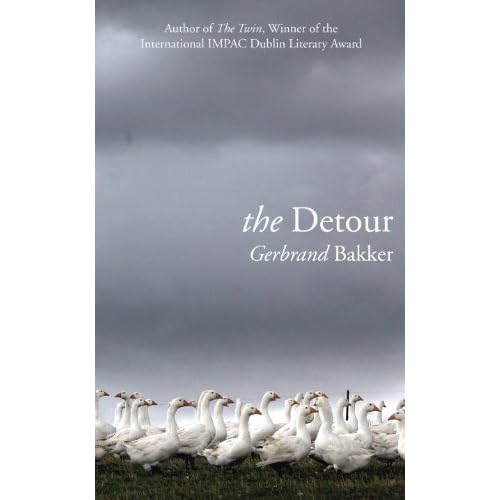
translated by David Colmer

Bakker's debut novel The Twin was one of my favourite reads from last year and also won the Impac Prize, the world's biggest literary award at €100,000 (I think I can guess which of those two accolades he was happiest about). It was a supreme example of what I have found in my limited experience to be a feature of Dutch writing. Prose that for the most part is as flat and uninflected as the landscape of that country so that telling words or phrases poke their heads up for the reader to notice and moments of great drama and tension seem to be waiting for their moment to jump up and grab the reader by the neck. Bakker may have chosen a different terrain and locale for his next novel but there is still something of that style about the writing, this time joined by a faintly hallucinatory feeling and the slight disjoint that comes from placing his heroine in a country where she is forced to communicate in her second language.

A Dutch woman rents a remote farmhouse in rural Wales, paying upfront, and sets about adding some homely touches to a building which still carries the smell of the old woman who had been its previous owner and whose garden contains the ten geese that were once hers. She is on the run from something. Most obviously the scandal of her recent affair with a first year student but also from her work on the poet Emily Dickinson and from something else that she cannot escape, something within that is only hinted at to begin with. She simply packed her car with some clothes, a single mattress and a coffee table and made her way across on a ferry, driving on until she reached Wales. In thinking about the reasons for her flight she is reminded of one of her relatives of whom she was particularly fond.

One day her uncle had walked into the pond, the pond in the large front garden of the hotel he worked at. The water refused to come up any higher than his hips...He must have judged the water to be deeper...Her being here had something to do with that uncle. At least, she had begun to suspect as much. Scarcely a day passed without her thinking of him, seeing him before her in the smooth water of the hotel pond. So far gone that he hardly realised that hip-deep water wasn't enough to drown in. Incapable of simply toppling over. All of the pockets of the clothes he was wearing stuffed with the heaviest objects he had been able to find in the hotel kitchen.

Disoriented enough by her circumstances as well as where she has found herself, little oddities mark her stay. The number of geese slowly dwindles, presumably prey to a local fox; she is bitten by a badger whilst sunning herself nakedly on a rock, an event disbelieved by everyone she mentions it to, even the chain-smoking doctor who attends to her wound. Then a young man literally tumbles into her life and his overnight stay extends from one day into the next until he is cooking and gardening with her and a christmas tree is erected in the house. Meanwhile back in Holland her husband strikes up an odd friendship with a policeman during his attempts to trace his wife and the two men set sail on the same ferry line that brought her to the UK and they make their way (with the annoying assistance of their Dutch satnav) towards Wales.

The peripheral characters remain sketches; the baffled husband, the comedic parents, the threatening neighbour, the loyal and doting young man; it is only the woman who really captures the reader's attention, partly because of that secret she is carrying. It is also because from the very beginning we sense that she is surrounded, by the men who define her life, by the unfamiliar flora and fauna of Wales, prey to the natural order around her. She is also an intensely physical presence and Bakker writes brilliantly about her body; its pains, needs, smells and sensations. When she first arrives into the solace of the farmhouse there is something almost feverish about her, either too hot or too cold, filled with memories and finding comfort with a hand between her legs.

Although there were no neighbours, she kept seeing the dark, uncurtained window and herself lying there. Aroused woman alone fantasising about things long past, things she would be better off forgetting. That unspoilt body, lean and lithe, the powerful arse, the hollows behind the clavicles, the jutting pelvis. The selfishness, the energy and thoughtlessness...[she]thought about him sitting in front of her later, amongst the other students, one of many, with the face of a sulking child. A spiteful egotistical child, and as ruthless as children can be.

The incident with the badger is preceded by her undressing completely to sun herself on a rock like a lizard. In another episode she walks out into the waist-deep water of a pond and 'understood perfectly why her uncle had been so indecisive in that hotel pond: the place itself had robbed him of the ability to decide.'

'Was this it, what Emily Dickinson had done for almost her entire adult life? Had she tried to hold back time, making it bearable and less lonely too perhaps, by capturing it in hundreds of poems?

Like the poet she studies and is in the process of translating she is trying to hold back time, why else run away from home if not to avoid its realities? Having left 'Like an old cat that wants to be left in peace' the farmhouse offers something like a stay of execution both physically and emotionally but we always sense that time is running out. The 'vague but persistent sense of deterioration' isn't limited to just her body but her mind too and there is a small element of suspense as to whether her husband will arrive in time to make a difference or what role exactly her house guest will play. As with The Twin it is those notions and emotions which remain barely expressed that truly intrigue. This novel doesn't quite deliver on its promise and is prone to repeat some its images thus robbing them of their power, but Bakker is a really interesting writer, finding power in repression and creating with great sensitivity a character we cannot help wanting to aid like an animal in peril. One of the problems in pinning a novel on the work of a poet as concise as Dickinson is that even someone as good at writing in spare prose as Bakker can only highlight, particularly to a non-poetry reader like me, just how few words are sometimes required to communicate an idea. Here then is the poem that the woman is translating throughout her stay and that might best encapsulate the novel's themes of solace, escape and peace.


Ample Make This Bed by Emily Dickinson

Ample make this bed.
Make this bed with awe;
In it wait till judgment break
Excellent and fair.

Be its mattress straight,
Be its pillow round;
Let no sunrise' yellow noise
Interrupt this ground.

Read more...

Thursday, 15 December 2011

2011 - Books of the Year


Yes, you may have already noticed that 2011's end of year post is just about books rather than also including my favourite music, films and other cultural highlights. The reason for this is quite simple: I've barely listened/watched/been to any as any regular readers will have noticed over the year. It has in fact been all I could manage to maintain a steady stream of book reviews this year and I have my fingers crossed about being able to do the same next year. It hasn't been easy. But every time I think I'm about to throw in the towel something comes along to make me persevere and I'm always glad that I do. The books below are all brilliant for different reasons and a couple of them are so good that they're worth writing the blog for alone. And then of course there's you and your comments.....

Many thanks to every single one of you who has read my blog this year and a seasonal hug and kiss to everyone who's left a comment. I can't tell you how much I appreciate it.


A Taste of Chlorine by Bastien Vives

It may be at the bottom of the pile in the photo above but this graphic novel is right at the top of my books of the year. If you want to read a graphic novel that truly uses pictures to tell a story that words wouldn't have been able to then this book is perfect. The story of a boy using swimming to help treat curvature of the spine is all about body-language, gesture and movement. There's hardly any text and yet volumes are spoken in Vives' exquisitely drawn panels, with the underwater environment particularly well presented, you can almost smell the chlorine. Like reading a perfect short story it is enigmatic, moving and left me with a warm glow in my heart.


A genuine masterpiece about tyranny and control from a writer who may only have produced two novels in his long lifetime but who made sure they were both in their own ways completely brilliant. This novel examines the symbiotic relationship between a man who is clearly Jewish (though never named as such) in 1930's Germany (though this is never made explicit) and the leader, or adversary, (clearly Hitler though again he is not named) who tyrannises him. Brave in its hypotheses, brutal in its psychological insights and honesty, this novel is a classic because it manages to be about all situations in which one group makes a pariah of another. Indispensable.

Great House by Nicole Krauss

This novel is by no means perfect but its failings come from ambition rather than lack of talent which Krauss seems to have in spades. There is a feeling that comes from reading the work of a mature writer, an ease that you are in the hands of someone who has something to say. This usually comes from writers far more experienced than Krauss but her maturity is just one of the attractive features in this novel about a desk and the various hands it passes through, characters created with such detail that they cease to feel like characters at all, and the novel as a whole written with a complexity that forces the reader to slow down and appreciate the thought, intelligence and humanity that has gone into creating it.


A collection of stories so unique, so specific, so perfect as to need little more than that from me to send you straight out to buy a copy. Pancake died without ever really knowing just how good a writer he was and too young for us to know just how good and influential he might have become. As it stands several writers cite him as an influence and the warmth and reverence with which they do this is worth noting. His stories embody the area of West Virginia in which Pancake grew up, with authentic details and voices but these aren't simply stories rooted in a particular geography so that we can indulge in a kind of literary tourism, he also shows with a couple of stories just how formally inventive he might have been. Just buy the damn book, ok?

The Summer Of Drowning by John Burnside

I have no shame in admitting that I am a fan of Burnside and take a small amount of pride in being one of the voices that has helped convince John Self over at Asylum to read more of him and realise just how good he is (although in his own end of the year round-up he mentions that he did so in order to shut people like me up). This latest novel shows a writer at the height of his powers returning to a story he failed to complete a decade ago and delivering a novel filled with atmosphere, unease, myth, storytelling, artistry and writing so good it sometimes make you want to take a moment and nod your head in appreciation. Set in the Arctic Circle and drawing on the folk myths of the area this is a book infused with the spectral light of the midnight sun; deeply unsettling, wonderfully complex, another weapon in my arsenal to make sure that you all make the effort to pick up one of his books. Soon.


An unalloyed pleasure from first page to last, Towles debut is a perfectly mixed dry Martini. Set in 1920's New York it tells the story of a life-changing year for Katherine Kontent, the only fictional character I have ever fallen in love with. Taking inspiration from Walker Evans' candid subway photographs Towles effortlessly recreates an era and peoples it with characters in which I believed totally and couldn't hope to forget. It's the kind of novel where you genuinely care about what happens to them and can't help but wonder what happens to them after the final page. Witty, funny, smart and beautiful: that's just Katey Kontent, but also a good description of the novel as a whole.

Lazarus Is Dead by Richard Beard

One of the most exciting reads of the year for the way in which its form was hard to pin down, Beard's 'novel' is a re-examination of the story behind one of Jesus' miracles. By taking an almost forensic approach Beard manages to tell the story more fully than ever before, bravely hypothesising about the childhoods of both men, drawing inspiration and evidence from other artistic sources, research into the period and of course the invention of the author. Structured around the number seven the chapters count down to Lazarus' death and then back up again after his resurrection, where Beard is brave enough not just to imagine what happens to the story of Lazarus after its usefulness in the Bible ends but to posit an even greater significance for the man who came back from the dead. If you want to know why fiction can still be exciting then pick this book up.


If I had a pound for every novel that takes a male protagonist, wipes his memory and then starts from there then I'd have a load more money to spend on books, but this novel from linguist Marani is ingenious and far smarter than most. A man is found badly beaten on the quay in Trieste in 1943. When he comes to he has no memory of who he is or even which language he speaks. The Finnish doctor on a German hospital ship that treats him presumes that he is also Finnish after spotting a name inside his coat and an initialled handkerchief and so begins to re-teach him his language in the hope it will unlock memories and lead him to recover his identity. This relatively slim novel covers huge themes around memory, identity and truth and manages to intrigue even further with the perspective from which it is written. Exactly the kind of novel I would hope to unearth on this blog (although Nicholas Lezard gets the credit on this one).

I Am A Chechen by German Sadulaev

A book that melds memoir with fiction, folk tale with fantasy, Sadulaev's account of the conflict in Chechnya doesn't fit into any easy categories and is all the more exciting for it. It may not be consistent but the early sections in particular are stunning in the way they weave Chechen myth with personal testimony to create something that manages to be grand and specific at the same time. Infused with the guilt of a man who wasn't there when things were at their worst, Sadulaev uses his creativity instead to speak on behalf of a people and give voice to a conflict the like of  which all too easily passes us by on the ticker tape of rolling news.


This is hardly news to anyone as the book was already well regarded by the time I came to read it at the very beginning of this year but it has remained very strong in my mind, a perfect example of why we should all read more literature in translation. Bakker's novel is written with the kind of quiet confidence that let's the reader relax in the knowledge that they are in safe hands. Reserved to the point of repression, the prose mimics the flat landscape of rural Holland but gives little hints along the way of the power that lurks beneath the surface. A farmer and his father inhabit a lonely farmhouse and the son's appalling treatment of his father leads us to wonder what might have happened in the past. Bakker expertly releases fragments from the past in his examination of love, loss and the special bond between twin brothers.

The Horseman's Word by Roger Garfitt

I don't tend to read an awful lot of non-fiction but I'm lucky that when I do it tends to be first rate. This memoir was literally forced into my hand by an excited publicist and her enthusiasm wasn't misplaced. The prose is beautiful as you might expect from a poet and its evocations of childhood innocence are heart-warming and comforting. When it follows Garfitt's misadventures at university and beyond it becomes a fascinating portrait of a mind unravelling and the writing shows the tissue-thin barriers between lunatic, lover and poet. A book that took many years to write and hone, and the passion of one publisher in particular to finally bring to print, this is a labour of love and madness that rewards the effort.


Over a decade after it was originally published and won the Booker Prize I finally get over my Coetzee hoodoo and discover just why this book, and writer, are so well regarded. A Cape Town university professor is forced to leave in disgrace after an affair with a student and goes to stay with his daughter on her smallholding. When the two of them are subjected to a brutal assault by three black men South Africa's fragile new politics are laid bare for examination. A brave and uncomfortable read that retains its ability to shock, this is a novel filled with anger and love, containing so many ideas and themes that you could happily discuss it for hours and hours. It has also of course made me want to read more Coetzee. Ah well, there's always next year....


And a few books that came close and deserve honourable mentions: At Last by Edward St Aubyn, A Visit From The Goon Squad by Jennifer Egan, From The Mouth Of The Whale by Sjón and Today by David Miller.

Read more...

Thursday, 24 February 2011

'You're always together.'

The Twin
by Gerbrand Bakker
translated by David Colmer


I don't want to sound like I'm sucking up to any publishers when I draw attention to their output, it is usually more to point out the distinguishing features of the books they publish, those things that give a sense of the ethos behind the colophon. I say this because I was sent a couple of books by Harvill Secker and they are both bloody brilliant, so good that I feel the need to point it out and even swear a little bit. The first, I Am A Chechen, was reviewed here - an important and wildly creative work born out of the conflict in the Chechen Republic, a book that I have been saddened to see received virtually no press attention. This novel is very different, having received plenty of attention after winning the Impac Award last year but no less deserving of praise from me because of that. Books that are reserved and controlled can often bring forth a passionate response in their readers, as if some kind of compensation comes in to play, and The Twin is such a book. As I attempt to give an impression of the power of this quiet book be in no doubt that in my humble opinion The Twin is a magnificent novel.

The idea for the novel came from Bakker wanting to write about a son who treats his father appallingly. That man is Helmer van Wonderen who opens the novel by moving his elderly father from his downstairs room to a bedroom upstairs, the opposite move you might expect for a man in poor health and an immediate hint of the way in which he intends to hasten his father's decline. Spartan surroundings, a permanently open window, infrequent meals, Helmer mounts a campaign of domestic terrorism which leaves the reader uncomfortable and wondering what reason he could have for treating him so badly - 'Staring up at the ceiling I realise that everything would be very different if I had someone, if I was married with children. When you have a family you can get rid of your father without feeling guilty.' At the same time he is stripping back the house, removing old furniture, repainting walls and floors with primer, almost as though he is trying to remove the traces of the family home that used to be. Whilst he carries out these labours a large hooded crow takes up residence outside the house, clearly visible form the window and standing like some kind of ill-omen, something fulfilled by the arrival of a letter that suddenly brings the past hurtling into the present. The letter comes from Riet who was the girlfriend of his twin brother Henk and who was also at the wheel of the car they shared when it spun off the road back in 1967 to land in a lake where Henk drowned.

This event unsurprisingly had far-reaching consequences. Riet was sent away by Henk and Helmer's father and with the loss of the son who had been primed to take over the farm he recalled Helmer from Amsterdam where he had been studying in order to learn his trade. So this is partly a novel of frustration and we begin to get an insight into Helmer's actions in the present day but it is far more than that. Looking back on his childhood we learn something of the unique bond between the two brothers. Themes of comparison and differentiation crop up in many different ways and as the boys go through adolescence, a time when the body goes through some of its biggest changes there is a touching intimacy in the way the two of them share a bed on occasion and Helmer finds in his brother someone whom he 'fits' perfectly. That bond is jeapordised by the arrival of Riet of course and the manner in which one brother becomes an excluded observer is brilliantly realised with the reader becoming as much a voyeur as the sidelined Helmer.


Bakker himself worked as a subtitler on nature films before training as a gardener but has been writing for many years beginning with children's fiction. He is not the product of a creative writing course or degree in literature and I can't help but wonder if that and his clear connection to nature is fundamental to this novel's success and in some way. The prose is pared back to the bone, its simplicity a stylistic statement in itself, and this helps to make the daily descriptions of the rural life of its protagonist and the Dutch countryside that surrounds him attain a poetic beauty whilst not having any kind of obvious poetic flourishes.

I've milked the cows, day after day. In a way I curse them, the cows, but they're also warm and serene when you lean your forehead on their flanks to attach the teat cups. There is nothing as calming, as protected, as a shed full of sedately breathing cows on a winter's evening. Day in, day out, summer, autumn, winter, spring.

The Netherlands is a country reclaimed from the sea and its cultivation has always been about maintaining defences against the water that always threatens to overwhelm it once again. It is the perfect landscape for this story of a man and the past that always threatens to return with its full force and overwhelm his own stoutly constructed defences. That simple prose acts in the same way, reflecting the controlled behaviour of the characters but always threatening to explode as past events and feelings long buried rise to the surface. This isn't always in a traumatic sense, Helmer's plain speaking even leads to moments of surprising humour ('Mother was an outrageously ugly woman') but there is no avoiding the generally bleak tone as Helmer confronts his family life. We learn about his now deceased mother and the 'alliance of glances' that they shared to support one another against the tyranny of his father and having lost his brother, the further devastating loss of his mother.

After her death I didn't have anyone left to look at, to look with - that was the worst of it. The alliance had been unilaterally dissolved. I found it - and find it - very difficult to look Father straight in the eye. In Mother's eyes I always saw Henk's shadow and I assumed that she saw the same in mine. (of course, she also saw Henk in my body as a whole, in my eyes she saw him double.)
All of this remembrance comes at the same time as the events put in motion by that letter from Riet. Her reason for writing was that she wants her possibly delinquent 18-year-old son to come and stay with Helmer and learn some discipline by helping out on the farm. There is plenty more 'plot' within this storyline but the dialogue between them is particularly well-written, in fact the dialogue as a whole is brilliant, written with a playwright's ear and instinct for what to leave out. Helmer's nosey neighbour and the comic interactions between Helmer and her young sons are other highlights that lend some much-needed levity to proceedings.

The original title of this novel in Dutch translates as 'It Is Quiet' something that reflects the prose and surroundings of this book. That style means that some readers might not immediately connect to it in the way that I did and lose patience but the hidden power in that quiet is always felt and the book's themes of loss, separation and frustration are all the more effectively portrayed because of it.

Read more...

  © Blogger templates The Professional Template by Ourblogtemplates.com 2008

Back to TOP